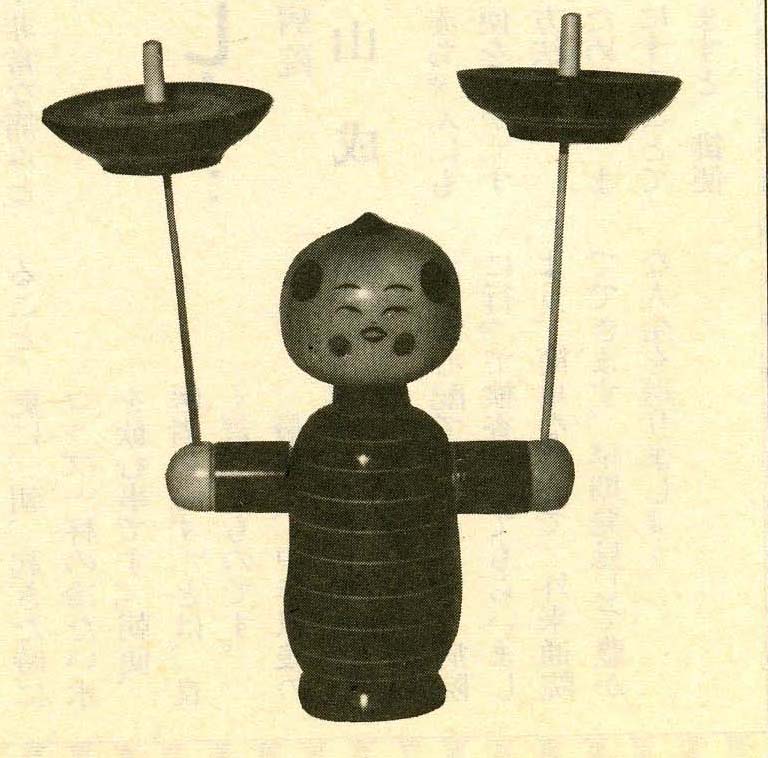
バテレン当て独楽 (bateren ategoma) priest roulette-style top
=====================
This top depicts a priest. When Catholic missionaries began to enter Japan in the sixteenth century, they were known as bateren バテレン, a word that comes from Portuguese padre, “father.” Most of the first missionaries entering Japan during this time were Portuguese Jesuits. Here, Hiroi-sensei has depicted a sixteenth-century priest with exaggerated frills at his neck to form the base of the roulette-style top, which features Roman numerals. A roulette-style top is a kind of game. Someone spins the handle at the top, and the priest’s long nose lands on the winning number on the base.
***
***
Hiroi Michiaki: Umm what was this? What is it called? A bateren [priest]. Yeah. It’s a bateren roulette-style top. I asked Landis-sensei what a bateren was, and she said she didn’t know. It’s sort of what Christians used to be called in the past.
Paula Curtis: Yes. In the sixteenth century.
Hiroi: Ahh, the sixteenth century. That long ago? Hmm…
Paula: Yeah, in the sixteenth and seventeenth centuries.
Hiroi: Ohhh it’s that old?
Paula: Yeah.
Hiroi: Then Landis-sensei wouldn’t know, huh? Heh heh heh. Ahh I see. It’s someone from that time period, and I made a roulette-style top game from it.
The photos below show Hiroi-sensei, Janell, and Mrs. Hiroi selling tops at a special event held in a local department store during the New Year’s holiday.
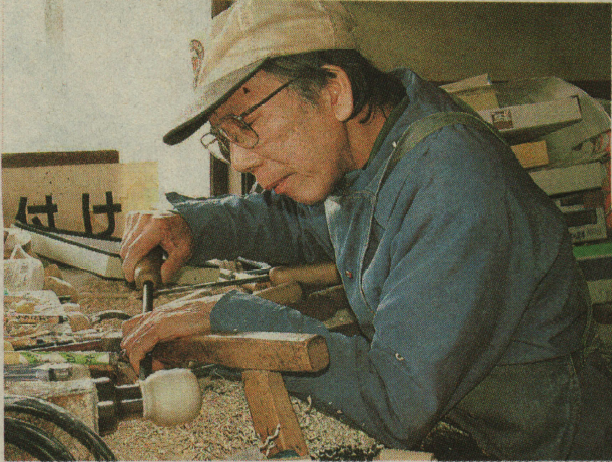
Hiroi-sensei has appeared many times in Japanese newspapers. Below is a translation of an article entitled “’Edo tops’ made in Sendai .” See the original Japanese article at the link below.
When you say “tops,” you might imagine tops you’d play with outdoors, but these are “land tops” (jigoma 地独楽). Edo tops are a type of tops known as known as “parlor tops”“(zashikigoma 座敷独楽), which you enjoy by spinning them in your home and decorating with them. In addition to single-block tops, there are all kinds of tops that rely on centrifugal force.
The blueprints for the tops are in my arms
“Even if you ask me how many types [of tops] there are,r” says artisan Hiroi Michiaki of the tops he has vividly colored, “If you were to categorize them like kokeshi, it would probably be over a thousand. Well, probably about 600.”
To the question “are there blueprints?” Hiroi says but one word: “No.” When I reply, “Then they must be in your head, right?”, he says, “No, there’s nothing in my head. But these arms have memorized them. My hands move on their own.” I’m speechless for a little while at this perhaps profound statement.
Edo tops—Wax polish makes the bright colors–the characteristic red but also purple, green, and yellow– stand out all the more. Once, these tops were intended for the children of high-status warriors and wealthy merchants, having little to do with commoners. As such, the finishing touches were minded to the smallest detail, and except for the single block tops, “they express the characteristics and old tales of each time period, and there’s no [top] without a history.”
This is something that can be said for all of Hiroi’s wooden toys, and even if they appear to have no origin story, that is simply a product of having forgotten it in the present day.
The spirit (kokoro) that protects tradition
When asked about the “spirit” of continuing to make Edo tops, a central part of [Japanese] wooden toy traditions, he dismissed this question smoothly, saying, “[Tops] are not something to tout as tradition. Because I was born an artisan, there’s no other path for me.”
On the subject of successors, he first said, “Right now about ten people are coming [to apprentice],” seemingly unworried, but added regretfully, “It would be difficult for them all to inherit [the practice].”
Why Edo tops in Sendai?
“During the war, we evacuated to Miyagi. We lost our chance to return to Tokyo,” Hiroi said, adding, “In Tokyo, there are many people in Tokyo with resources and many people who understand [our work]. And people who suggested I come back.” Saying that his younger brother was working hard on making tops in Tokyo now, Hiroi seems determined to preserve the Edo top tradition here in Sendai’s Fukuhara.
Hiroi also makes kokeshi, but doesn’t seem very interested in them.“Kokeshi are easier to make compared to tops, and sell well, but…” he said, although he was unable to identify the reason why he wasn’t motivated to make them.
There are Edo artisans here
Hiroi’s wife, listening to us nearby, says, “When we have an order deadline approaching he procrastinates. Then when he starts, he’ll skip meals and stay up turning the lathe late into the night. If he’s even a little unsatisfied with the result, he’ll just toss it out.” Because these tops now are being gifted to an orphanage , Hiroi-san has stopped tossing out ones he doesn’t like.
Hiroi, who was born an artisan, aims only to create the best products. Right now, he only makes direct sales aimed at about sixty people without going through wholesalers. His reason is that “if you sell them in stores, they can mark them up to absurdly high prices.”
“Despite all the effort you put in, you don’t make much money. It’s the kind of work only an idiot could do,” Hiroi says [joking], finally adding, “This is the only path for me, now and forever.”
Hiroi-sensei and his apprentices participated in many local community events. Below are photos of them selling their top and kokeshi products at Sendai’s Shimin Matsuri, a local festival, in the 1980s.
Hiroi-sensei has appeared many times in Japanese newspapers. Below is a translation of an article entitled “Looking Forward to the Creation of “Akiu Products” that ran April 20, 2004 in the newspaper Kahoku shinpō. See the original Japanese article at the link below.
Hiroi Michiaki makes kokeshi at Akiu Craft Village. He hopes to create a kokeshi forest.
Kahoku shinpō (April 20, 2004)
Looking Forward to the Creation of “Akiu Products”
Steady Work on Making a Forest for Kokeshi
Sendai City/Akiu Craft Village Collaboration
In an attempt to promote the local woodworking industry, Sendai City is embarking on a “kokeshi forest”-making project in the town of Akiu’s Taihaku ward. In collaboration with Akiu Craft Village, painted maple and dogwood saplings will be planted; those trees will become the pulpwood for traditional craft goods. Their aim is to eventually have kokeshi that are entirely made from “Akiu Products,” and to facilitate that, a planting event, for which city residents can volunteer, is planned for May 5 [2004] .
Pulpwood trees to be planted this year, too, on May 5
Dogwood trees are native to the Akiu area, but the region is very marshy, making logging work very difficult. Because of this, Hiroi Michiaki (age 70), an artisan of Akiu Craft Village who makes kokeshi, is supplied with woodchips made by the lumber workers of Miyagi Prefecture’s Kunomori Ward for his work.
However, for a number of years lumber imports have been increasing and the amount of woodchip production has gone down; dogwood preservation, too, is becoming more difficult. Planning the pulpwood through their own supply efforts, Sendai and Akiu began the “kokeshi forest” project in May of last year. The city-owned forests near the Craft Village are roughly 6 hectares, and they plan to plant about 10,000 saplings over the course of 6 years, finishing in 2008. In one year, they have planted 1,400 dogwood trees.
It’s projected it will take roughly 15 to 20 years for the trees to grow into usable materials, but Hiroi-san has said, “If the next generation of artisans is able to use local dogwood to make kokeshi and other goods, I would be happy,” and is watching over the saplings affectionately.
The planting event, sponsored by the joint Sendai and Craft Village project, will be held on the 5th and is recruiting volunteers to help the artisans plant 1,500 saplings in the city-owned forest area. They also plan to hold cultural exchange events, with woodworking workshops and atelier tours.
The Sendai City Agriculture, Forestry, and Public Works Division stated, “Through the collaboration of the artisans and city residents on this forestation project, we hope to assure the continuation of traditional arts and to deepen our residents’ understanding of forestry and woodworking traditions.”
There are 100 volunteer positions available on a first come, first serve basis. To volunteer, contact the Sendai City Agriculture, Forestry, and Public Works Division’s Forestry Branch at 020 (214) 8264.
As a part of building the Akiu Craft Village and its community, artisans working there have each of their homes, workshops, and shops together in one building. In the following photos, we see Hiroi-sensei and Mrs. Hiroi in their shop, “Onkomaya Hiroi,” where they sell their tops, along with some photos of Hiroi-sensei’s work on display. New tops are always appearing in the shop, as Hiroi-sensei and his apprentice design new works, create seasonal tops, and recreate old favorites.






 Carving Community:
