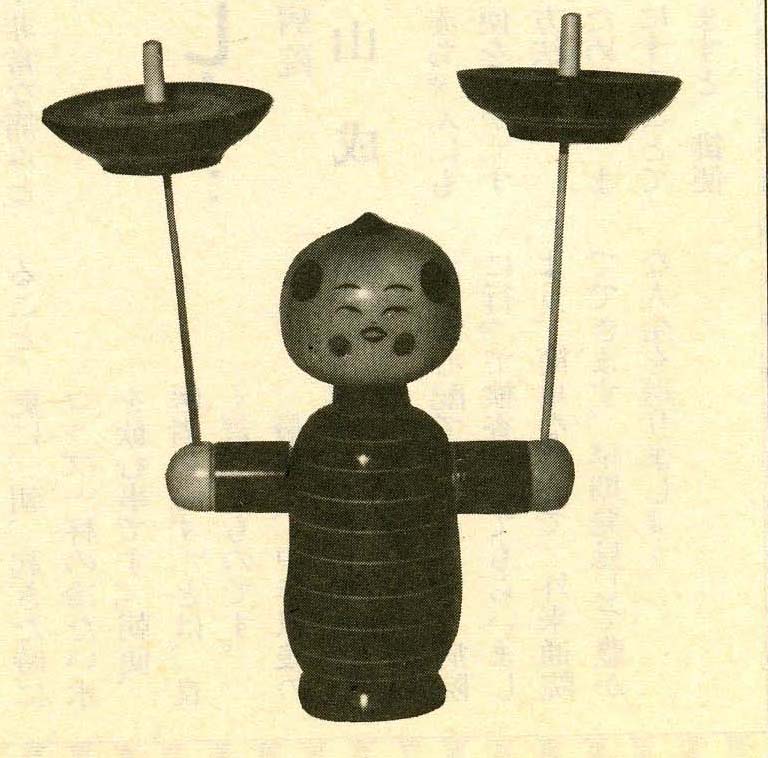
バテレン当て独楽 (bateren ategoma) priest roulette-style top
=====================
This top depicts a priest. When Catholic missionaries began to enter Japan in the sixteenth century, they were known as bateren バテレン, a word that comes from Portuguese padre, “father.” Most of the first missionaries entering Japan during this time were Portuguese Jesuits. Here, Hiroi-sensei has depicted a sixteenth-century priest with exaggerated frills at his neck to form the base of the roulette-style top, which features Roman numerals. A roulette-style top is a kind of game. Someone spins the handle at the top, and the priest’s long nose lands on the winning number on the base.
***
***
Hiroi Michiaki: Umm what was this? What is it called? A bateren [priest]. Yeah. It’s a bateren roulette-style top. I asked Landis-sensei what a bateren was, and she said she didn’t know. It’s sort of what Christians used to be called in the past.
Paula Curtis: Yes. In the sixteenth century.
Hiroi: Ahh, the sixteenth century. That long ago? Hmm…
Paula: Yeah, in the sixteenth and seventeenth centuries.
Hiroi: Ohhh it’s that old?
Paula: Yeah.
Hiroi: Then Landis-sensei wouldn’t know, huh? Heh heh heh. Ahh I see. It’s someone from that time period, and I made a roulette-style top game from it.
The photos below show Hiroi-sensei, Janell, and Mrs. Hiroi selling tops at a special event held in a local department store during the New Year’s holiday.
Hiroi-sensei has appeared many times in Japanese newspapers. Below is a translation of an article entitled “’Edo tops’ made in Sendai .” See the original Japanese article at the link below.
When you say “tops,” you might imagine tops you’d play with outdoors, but these are “land tops” (jigoma 地独楽). Edo tops are a type of tops known as known as “parlor tops”“(zashikigoma 座敷独楽), which you enjoy by spinning them in your home and decorating with them. In addition to single-block tops, there are all kinds of tops that rely on centrifugal force.
The blueprints for the tops are in my arms
“Even if you ask me how many types [of tops] there are,r” says artisan Hiroi Michiaki of the tops he has vividly colored, “If you were to categorize them like kokeshi, it would probably be over a thousand. Well, probably about 600.”
To the question “are there blueprints?” Hiroi says but one word: “No.” When I reply, “Then they must be in your head, right?”, he says, “No, there’s nothing in my head. But these arms have memorized them. My hands move on their own.” I’m speechless for a little while at this perhaps profound statement.
Edo tops—Wax polish makes the bright colors–the characteristic red but also purple, green, and yellow– stand out all the more. Once, these tops were intended for the children of high-status warriors and wealthy merchants, having little to do with commoners. As such, the finishing touches were minded to the smallest detail, and except for the single block tops, “they express the characteristics and old tales of each time period, and there’s no [top] without a history.”
This is something that can be said for all of Hiroi’s wooden toys, and even if they appear to have no origin story, that is simply a product of having forgotten it in the present day.
The spirit (kokoro) that protects tradition
When asked about the “spirit” of continuing to make Edo tops, a central part of [Japanese] wooden toy traditions, he dismissed this question smoothly, saying, “[Tops] are not something to tout as tradition. Because I was born an artisan, there’s no other path for me.”
On the subject of successors, he first said, “Right now about ten people are coming [to apprentice],” seemingly unworried, but added regretfully, “It would be difficult for them all to inherit [the practice].”
Why Edo tops in Sendai?
“During the war, we evacuated to Miyagi. We lost our chance to return to Tokyo,” Hiroi said, adding, “In Tokyo, there are many people in Tokyo with resources and many people who understand [our work]. And people who suggested I come back.” Saying that his younger brother was working hard on making tops in Tokyo now, Hiroi seems determined to preserve the Edo top tradition here in Sendai’s Fukuhara.
Hiroi also makes kokeshi, but doesn’t seem very interested in them.“Kokeshi are easier to make compared to tops, and sell well, but…” he said, although he was unable to identify the reason why he wasn’t motivated to make them.
There are Edo artisans here
Hiroi’s wife, listening to us nearby, says, “When we have an order deadline approaching he procrastinates. Then when he starts, he’ll skip meals and stay up turning the lathe late into the night. If he’s even a little unsatisfied with the result, he’ll just toss it out.” Because these tops now are being gifted to an orphanage , Hiroi-san has stopped tossing out ones he doesn’t like.
Hiroi, who was born an artisan, aims only to create the best products. Right now, he only makes direct sales aimed at about sixty people without going through wholesalers. His reason is that “if you sell them in stores, they can mark them up to absurdly high prices.”
“Despite all the effort you put in, you don’t make much money. It’s the kind of work only an idiot could do,” Hiroi says [joking], finally adding, “This is the only path for me, now and forever.”
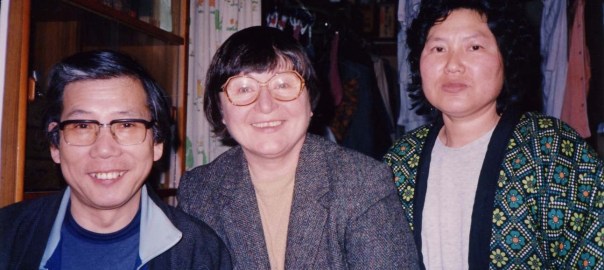
In this post, Janell Landis describes visits home during her time as a missionary, her friends in Japan, and her special relationship with her teacher, Hiroi-sensei.
===========================================
Malina Suity [7:20]: How did you communicate with your family back home in the U.S. or any people you might consider to be family in Asia?
Janell Landis: Yes. At that time there was no email when I was…with letters. My mother was very good at writing and my younger sister still, we don’t, neither of us have a computer. She’s very faithful in writing to me so I have to write to her. I’m not getting very good at writing anymore. I’m using white out more than I’m using ink [laughs]. But anyway, I had had communications with my family mainly through letters. There were occasional phone calls, but not many, because there were times when phone calls between India and Japan where you had to make a…Indians had to make a reservation to call me. And the calls wouldn’t go through sometimes. But, in Japan, when I was uh, when they were getting into the technical age..faxes. You can still see in the list of missionaries there many of them still have the fax because that was the connection that made it easy to contact somebody. But now I think they’re in the internet just like we are. Probably, but many of the missionaries still have a fax, because then they can contact the Japanese without the internet.
Malina: Did you often get chances to return to the U.S. you mentioned–
Janell: Yes. Our board had a system, every year in Japan um, for every year you’d get a month or something like. I had five years and then one years furlough or nine months. Because I was a teacher sometimes I didn’t stay the whole year. I would go and there would be somebody to replace me in that school year from April to March of the next year. But I also went home every three months, I mean every three years for three months. One home assignment–they used to call them furloughs but in more recent years they changed it to home assignment. One third of the time was for yourself. One third was–two thirds for the board. And so when I was home in the United States I was often on the road. And when I could I’d drive myself. Because when I didn’t have a car you’re at the mercy of the place you’re going to and you have to tell the same story five times. You know, somebody’s breakfast and somebody drove you there and and it became almost humorous. I would have liked to have a tape recorder and just play it for them because they ask the same questions in various areas. But I had many times I came back and I was assigned to the same areas. In Pennsylvania, the E&R Church was big and the United Church has a lot of contacts in Pennsylvania. The Southeast Conference, the Northeast Conference, the Central Conference, and the West Conference. And then some places it was just…in Ohio it was a conference but then it had associations. And up in New England I had some very helpful contacts there. Not just one overnight and a supper there and a lunch there, but I’d be in at one place for three nights and doing various groups in the same church for several times. And I’d see people more often than just once because, ‘Oh yeah we had a missionary from Japan, what was her name?” Kind of was harder there in Connecticut to get into that group because the one visit I had there with what they called the Connecticut mafia because the Connecticut chairman was of Italian background and then this man who sent me my schedule was of Italian background. But they were very good at using the missionary who was there for what we called deputation and that was part of being a missionary. Being able to be sent and paid for by the church or the mission board for visiting and having a chance to share. I had some articles and stuff that talked about the missionary coming.
Malina: Um, what, um. Were your acquaintances and friends in Japan mostly Japanese people or mostly foreigners or was it a mix of the two?
…….
[14:20]
Janell: I think in the beginning my friendships were mainly the missionaries that were aligned with…but as the years went on and I came back from language school my friends were mostly Japanese and the number of missionaries became less and less too.
In the last couple years, there were only three of us missionaries. The music teacher and another–a man. And a woman who was in the same department. But I, for some of that she was only in the college and I was in the Junior-Senior High, but then she became ill and couldn’t work and I was still part time then. And the music teacher we were together in 2006 for Miyagi’s 120th birthday and the school paid for our coming home to Japan, I mean coming back to Japan. And um then shortly after he came back from that visit he died in California. So, I’m the only living one that was in that Miyagi period where [there were] the three missionaries.
I think there’s one of the wives of a missionary who’s serving the men’s school. His wife is finally helping in the Junior High. She was dropped from the mission board for a while and that made me very angry. Because she was just getting to the point where her work with hospice was being taken up in Japan. And just before that got off the board, the mission board said she wasn’t connected to any organization. She raised four kids there and they were all in the neighborhood and she had neighborhood children in her home. But now she’s teaching in the Junior High and I’m glad for that. But she’s not listed as a missionary because her salary is coming from the school.
And I think there’s another young person there too. But our mission board is down to supporting two missionaries and they’re both children of former missionaries. One in Kyoto and one, one was in Sendai but he’s going on with his family to the Kansai area too.
…
Malina: So, now I think we’re going to shift over to, um your work with Hiroi Sensei.
Janell: Yes. Uh-huh.
Malina: So how–you mentioned how you first met him, had you heard about him before?
Janell: No. No. He came from Tokyo and settled in Sendai but it was–I didn’t know he was there. It was through Mr. Amano’s connection, he and Mr. Takahashi helping Hiroi sensei and visiting for this particular, they discovering him. They found, like I said, they were looking for a kite-maker to interview on one of these New Years programs because flying kites is the big thing for boys and playing badminton is for girls. And anyway, they didn’t find a kite-maker but a woman who was running–a Japanese woman who had a nice book store was acquainted with Hiroi-sensei. and she found that they had a top-maker right there in Sendai. And that’s when they found him and he was not well, and he was not making much money to live on. So they got him into the hospital and got him taking them on as apprentices. So they could get some money to him and assisting him in getting back to making tops. And around that period, I had been on that program with Mr. Amano’s wife and she was my associate and using the Japanese while I was doing the English. But anyway, he and his friend from the same company, TBS, asked me to be on this program. And they took me to the home of Mr. Hiroi. And I met Hiroi-sensei and his wife in a very strange house. They had one or two rooms besides the shop and we’d sit around the table and have tea after we finished working.
…
[31:28] And many times his wife and I were the only women, and so we listened a lot. And it was fun. I enjoyed those times in the kotatsu and listening to the discussions. For a teacher of English who was with college and junior high and senior high school girls, and in many ways being a leader for them, it was just wonderful to be able to sit around a table with these Japanese men and listening to what they were talking about. Because a lot of the times it was about making the tops, but the friendships that developed in that area were some that were quite different from being a missionary in a Christian school. But I was always accepted as a valid person.






 Carving Community:
