ミノ虫飛び出しの中の独楽 (minomushi tobidashi no naka no koma) bagworm larva leaping out top
=====================
This top depicts a bagworm larva, the larval stage of the bagworm moth. They are sometimes called “case moths” because their caterpillars build little protective cases in which they gestate. As they emerge, bagworm larva pop their heads out of their case to eat the leaves of the tree they inhabit. In Japan, their popular image is related to the top of their case looking like a straw raincoat. Bagworms are often used as a subject for seasonal haiku in the fall. For this top, Hiroi-sensei depicts a bagworm popping out of its case, which is attached to a tree branch.
***
***
Hiroi Michiaki: And what was this? Ahh, we talked [about this]. The bagworm larva? The bagworm larva doesn’t have a body.
Mrs. Hiroi: Yeah.
Hiroi Michiaki: Bagworm larva dangle [from branches] like this. From here. It’s a top with that sort of shape, one that leaps out. The bagworm inside jumps out, and it’s wearing a bowtie.
While Janell was an apprentice to Hiroi-sensei, he encouraged her to produce tops that dealt with themes related to American folk culture and lore that reflected both her background and the art and culture of her new home through traditional Japanese crafts. The photos below show tops Janell made in the 1980s. There are both western-themed tops and traditional Japanese tops.
Hiroi-sensei and Maeda-san have appeared many times in Japanese newspapers. Below is a translation of an article entitled “Moved from Toshima, To Train in Akiu: Maeda from the Izu Islands” that ran January 10, 2008 in the newspaper Kahoku shinpō. See the original Japanese article at the link below.
Maeda makes traditional artworks using reclaimed camellia wood, which is difficult to work with.
Moved from Toshima, To Train in Akiu: Maeda from the Izu Islands
“I want to become a woodworker using camellia wood in my hometown”
Akiu Craft Village in the Taihaku Ward of Sendai City and the Izu Islands near Tokyo are forming a closer bond. A man from Toshima has moved to Akiu and is training in traditional crafts. Given the opportunity to use reclaimed camellia wood from the Izu islands during his training at Akiu Craft Village, in the future, he hopes to return to his hometown as a woodworker specializing in their local camellia wood. For Akiu, they can also greatly increase the assortment of products they make, and their craftspeople have responded warmly, saying, “We this to become a bridge between Akiu and isolated islands of the Pacific.”
This man is Maeda Ryōji (26). While working a part-time job at a gas station in Sendai, he commutes to the “Komaya [Top Shop] Hiroi” workshop and is learning how to make tea cups, saucers, and tops.
The Hiroi workshop is managed by Hiroi Michiaki (74), one of the seven artisans of the Akiu Craft Village Work Association.
Maeda, after helping with his parent’s fishing business, worked at a company in Tokyo. In spring of 2004, he came to sell camellia oil at a product fair in Akiu Craft Village, where he by chance met Hiroi and developed an interest in traditional arts. In fall, he moved to Sendai.
Maeda says that his dream is “to master [everything], from methods of sawing to the making of ten types of edged tools using the lathe, then become the only woodworker in Toshima.”
In 2004, at the suggestion of local planner Aizawa Yū (51, Izumi Ward), the Work Association began a project to create new traditional craft pieces using reclaimed wood from Toshima. They received a donation of camellia wood from Toshima village and began their exchange selling kokeshi and accessory cases they made from it.
Compared with dogwood and other trees used for wooden toys, camellia has numerous hidden knots in the wood and becomes extremely hard when dried, making it difficult to work with. The products made from camellia have a particular texture and tint to them that give them a high-quality feeling.
Aizawa has said, “I thought we would join forces—Toshima, which had an issue with disposing of its old camellia wood, and the Craft Village, which was looking for a new challenge. We would be happy if Maeda became an independent craftsperson and inherited our traditional craft techniques.”
A map of Toshima 利島 off the coast of Tokyo and Yokohama.
“I don’t think there are any woodworkers in Japan that use camellia. I want to guide Maeda so he can readily become an independent artisan,” Hiroi said enthusiastically.
Toshima 利島 is located 140 km south of Tokyo. The population of the island, which spans about 8 km in circumference, is around 300 people. More than half the island is covered with around 200,000 camellia trees, whichproduced about 14.5 kiloleters (3830.5 gallons) of camellia oil from their seeds a year in 2006–an estimated 60% of all of Japan’s camellia oil.
Creating Edogoma involves careful work within the workshop. Hiroi-sensei creates his own tools and spends hours at the lathe carving and painting his tops. The following photos show Hiroi-sensei at work in his small workshop at the front of his store and home in Akiu Craft Village.
The following materials are from an exhibition Hiroi-sensei described in his earlier interviews. The exhibition occurred from June to August 1993 at the Sendai City Museum. The materials included an image guide to tops in the exhibition and an informational page on the history of tops. Regarding this exhibition, Hiroi-sensei said:
“The Sendai museum. I’ve done an exhibition of these Edo tops before. What was amazing at that time was the museum exhibited all of the tops, and we asked Landis-sensei if there was something she’d use to describe the Edo tops in one word in English, and it was the first time I’d heard her use the word unbelievable [anbiriihaburu]] And the museum wrote above its entrance “Unbelievable Edo Tops.” And before long it was on television, so at the time they started saying unbelievable. It might be because of Landis-sensei that the word unbelievable spread throughout Japan at the time. Heh heh heh. Until then no one knew about that kind of thing. It was said that that word fit Edo tops perfectly. I thought, “Yeah, that’s the sort of thing they are.” “
This top does not have a particular title, and Hiroi-sensei does not remember anything about it.
***
***
Hiroi Michiaki: I don’t know what this is. I didn’t know [before either]. Mm. It’s pretty big isn’t it? Mm. I don’t quite know, though. I don’t know. It’s a top that comes to a point, huh.


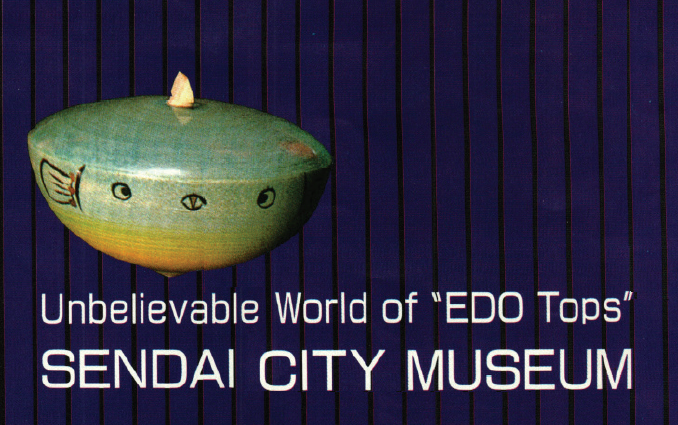
 この資料は先のインタビューで廣井先生が言及された展示に関するものです。1993年6月から8月、仙台市博物館で行われた企画展です。展示された独楽の案内、独楽の歴史などが含まれています。廣井先生はこの展示について次のように言われました:
 Carving Community: