Category Archives: video

とらの転がし

053

タイトル:

とらの転がし (tora no korogashi)
tiger rolling toy

=====================

とらの形をした子どもの玩具である。床の上で引っ張って遊ぶおもちゃである。廣井先生は寅年にこの独楽を作った。

***

***

廣井道顕:で、あ、これは虎の転がしだね。

廣井夫人:うん。

廣井:これ虎で、これねやっぱり寅年のとき作ったのね。

廣井夫人:うん、作ったの。

ジャネル・ランディス:私は寅年。

廣井夫人:寅年?あぁ・・・

廣井:ね。へへへ。でこう転がすっつって、こう転がすんですよ。虎がこう、こういう感じで、動くのね。


平伏 (prostration)

Click to enlarge.
Click to enlarge.

Title:

平伏 (heifuku)
prostration

=====================

This top depicts a popular doll figure in Japanese and Chinese culture, Fukusuke. Fukusuke figures in Japan go back to around the nineteenth century (Edo period), where they were often enshrined at brothels and tea houses as bringers of good luck. Their use has since widened. Fukusuke figures are typically shown to be sitting in traditional seiza position while prostrating themselves. Hiroi-sensei has made this figure so that the head and katana disconnect from the torso to form two tops.

***

***

Hiroi Michiaki: And this is “prostration.” This is Fukusuke [a bringer of good luck]. Fukusuke goes like this and is prostrating himself. And he takes this, this is a katana. You take the head, the head becomes a top, and you take the torso like this–

Mrs Hiroi: Yeah. You put all of it together.

Hiroi: It becomes two tops and you spin them.

平伏

Click to enlarge.
Click to enlarge.

タイトル:

平伏 (heifuku)
prostration

=====================

日本・中国文化において人気のある人形、福助を表現した独楽である。日本での福助の歴史は十九世紀(江戸時代)頃にさかのぼる。当時は遊女屋や茶屋で幸運をもたらすシンボルとしてよく祭られていた。以来広く使われるようになる。典型的な福助は平伏しているときに正座をしている。廣井先生は福助の頭と刀を胴体から取り外し可能にすることで二つの独楽になるように作った。

***

***

廣井道顕:でええと、こいつは平伏か。これふくふく福助。福助がへへえと、こうやって、平伏しているところなんだね。でこれ取っ、これ刀ね。これ頭取って、頭も独楽になるし、この胴体もこうやって取る

廣井夫人:そう。全部さしてる。

廣井:独楽が二個になって回る。


火鉢セット (hibachi set)

Click to enlarge.
Click to enlarge.

Title:

火鉢セット (hibachi setto)
hibachi set

=====================

For this piece, Hiroi-sensei has created wooden parts of a miniature hibachi set. Hibachi are heating devices used for cooking. They come in either cylindrical or square shapes and typically use charcoal as their source of heating. Hiroi-sensei has included a kettle, small dishes, and a container with real charcoal inside.

***

***

Hiroi Michiaki: And this, this is a hibachi set. In the set there’s a kettle. And I think there’s charcoal in here. Charcoal.

Mrs. Hiroi: Yeah. There’s charcoal in it.

Hiroi: And here there’s a tea cup. What is this? I think it’s a pitcher.

Mrs. Hiroi: Yeah.

Hiroi: If there’s no more water, you put it in from here. And in the old days, green tea was like a luxury, and you would usually only drink hot water. You would only drink green tea on special occasions.


火鉢セット

Click to enlarge.
Click to enlarge.

タイトル:

火鉢セット (hibachi setto)
hibachi set

=====================

この作品では、廣井先生が木製でミニチュアの火鉢セットを制作した。火鉢は調理のためにも使われた暖房器具である。円柱や四角い形をしており、通常は加熱するために炭を使用する。廣井先生は薬缶、小皿、本物の炭を中に入れた炭入れをこの火鉢セットで作った。

***

***

廣井道顕:で、これは、これは火鉢セットでね。あの火鉢で、こう薬缶が入っていて。で、ここに炭が入ってるのか。炭。

廣井夫人:うん。炭入るのね。

廣井:で、ここに湯呑があって。これ何だ、水差しかな。

廣井夫人:うん。

廣井:これ水がなくなったら、こっからスッと入れたりして。で昔はあの、お茶はうんと贅沢みたいで、お湯飲んでたんだそうですね。普通にはね。お茶は特別の時しか飲めなかった、みたい。


Jan, the Feminist

In this post, Jan discusses how she developed as a feminist, her desire to share her point of view with her students, and her unique position as an unmarried American woman in Japan.

===

Malina Suity: [1:00:42]: When you were working as a teacher at Miyagi, what were your–did you have any particular duties other than just teaching classes? What were your classes like?

Janell Landis: Um, well. The classes were, as I said, were sometimes with junior high school girls. And that was about fifty kids in one room and reviewing the English studies that they had with their Japanese teachers. They had me twice a week and the other teachers every day. And so it was back up for the Japanese teachers, and then that was true in senior high too. In college, I was given an opportunity with the juniors and seniors to have these elective courses. And then I attempted to really concentrate on some of the issues that women would face. And that’s when my feminist years developed. And I saw some of the girls develop too. And one of them ended up being, working on the wonderful program north of Tokyo that was involved with educating workers from other Asian countries and for commuting to work and so on. [1:02:09]

***

Malina [1:09:50] You mentioned your development as a feminist and working with women’s issues. Can you describe your experience as a woman in postwar Japan?

Janell: Yes. Uh, it was, my own conversion was when I was going with a group of people from New Jersey to what they called the God Box. To a Riverside area where the national church of these mainline denominations was located. And I went into a drug store while we were waiting for the car and I bought the first magazine of Ms. and that changed my life. And I didn’t see…what was your question again?

Malina: Um

Janell: I’m ready to get off of it.

Malina: It’s uh, being a woman in Japan.

Janell [1:10:58]: Oh, a woman in Japan. Well, because of that conversion in the States when I went back. I had the privilege in some of these elective classes to show what women were doing in other countries or so on. So, I myself branched out. But I had a reaction of one of my female Japanese teachers, she thought I was degrading the men. And uh, like I was anti-man. And that really hurt me in a way. I didn’t ever feel like I would, that I would, ever degrade my fellow men that were working on the faculty. I was cautioned then, to be careful not to be too demanding.

But um, like I said, being a single woman. I was my own self and I think I got a little bit different treatment than a wife would. And she would have opportunities that I didn’t have. But I never begrudged the difference. Each of us is given a walk and we have to walk our walk, own walk. We can’t imitate somebody else’s trot, but uh. I never felt…well let’s see I can’t say never. There were times when being a woman in postwar Japan might have been more difficult. But, being an American woman, being a single woman. [laughs] I had some freedoms that my Japanese women didn’t have. I was always–In the first years when things weren’t as progressive, I never got invited to the weddings. But after how many years there, it was like, if they had the American teacher there that was a real special thing. I got took to so many weddings and their parties. But, it was rarely that we were in the weddings. Many of them were held in a Shinto temple, but we were having the wedding parties in these big hotels or these big wedding parlors. And they’d spend a fortune and give everyone a present and so on. But I, in the latter years, I was one of the people they called. [1:14:02]

For more information on Ms. Magazine and the impact it had on women like Jan, read this oral history from New York Magazine.

Photograph of Janell and English Department staff at Miyagi Gakuin via Janell Landis.


フェミニスト、ジャネル・ランディス

ジャネルがフェミニストとして成長する過程や、生徒たちにジャネル自身の意見を共有したいという強い思い、そして日本に住む未婚のアメリカ人女性という立場について語っている。

===

マリナ・スーティ:宮城で教師として働いていたとき、あなたは―、ただ授業を持つ以外に特別な仕事はありましたか?授業はどんな感じでしたか?

ジャネル・ランディス:そうねぇ。授業は、まぁさっき言ったけれど、時には女子中学生に教えることもあったの。15人くらいの子たちが一つの部屋に集まって、日本人の先生がやっていたような英語の勉強をしていたの。私は週2回教えていて、他の先生は毎日。だから私は日本人教師の補助みたいなものだったし、高校の授業でも同じだった。大学では、1、2年生の選択科目を教える機会が与えられたの。だから女性が向き合わなければならない問題について専念して教えようと考えたわ。私がフェミニストとして開花した時期だった。学生の中にも何人かフェミニストとして成長した子がいて。中でも1人、東京でアジアの国から出稼ぎに来ている労働者への教育を支援するような素晴らしい活動をするようになった子がいたわ。

***

マリナ:先ほどフェミニストとして成長したことや女性が向き合う問題について触れましたね。戦後の日本においてご自身が女性として経験したことを教えてもらえますか?

ジャネル:いいわよ。そう、あれは、ニュージャージー州から来た人たちとニューヨークのゴッド・ボックス※を何て呼ぶかってことについて話していたときだったわ。主だった宗派の教会があるリバーサイド地域へ向かったときね。 車を待っている間に私は薬屋さんに寄って、初出版の『Ms.』という雑誌を買ったのだけど、それが私の人生を変えたの。当時は分からなかったけど…質問はなんだったかしら?

マリナ:あのう…

ジャネル:話戻しましょうね。

マリナ:えっと、女性として日本で生活することについて。

ジャネル:あぁ、日本で暮らす女性。そうね。アメリカに戻ったときにした会話があったからだったわね。選択科目のいくつかで、他の国では女性がどんなことをしているのかとか色々と教える機会に恵まれたの。それで、私自身の考えも広がったわ。でも、ある日本人の女性教師から、私が男性を卑下しているって反発があったの。私が、まぁ、反男性主義者みたいな。本当に傷ついたわ。そんなこと考えたこともなかったのよ、私が、そんな、一緒に頑張って働いている男性たちを見下すようなことをしようだなんて。その時に、あまり、きついフェミニストにならないように気を付けないと、って思った。

でもそうね、さっき言ったけど、独身女性として。私は私自身でいることができたし、誰かの奥さんっていうのとはちょっと違った扱いをされたわね。きっと誰かの奥さんだったら独身の私が得られなかった経験があったんでしょうね。でもその違いを嫉ましく思ったことはなかった。人はそれぞれの道が用意されてて、自分自身の道を歩まないといけないんだもの。他の人の道を真似して歩んだりできないんだから。でも、まぁ。私は絶対に…まぁ、絶対になんて言えないのよね。戦後の日本で女性として生きることは時に困難なことだったかもしれないわ。でも、アメリカ人女性として、独身女性として。私は日本人の女友達よりも自由だったわね。私はいつも– まだ世の中が積極的に進歩しているとは言えなかった最初の数年間、誰も私を結婚式に招待しなかった。でも歳月が過ぎれば、アメリカ人の先生がいることがすごく特別なことみたいな扱いになった。結婚式やらパーティーにたくさん呼ばれるようになった。でも、結婚式自体に行くことは滅多になかった。ほとんどが神道の寺社で執り行われたけど、結婚式のパーティーは大きなホテルとか式場でやってたから。大枚をはたいて披露宴をして、みんなにプレゼントを配ったりしてた。でも私は、何年経っても、呼ばれる側の人間だった。

※ゴッド・ボックス: ニューヨーク州、マンハッタンのリバーサイド通りにある19階建てのオフィスビルで、アメリカにある主だった教会や宗教関連の非営利団体がオフィスを置いているため通称ゴッド・ボックスと呼ばれている

===

ジャネルのようなアメリカの女性たちに大きな影響を与えたMs.誌の誕生についてはこちらのNew York Magazineに載るオーラルヒストリーの特集をご覧ください。

以上の写真はジャネル・ランディス(右)と宮城学院女子大学英文学部の事務員です。

熊坂長範 (Kumasaka Chōhan)

Click to enlarge.
Click to enlarge.

Title:

熊坂長範 (kumasaka chōhan)
Kumasaka Chōhan

=====================

This top depicts Kumasaka Chōhan, a legendary Heian period (794-1185) figure known as the original Japanese burglar. Kamasaka Chōhan first appeared in literary and performance works of the late Muromachi period (1336-1573). Most notably, he appears as an antagonist in the fifteenth-century Japanese war tale Gikeiki (義経記), where his band of thieves encounter the hero Minamoto Yoshitsune and the two battle.

***

***

Hiroi Michiaki: This is Kumasaka Chōhan, the original Japanese burglar. Heh heh heh. He’s the first person to burgle.

熊坂長範

Click to enlarge.
Click to enlarge.

タイトル:

熊坂長範 (kumasaka chōhan)
Kumasaka Chōhan

=====================

平安時代(794-1185年)の伝説上の人物であり、日本で最初の泥棒として知られている熊坂長範がモチーフの独楽である。熊坂長範が最初に文学や舞台芸の中で登場したのは室町時代(1336-1573年)後期である。注目すべきなのは、熊坂長範が15世紀の日本の軍記物語、義経記に敵として登場することである。義経記の中で長範とその一味は英雄、源義経に出くわし、長範と義経が戦うことになる。

***

***

廣井道顕:これは熊坂長範っていって、日本の泥棒の元祖。へへへ。泥棒の始まりの人なんだって。

やじきた (Yajikita)

Click to enlarge.
Click to enlarge.

Title:

やじきた (yajikita)
Yajikita

=====================

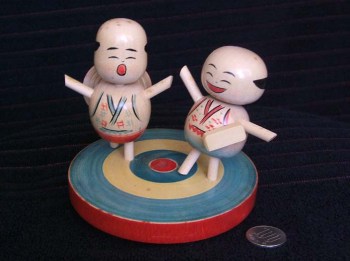
These top figures depict a scene from a popular nineteenth-century comical story called Tōkaidōchū Hizakurige (東海道中膝栗毛), known in translation as Shank’s Mare. It is also popularly known as “Yajikita on the Road,” as it depicts two main characters, Yajirobē (彌次郎兵衛) and Kitahachi (喜多八), on a pilgrimage from Edo (modern day Tokyo) to Ise Shrine. The story was written as a comical travel account of the anecdotes and foibles of the pair as they cross the country acting foolishly.

***

***

Hiroi Michiaki: This is called “Yajikita”… there’s an interesting story from long ago called “Yajikita on the Road.” It’s about these two people, like a short story now. Mm. And Yaji and Kita are walking along the Tokaido road. There’s all kinds of interesting stories about their journey, and here I’m showing one of them. If you do this, they stagger about and spin. Mm. It’s just like they’re traveling and having fun and like they’re walking about.