Category Archives: video

廣井先生と職人としての生き方

廣井先生が木工職人の生活と現代社会で日本の伝統工芸や芸術を伝え守っていくことの難しさを語っている。

===

===========================================

ポーラ・カーティス:あのう、そしてまぁ職人としての生活にはあのう、一番難しいことが何だと思いますでしょうか。

廣井道顕:一番難しいこと・・・難しいことばっかりだな。(laughs)簡単なのっつうのはないですね。どれが一番難しいって言われると、全部難しいね。一番、逆に嬉しいのが、お客さんとか、買ってもらった人が喜んでくれる。ワァァってやってくれっと、ものすごく嬉しい。後は毎日苦しんでいます。(grins)

ポーラ:(laughs) その、まぁあの難しいことが、もちろん、多いと、おっしゃいましたが、まぁあの時間とともに、ま、多少変化しましたか。何が難しいか、あのその、ビジネスとか、売るのとか。

廣井:まぁ職人として難しさは、やればやるほど難しくなってくのね。あと、売る、売るのは苦手なんだよね。だからね、うん、損ばっかりしてんのね。

ポーラ:で、あの職人の、あの職業がだんだん消えつつあると思いますでしょうか。それはなぜだと思いますか。

廣井:あぁ!そう。これが一番、あのう困ったことだなと思って、あのう・・・なぜか日本は職人て言うと軽く見られるんですよね。で職人がいないと、あのう、日本の大企業だって成り立たないはずなんだけども、なぜか職人は、馬鹿にされるしね、軽く見られるし。あのう・・・行政の方でも職人は軽く見て、何の援助もしてくれないしね。援助が欲しくて言うんではないけど、もっと大事にして欲しいなと思うのね。

だって日本が今こんだけ技術が発達してんだってその底辺ていうか、一番下には職人が必ずいるんですよね。職人がモノを作って、それを今度機会で大量に作ってって。であの、大企業が成り立って。で、その職人がだんだんいなくなってくれば、あのう何か今度やろうつったって何もたぶんできなくなると思うんですよね。だから、職業は、色々職人もあるけども、もうとにかくその職人っていう人をもっと大事にしてほしいなあと。まぁ希望ですけどね。

ポーラ:ではあのう、現在は、昔と比べると、弟子が多かったですか。

廣井:あぁ、うん。だからね。あのう、これはね、なんで弟子を多くしたかというと、あのう伝統こけしをやって、うんん・・・あの、こけしやっている人も何人もいたし。だからそれを集めてる人もいっぱいいたんですけれども。で、こけし描いてて、で売って、あのう収集している人に売って、どうのこうの、あれがダメだの、これがダメだのと、難しいこと言われて、うんと悩んで、でも一生懸命やって、ある程度できるようになって。まぁ本なんかでも、

こけしの本とか必ず名前が載るようになって。でそん時にね、気が付いたんですよ。『あぁ、うちにはこけしよりもっと大事なものがあった』って。こけしはいっぱいこけし屋さんがいて、完全に残っているけど、うちの江戸独楽はうち一軒なんですよね。日本中で。ということは世界中で。それを引き継いだのは俺と弟の二人だけで。日本では、でうちの場合は、あの、こけしみたく一つだけではなくて、何百何千って数があるものですから。一人でそれを再現して残しておくっていうことが不可能だなってのが気付いて。これは弟子をいっぱい増やさなきゃならないと思って。そんであのう、こけし屋さんの、若い跡取りを・・・あのううちに来たんですよ、あのう、これから先こけしだけでは、生活していかれなくなるんでねえかっていうことで他のことも覚えたいんだって、若いのが。

あの時ね、うちであのう、一人、あのう今の前田くんみたく一人あのう、教えてやってたのがいたのね。それがあのこけし屋さんの息子で、あの小原温泉の、人なんですけど、これも有名な人なんですけど、その人の子供で。雄介、本多雄介っていう。それがあのう、白石で、あのう、弥治郎系のこけし屋さんの息子たちの、子供たちの若い人の集まり、で七人いるんだって。で、その雄介が『今自分はこういう所でこういうもの習ってんだ』っていう話をしたらば、みんなそういうの覚えたいなっていうことになったって。で『教えてくれるか』って来たから。本当かってったら『本当だ』って言うのね。で、『みんな連れて来い』っつって。でそん時七人、白石から来たんですよ。では、教えてやったっていうことになって。

でまぁ、うちの品物はこけしと違って、種類がいっぱいあるし、遊び心がいっぱいなきゃならないので、まず『うちに来るんだったら真面目になってないで遊びな』っつったの。したっけ『えええ!』なんてみんなビックリして。へへへ。で、一人、本気になって遊んで、彼女見つけて結婚して。へへ。

今、こけしでは弥治郎で一番ぐらいになってるね。でそいつ、こ、独楽できなかったのね。まだあのう習い始めて半年だかって言うんで、ほとんど独楽できなくて。ほんで、こけし、ま親がこけし屋さんだから、で、まず、でまずこけしやったらいいでねえかっつうことで。で、こけし一生懸命やって。他の人たちはみんな独楽やって。したらみんな親たちにてっきり『怒られるかな、文句言われっかなあ』と思って『大事な、跡取り息子に余計なこと教えた!』なんて怒られるんじゃないかと思ってたら、みんな親たちが来て「宜しくお願いします」ってここでね、みんな頭ついてったね。七人とも。これには、逆にこっちの方でビックリしちゃって。『あぁこれ本気なんだな』と思って、ほんで一生懸命教えてやって。で、大体一人でもう百種類ぐらいは覚えたんのじゃないのかなと思うんですけどね。

ポーラ:あのう、まぁこの職人の職業がその、あのう消えつつある問題についてですが、どうすればいいと思いますでしょうか。あのう、そのまあ、人気があるように。

廣井:あぁ。そうね。

ポーラ:何かできますか。

廣井: そういうのがあると本当いいんですけどねえ。残念なことに日本にはまだそういう制度ないし。もうちょっと、偉い人がさっきも言ったように職人に、えぇ、こう、目を向けてくれれば、少しは、伝統的なものとか、技術が、残るんじゃないかな。で、若い人も、職人に、結構職人になりたい若い人いるんですよね。でも、職人の世界って難しい。で職人っていうのは頑固でなかなか。こう、馴染めないっていう、そっちのイメージの方が多くて恐ろしがってね、へへへ。なかなか『やりたくてもなぁ・・・』っていう人結構多いんですよね。だから、そういう人たちにね、もっとこう、スムーズに馴染んでもらって。育てたいな、と思っていたんですけど。ええと、去年ね、ええと一年半、仙台市で、この工芸の里で、後継者の育成をしようっていうことで市の、市がお金を出してくれて。で五人、入れたんですね若い人を。

で、あー、市で給料を出してくれて。ほんで教える方も、謝礼金として結構なお金、もらったんですけど。一年半続けて、で今年の三月でそれ終了したんですけど。んで結果的に残ったのが、うんと、小竹さんのとこに一人、うちに前田くんいるし、もう一人あのう、みさちゃんって女の子がいるんですけど。三人残ったんですけど。で、そういうことをもう少し続けてやってくれれば、もっと若い人が来ると思うんですけどね。で、あまりこう難しい条件、つけないでやってくれって言うんですけど。で今回はね、そんな難しい条件でなくても良かったし。で五人来て、ま結果三人残ることになったんですけど。大成功でないかなと思うんですけどね。

でこういうことを、こう繰り返し、市ばかりでなくてね、県とか国で、やってくれれば、若い後継者が日本中で結構増えると思うんですけどね。でまあ、同じ職人でもほら、うんとお金のある、所はね、自分の所でどんどん若手を育てることできるけど。我々みたいにお金のないのはね、それこそ前田くんでもみたくアルバイトをしながら、でも習いたいっつうんで来てた。そういう人たちあの、ホンモノになれると思うんですよね。だから、そういうところにね、もうちょっとこう、手を差し出てくれれば、もっと若手育てられて、日本も、もうちょっと豊かになれるような気がするんですけどね。

河童の水汲み (kappa no mizukumi)

Click to enlarge.
Click to enlarge.

Title:

河童の水汲み (kappa no mizukumi)
kappa drawing water

=====================

This top depicts a kappa. Kappa are yōkai (supernatural creatures) from traditional Japanese folklore. Kappa are typically depicted as somewhat humanoid and the size of a child, although sometimes they can appear more like birds or turtles. They are said to live in rivers and ponds, where they cause mischief, occasionally kidnapping or drowning people or animals. Sometimes they are depicted as balancing a bowl or plate of water on their heads, which is a technique they use to travel outside of their watery homes. Even today, some areas of Japan will have signs near rivers warning people about kappa. Kappa may also be considered friendly or helpful, helping humans with water-related tasks like irrigation or fishing. Each part of this figure can be removed and turns into a separate top. This top features kappa drawing water out into gourds.

***

***

Hiroi Michiaki:  This is… What is this? Kappa drawing water? The kappa are drawing water out into gourds. When you spin this, it totters around like this. They look like they’re playing.

河童の水汲み

Click to enlarge.
Click to enlarge.

タイトル:

河童の水汲み (kappa no mizukumi)
kappa drawing water

=====================

河童とがテーマの独楽。河童は日本の伝統的な民間伝承に出てくる妖怪(日本の化け物、非科学的な存在)である。河童は人間のような姿をしており、大きさは子どもと同じ程度、しかし時に鳥や亀のような姿をしていることもある。川や池に住んでいると言われ、そこでいたずらをしたり、時には人や動物をさらったり溺れさせたりもする。頭に水の入った器や皿をのせている姿で描かれるが、河童が水中から外の世界に出ることができるのはこの皿や器があるからである。今日でさえ、河童についての注意書きが川の近くに立てられていることがある。河童は友好的、頼る存在として考えられることもある。かんがいや魚釣りなど水に関係することに関して人間の手助けをする。パーツを取り外すと、それぞれが独楽になり回すことができる。ひょうたんで水を汲む河童の姿が表現されている。

***

***

廣井道顕:これがこれが何だ。河童の水汲みか。河童がこの瓢箪に水を汲んでるところ。これ回すとやっぱりこう、ふらふら動いてね。なんか遊んでるように見える。

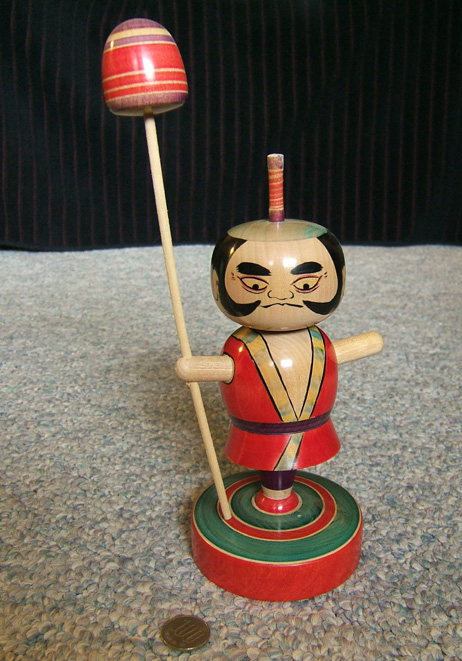
奴道中 (attendant on the road)

Click to enlarge.
Click to enlarge.

Title:

奴道中 (yakko dōchū)
attendant on the road

=====================

This top depicts a samurai attendant. During the Edo Period (1600-1868), daimyō (military lords) were required to travel to the capital of Edo (modern day Tokyo) on alternating years to reside there. Travel across the country took place in long processions of the daimyō and their retainers and servants. These processions were a point of pride for each individual province and local ruler, and could include as many as several thousand men. At the forefront of these processions were bannermen, who carried spears or flags, and called out for commoners to clear a path for the daimyō’s party to move through the road. Here, Hiroi-sensei has made a top of one of these bannermen.  

***

***

Hiroi Michiaki: And this is a samurai attendant. In the past, there were daimyō (military lord) processions; there was a practice called sankin kōtai [in which daimyō travelled on alternating years to do a year-long residence in Edo [Tokyo]]. For example the processions even went all the way from Sendai to Edo. And after some years they’d turn around and come back. At that time, the person in the very front of the line, the attendant, carried a spear, and while calling out something out loud he’d walk like this. [This top] shows this. The attendant on the road. At the very front of the daimyō procession.

奴道中

Click to enlarge.
Click to enlarge.

タイトル:

奴道中 (yakko dōchū)
attendant on the road

=====================

奴さんの独楽。江戸時代(1600-1868年)、大名は参勤交代のために江戸(現在の東京)に住むことが義務付けられていたので、江戸まで旅をしなければならなかった。家臣や家来を引き連れて大名行列をなし国々をまたいで旅をした。それぞれの国や地主の誇りに関わる大事だったので、数千人を動員することもあった。大名行列の先頭には旗や槍を持つ旗持ちがおり、大名のために道を開けるように庶民に掛け声をかける。廣井先生はこの旗持ちを独楽で作った。

***

***

廣井道顕:で、これはやっこさん。で昔あの、大名行列ってあの、参勤交代でみな江戸に、ま例えば仙台入るのもね、江戸まで。何年かにいっぺん行ってて。その時にはあの、行列の一番先頭でやっこさんがこう槍持って来て、なんか声かけながら、こうやって歩く。それを表してるんですけど。やっこ道中。大名行列の一番前ですね

だるま (daruma)

Click to enlarge.
Click to enlarge.

Title:

だるま (daruma)
daruma

=====================

This work depicts a daruma. A daruma is a traditional Japanese doll whose figure is based on the Bodhidharma, the founder of the Zen sect of Buddhism. Daruma are often depicted in this roundish shape because of a legend that the Bodhidharma stared at a wall in intense meditation for nine years, until both his arms and legs fell off. Daruma are traditionally depicted in red, but can appear in various colors with different meanings. They are considered good luck figures.

***

[no video/commentary]

***

だるま

Click to enlarge.
Click to enlarge.

タイトル:

だるま (daruma)
daruma

=====================

だるまがテーマの独楽。だるまは伝統的な日本の人形で、そのモデルになっているのは仏教禅宗の開祖とされている菩提達磨である。だるまがよく丸い形で表現されるのは、菩提達磨が壁を見つめて座禅を九年もの間 続けたので腕と脚が取れてしまったという伝説から来ている。だるまの伝統的な色は赤であるが、他の色もあり、色によってそれぞれ意味もある。どの色も幸運のシンボルとして考えられている。

***

[ビデオなし]

***

桃太郎 (Momotarō)

Click to enlarge.
Click to enlarge.

Title:

桃太郎 (momotarō)
Momotarō

=====================

This top depicts Momotarō, sometimes translated as “The Peach Boy,” or “Peach Tarō,” a legendary figure originating in the Edo period (1600-1868). In many versions of the Momotarō legend, Momotarō is a boy who came to Earth inside a giant peach who is discovered by an elderly couple who then raise him. He later leaves his home to fight a band of demons on a distant island, meeting a talking dog, a monkey, and a pheasant on the way who joint him in his quest. Most versions of the legend end with Momotarō defeating the demons, taking their treasure and their chief captive, and then returning home to live happily ever after with his parents.

***

***

Hiroi Michiaki: And this is, did this one have two faces? He’s facing backwards, and there’s another [face] in the front. This is Momotarō on the back, too. And he’s carrying dango (dumplings). Ahh, there it is, there it is. He’s carrying dango, Momotarō, too. And this is the back of the oni. I think the front is in here somewhere, too. This the reverse side of Momotarō.


桃太郎

Click to enlarge.
Click to enlarge.

タイトル:

桃太郎 (momotarō)
Momotarō

=====================

江戸時代(1600-1868年)が起源の伝説上のキャラクター、桃太郎を表現した独楽である。桃太郎の伝説には様々な種類の話があるが、どの話でも桃太郎は巨大な桃から生まれ、桃を見つけた老夫婦に育てられている。後に遠くの島にいる鬼を退治するために家を離れ、その道中で出会った話しのできる犬、猿、キジを鬼退治の仲間に引き入れる。どの話でも桃太郎が鬼を倒し、鬼の親玉を捕らえ、宝を持ち帰って育ての親である老夫婦と幸せに暮らすという終わり方をしている。

***

***

廣井道顕:そんでこれが、これ確か裏表あるんだっけ。こいつ後ろ向いてっけど。前もあるんだね。これ桃太郎も後ろ。確か団子しょってる、ああ、あるある。団子しょってるんだね。あぁこっちが後ろだね、桃太郎もね。で、あ、これ鬼の後ろで。ううん、正面もどっかにあるはずだね。これ桃太郎の裏表

Janell’s Missionary Work

In this post, our conversation delves deeper into Janell’s duties and thoughts on her work as a Christian missionary in Japan. Jan discusses the Christian population of her college, and how some of her American friends had misconceptions about the goals of her mission.

===

This clip has been slightly edited from the original interview for clarity and theme. A transcript of this clip can be found below. And a full transcript of our interview with Janell can be found here [forthcoming].

===========================================

Janell Landis: But anyway, I had the English classes in the YWCA where some of my friends from Miyagi were a part of that. I had people who would ask me as a blue-eyed American my opinion of Japan, to give a speech on that, and I didn’t have blue eyes [laughs] but anyway. It was a women’s group or I actually talked to all Japan women somewhere, sometime. But, those were not as frequent as everyday teaching in school.

But, then I had some very interesting groups coming to my home, once a month. And we made–that was later in my life. We made decorations for all kinds of things, Christmas and et cetera. That group was a group of women who were on the staff of the college. And uh, the school was, for me, was a family. It really was, and these were all my little girls [laughs].

But, I was not asked to start the Christian work, I was just in it in a program that had been founded years before and carried on. When the missionaries had to do the leading for this program or that. But I was just fitting into what the Japanese wanted and needed, and um, I didn’t have to institute anything on my own, but I was able to if I wanted to branch out. So, there was a freedom there that we missionaries from America were given. It was a Japanese church that was, it’s still one percent of the population. It doesn’t get larger. But it’s a faithful part. And I have a prayer calendar I read everyday, and the list has got a lot of social welfare programs, like a home for mothers or babies, or a home or elderly or children and the challenged and so on.

Malina Suity: Were many of your students Christian?

Janell: What?

Malina: Were all of your students Christian, or many of them?

Janell: Oh no no no. No no. I remember the college used to have each year a fair, a celebration once a year that the students themselves took a survey of the students and less than one percent were Christian. But when they took this survey about 10 percent of the students said they would prefer Christianity to Buddhism or Shinto. Now, that wasn’t something they did every year. But that indicated, I always felt that there was a back up much higher than one percent, but many that could not become members. Couldn’t be baptized. And a lot of women when they married, married into their husband’s family. And she was, I can’t say a slave, but she was an underling of the mother and law and sometimes they were not able. I remember occasionally at our church that I attended a woman seventy-four years old finally could get out of the house and come to church.

And there was people like that, men and women who… I remember the story of a man who went to church in a completely far away neighborhood so nobody would know he was a Christian in his neighborhood. And when he died they didn’t know what to do. Um, but if…if um–I also remember one of my Christian men friends. His parents, when he became a Christian, his parents became Christians too and they severed their relationship with their cemetery, their Buddhist cemetery. Now, to give up their Buddhist cemetery was a real step, because that was a normal thing for you to be buried in that cemetery. But they chose to drop that and go into a Christian cemetery. So that was real conversion.

But my job was not particularly to count the heads that I baptized. If I ever write a book about myself I’m going to  write it called it “Heartbeats and Headcounts” because I would come home and the people would say, “How many people did you bring to the Church?” or something. You know, people who always think of mission work as conversion. Our mission work was to share life with people and I learned more from my life there than I was ever able to teach. And anybody that became a Christian became because they themselves made the decision. I can’t make a decision for them.

But with that opportunity of having variety in my life, there was a real good chance to meet a lot of people, not just from Japan, but that…people from India and Thailand. That came to Japan for work or training. The rural institute down in uh North of Tokyo, they’re very close to Utsunomiya, big city. That was especially founded by a Japanese Christian to serve community leaders from a lot of Asian countries. Now it includes people from Africa and South America. And we were able to visit there and I could take students there when they’d have a special program. So, there was a lot of freedom that made it possible to…uh, I didn’t feel restricted by school rules or…as long as you didn’t lead the students astray [laughs] into a wicked life. Why, you had a lot of freedom. 

Malina: What was your first job in Japan?

Janell: Excuse me?

Malina: Your first job in Japan?

Janell: The first job in, that was from 1953 all the way to about ‘85. My job was working in Miyagi Gakuin College and Junior and Senior high. There were several years where I was assigned to the Junior and Senior High and attended their faculty meetings. The rest of the time I was on the faculty of the college and the junior college, teaching English as a second language. That was my first job and my last job in that school.

But then the last ten years of my life in Japan were in connection with the Tohoku, that’s Miyagi, Yamagata, Fukushima prefectures that were Tohoku conference. The prefectures north of us were in the Ou conference. But the Tohoku conference, and I visited churches with puppets and I had English bible classes with members, youth and older. I also worked with the YWCA. They had some wonderful women who were interested in reading the Bible in English. And um, so there were opportunities for visiting kindergartens. And recently, with that tsunami there were some of the kindergartens in the area around the sea that I don’t know if they’re still there. I lost contact with those churches after I came back here in ‘95. But I was visiting some of those churches’ kindergartens. And, um they weren’t very big. The churches themselves didn’t have that many members, but that was part of my program in the last ten years of my life in Japan. I was on the train a lot and in the car.