たつと竜の子太郎 (tatsu to tatsu no kotarō) dragon and Tarō, the Dragon Boy
=====================
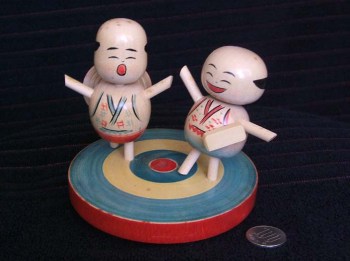
This toy depicts a dragon and Tarō, the Dragon Boy. Though there are many versions of the tale, the story behind the toy comes from a local legend called Koizumi Kotarō monogatari (小泉小太郎物語), about a dragon that gave birth to a little boy near Lake Sayama. The waters of the lake sweep the boy away, and he is found and raised by a kind old woman living in a village nearby. He later embarks on a journey to find his dragon mother. Depicting the story of Tarō, the Dragon Boy in rolling toys such as this one is very popular in Japan.
***
***
Hiroi Michiaki: This is a toy I made in the year of the dragon. Like the ones children ride on, [but] you hold it in one hand [like a top]. It’s a toy, not a top.
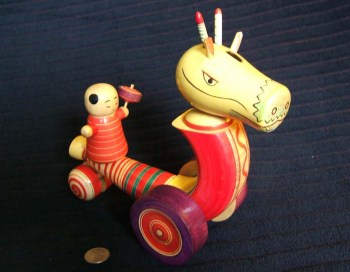
This is not a top but a pulling roller toy. The toy depicts Kintarō, a semi-legendary figure in Japanese folktales, who is said to be a child born of superhuman strength and great bravery. It is customary to put out dolls of Kintarō on Boy’s Day (nowChildren’s Day) in the hope that young boys will become equally strong and brave. Special carp streamers (koinobori) are also flown on this day, and in popular imagery, a number of famous prints show Kintarō wrestling a giant koi, so the two often appear together.
***
***
Hiroi Michiaki: This is also a toy. This is Kinta riding a koi, and this isn’t a top, but a toy you pull along with the string.
Mrs. Hiroi: Yeah.
Hiroi: This koi looks like it’s swimming like this.
Mrs. Hiroi: It spins like it’s swimming.
Hiroi: And Kintarō’s carrying a broadaxe, this… what is this…? What should I call this?
Mrs. Hiroi: Kintarō.
Hiroi: A mallet… What was this called? I forgot the name. Anyway, the hammer is really huge.
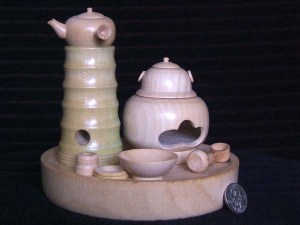
This piece depicts open-air tea utensils. In spring or autumn, sometimes tea ceremonies are held outdoors so that the participants can enjoy nature and beautiful weather while drinking their tea with seasonal treats. Open-air tea ceremony is sometimes held at temples or shrines.
Another view:
Click to enlarge.
***
***
Hiroi Michiaki: And, ah, these are tea utensils. For open-air tea ceremony.
Mrs. Hiroi: Open-air tea.
Hiroi Michiaki: It’s for setting up tea outdoors, green tea. So it’s the same as the tea we’re drinking now.
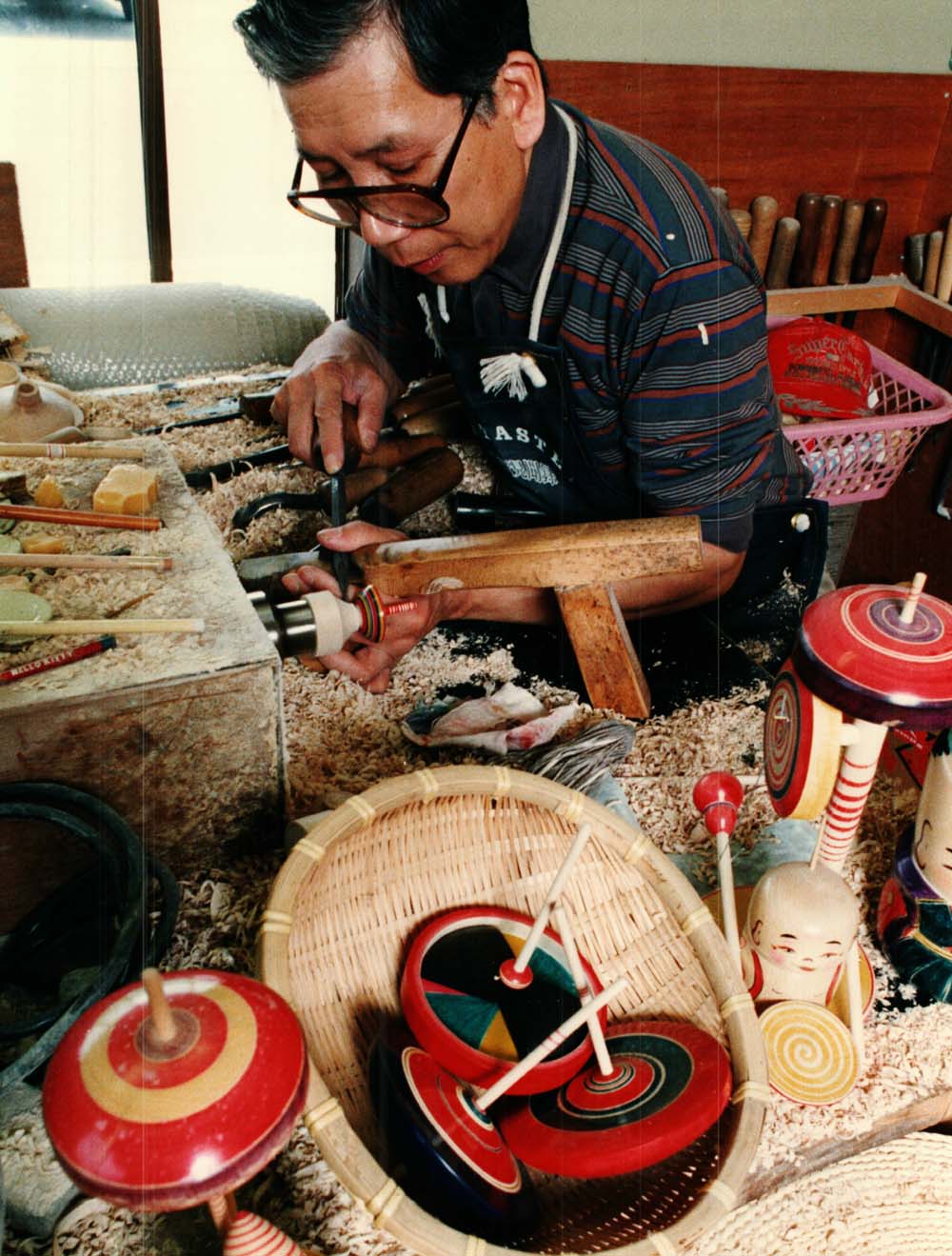
In this interview segment, Hiroi-sensei describes his early experiences as a woodworker in Sendai selling kokeshi dolls before he settled on reviving his family’s tradition of making Edo-style tops. He discusses the difficulties his family had selling their goods, despite being discovered as the last surviving family in Japan that made Edo-style tops.
This clip has been slightly edited from the original interview for clarity. A transcript of this clip can be found below. And a full transcript of our interview with Hiroi can be found here [forthcoming].
===========================================
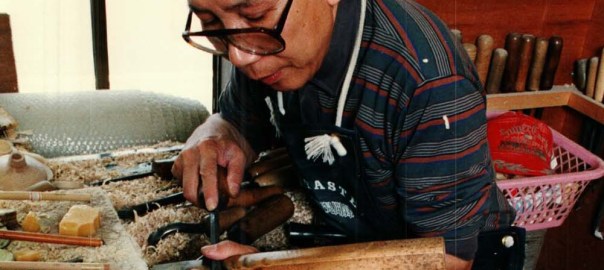
Young Hiroi-sensei.
Hiroi Michiaki:Hmmm. Since I first came to Sendai… mmm… there were many [moments that stay in my mind], my father worked in many woodworkers’ shops, and was an artisan. And from that he became independent, and rented a house himself and of course put a lathe in it, and worked wholesaling and subcontracting kokeshi. And, ahh around this time kokeshi, souvenir kokeshi that is, they’re different from the traditional style of kokeshi [you see] now. He was able to sell a lot of those. There was a wholesale shop, and there he subcontracted unpainted objects called shirakiji (blank wood), and worked doing that. And doing that, he said that if he was to make kokeshi he might as well do traditional kokeshi, and he became a person named Wagatsuma-san’s apprentice, and came to [make kokeshi] from the Toogatta kokeshi tradition. And then they were able to sell traditional kokeshi, and it became a kokeshi boom, and they became able to sell them. He took his lathe to Tokyo and [sold them] at performances and department stores. At first he did kokeshi, but kokeshi take a lot of time, so he did tops [instead].
Paula Curtis: Yes.
Hiroi: Then, in Tokyo, they said that along with Italy they were going to gather kokeshi. “Native toys” (kyōdō gangu) were [being gathered] here and there in Japan—if it’s Aizu, for example, they have the Akabeko (red cow). People came [here] that were collecting those kinds of native toys and kokeshi. Mmm I was doing tops, but at that time, since I was in Sendai I wasn’t doing Edo tops, but those called Sendai tops or Miyagi tops. Because they were [being sold] at goods shops in Sendai and Miyagi prefecture. And when I did that in Sendai [I made] Sendai tops, and when I was in Miyagi prefecture I did Miyagi ones, tops called Miyagi tops. And they were popular, since they were spinning right in front of you. The people who came to gather the native toys said something like “Where are you really from?” and I said “Actually I’m from Tokyo.” And they were like “Ahh of course!” They said, of course, we thought that in Tokyo, too, long ago there were lots of toys called “Edo tops (edogoma)” but no matter how much we looked, we couldn’t find them. When they said “Have you made them?” I said something like “My family has traditionally done them.” He said, “Ahh! I found them!!” and there was a clamor about it in Tokyo, saying they finally found Edo tops. And my younger brother went to Tokyo. My brother got married in Tokyo and has done Edo tops there ever since. When he has a chance he makes Edo tops here in Sendai. Well, in Sendai, too, to a certain extent we made Edo tops, but people here didn’t understand about them, so even if we sold them they didn’t sell well.
Paula: Did your family expect you to continue business as a top-maker?
Hiroi: Mm, that was the only thing to do. Somehow I sold the tops. Like in the past, I thought I might not be able to eat, and in Sendai, just like back then, I wasn’t understood, and I couldn’t sell anything. And I went to Tokyo and it was a situation like I just described, and so I was able to sell my tops there. Though, at that time, rather than Edo tops I actually was working hardest at making the traditional kokeshi.
Paula: When did you become an independent Edo top maker?
Hiroi: Hmm… when was it? I don’t remember exactly. Mm… I didn’t really become aware of [when I started working independently, because] I was helping my father. And at some point I started using the lathe. So I don’t exactly what year, what month, what day–it wasn’t like that.
Paula: About how many years were you an apprentice?
Hiroi: Mmm, I don’t really know that either… It happens before you know it. At some point I was helping my father and working with my brother, and the three of us came to work together. What year, month, day–it wasn’t set. So I don’t really know how long [I was an apprentice].
Paula: This is a bit similar to the previous question, but when did you first come to Sendai?
Hiroi: When I first came to Sendai… Shōwa–What year was it? Twenty-three. It must have been Shōwa 23 [1948].
Paula: What was your life like there?
Hiroi: Mmm that time… we rented a room in someone’s house. Rented [just] a room. So how would [you say] we lived, I wonder? Somehow it’s weird to think of it as [properly] living there, but my father was working hard. And… at any rate we went back and forth all over within Sendai. We hadn’t been there long, so [we went] here and there. So even within Sendai we lived in a number of places… One, two, three, four, five, six, seven. We moved seven times.
Paula: That was before you were married?
Hiroi: Before.
Paula: And after you were married…?
Hiroi: After I was married… umm… After I was married… Ahh. It was once or twice [that we moved]. To here. Umm… in Higashiguchi, Higashi… We got married at the town Higashi shichiban, and moved to Fukurobara, and here. It was twice [until] we were here.
Paula: In Sendai, well, what sort of memories do you have of the various places [you lived]? Are there any that stand out?
Hiroi: Mmm I have unpleasant memories, you know. (laughs) There were two places. Really terrible ones, two places where I was bullied, awful places I experienced. But after that, they were all enjoyable. Especially after I was independent. Umm… I had many friends, and it was nice that there were many people my age. It was really fun. In one place, for some reason in one place almost all of the kokeshi makers in Sendai gathered together, and I lived independently and felt like it was a neighborhood community, and there were lots of people doing the same work so it was nice. Even now looking back on it, it was a really a great time [in my life]. And that [time], the son of the sensei who taught kokeshi-making back then, he’s alive now, and even now he’s always saying “That was the best time, wasn’t it?” It was really great.
 Title:


 Carving Community: