What does making wooden tops look like? How do they use the lathe to make this kind of art? Below we feature photographs of Hiroi-sensei and his apprentices from the 1980s, seen hard at work producing Edo-style tops. The tops are made by placing a block of wood on the lathe and spinning it rapidly while cutting into the wood with metal tools. Paint is applied to the finished top while it spins on the lathe.
You can listen to and read an interview with Hiroi on his own early apprenticeship here.
This top features Onabegonsuke. According to Hiroi-sensei, Onabegonsuke is the lowest-ranking god of luck.
***
***
Hiroi Michiaki: And this is Onabegonsuke. Onabegonsuke is… umm, he’s the lowest-ranking god of luck. And if you spin this, his neck bobs up and down at this part. Heh heh heh. That [part is] a kitchen, a cooking stove.
This top depicts a kappa. Kappa are yōkai (supernatural creatures) from traditional Japanese folklore. Kappa are typically depicted as somewhat humanoid and the size of a child, although sometimes they can appear more like birds or turtles. They are said to live in rivers and ponds, where they cause mischief, occasionally kidnapping or drowning people or animals. Sometimes they are depicted as balancing a bowl or plate of water on their heads, which is a technique they use to travel outside of their watery homes. Even today, some areas of Japan will have signs near rivers warning people about kappa. Kappa may also be considered friendly or helpful, helping humans with water-related tasks like irrigation or fishing. Each part of this figure can be removed and turns into a separate top. This top features kappa drawing water out into gourds.
***
***
Hiroi Michiaki: This is… What is this? Kappa drawing water? The kappa are drawing water out into gourds. When you spin this, it totters around like this. They look like they’re playing.
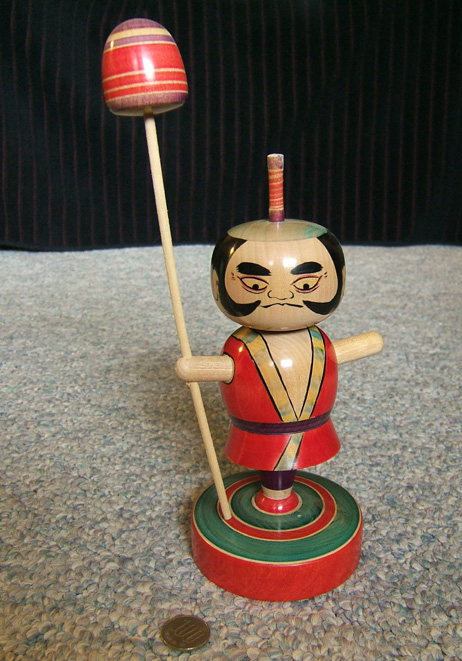
This top depicts a samurai attendant. During the Edo Period (1600-1868), daimyō (military lords) were required to travel to the capital of Edo (modern day Tokyo) on alternating years to reside there. Travel across the country took place in long processions of the daimyō and their retainers and servants. These processions were a point of pride for each individual province and local ruler, and could include as many as several thousand men. At the forefront of these processions were bannermen, who carried spears or flags, and called out for commoners to clear a path for the daimyō’s party to move through the road. Here, Hiroi-sensei has made a top of one of these bannermen.
***
***
Hiroi Michiaki: And this is a samurai attendant. In the past, there were daimyō (military lord) processions; there was a practice called sankin kōtai [in which daimyō travelled on alternating years to do a year-long residence in Edo [Tokyo]]. For example the processions even went all the way from Sendai to Edo. And after some years they’d turn around and come back. At that time, the person in the very front of the line, the attendant, carried a spear, and while calling out something out loud he’d walk like this. [This top] shows this. The attendant on the road. At the very front of the daimyō procession.


 Carving Community: