唐子の蝶々遊び (karako no chōchō asobi) karako (Chinese child) playing with butterflies
=====================
This top depicts a karako (Chinese child, or a child dressed in a Chinese fashion) dancing with butterflies. In Japan, these figures are said to be messengers for the God of Luck, sent to do his bidding. They are thought to be good omens.
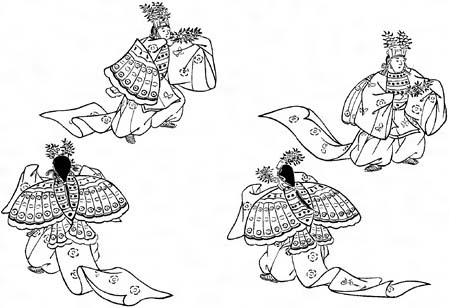
kochō no mai 胡蝶楽〈舞楽図譜 宮内庁書陵部蔵〉
The image of a Chinese child with butterflies also extends to ancient Japan, when there was a tradition of kochō no mai 胡蝶の舞 (butterfly dance) inherited from China. As a part of gagaku 雅楽 court music performance, four young boys would dress as butterflies, attaching yellow wings to their outfits, and perform dances for the imperial court.
Below, you’ll find a video of Hiroi-sensei explaining the top, along with transcripts of his explanation.
***
***
Hiroi Michiaki: This is, um, “A karako (Chinese child) playing with butterflies.” A karako is… [literally] a Chinese child [a child dressed in a Chinese fashion], but in Japan they’re said to be the messengers of the God of Luck. The God of Luck orders them to go do something, “Go here, go there.” And when he requests many things, it is said that this karako goes about taking care of it. They’re good omens. This, if you spin it, the butterflies look like they’re fluttering and fluttering, flying about.
Paula Curtis: Um, in ancient times there was also a “butterfly dance,” right?
HM: Mm. Ahhhh [yes].
PC: From China.
HM: Yes, there is. They move around with the same feeling as that.
Janell Landis: Looks like butterflies flying.
HM: Yeah.
JL: Uh huh.
HM: If you spin it here a little, [it looks that way] because [the butterflies] clatter about.
JL: Right.
HM: The butterflies look like they’re fluttering flying about. This is the “Chinese child (karako) playing with butterflies”…
Dissatisfied with her work in America, Janell decides to try a short term of service as a missionary in Japan. Listen as she describes her decision, her travels, and her experiences upon her arrival in Sendai, Japan.
This clip has been slightly edited from the original interview for clarity and theme. A transcript of this clip can be found below. And a full transcript of our interview with Janell can be found here [forthcoming].
===========================================
Malina Suity [18:24]: How and why did you decide to go to Japan?
Janell Landis: I attended a meeting in Toledo, Ohio and I met the man who was our director of work in Japan–in the Orient actually, China too, at the time. He gave a very passionate presentation and I was deeply moved and thought well, they had a short-term program where you could be there for three years, in Japan, as a teacher. So, I volunteered and appeared before the board committee and they accepted me. So in March of 1953, I was on my way to Japan by ship from San Francisco to Yokohama. It was neat.
*******************************
It was a 14 day trip on the ship. But when I got there I was able to start the school in April. Japan[‘s school year] is April through ‘til March. And I went right into the job teaching English as a second language to junior high kids, senior high kids, and college girls. And um, I didn’t have a good textbook, I didn’t have a good experience but, I had a love and a lot of love around me so that in six months I decided I’d like to be career. And the mission board permitted me to do that. And in the next year of ‘54 to ‘56 I was down in Tokyo learning the language in a school for people–for Americans and foreigners–learning Japanese.
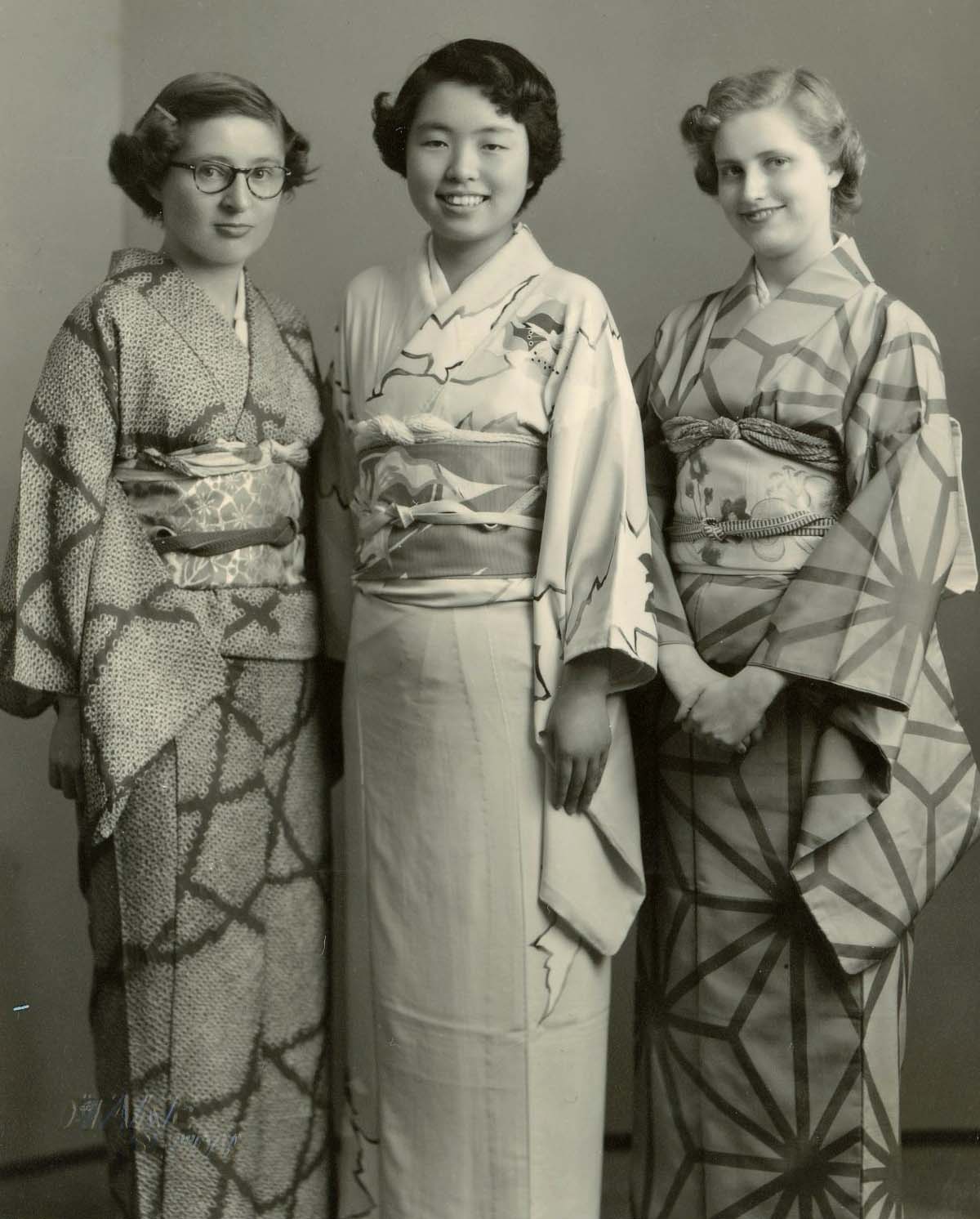
Pat Landis, Ruth Alice Steele, and Janell circa 1950.
Malina:[20:25] Did your family have a strong reaction to your decision to go to Japan?
Janell: My mother was always in favor. It was only after all of those years there, and uh, my father was recovering from illness and I was recovering from, uh, illness. But, I was going to go back to Japan–oh, I think I had some kind of injury and anyway–he was sitting at the table with me and he said ‘I appreciate so much what you are doing,’ and so on. But, I never felt that in the beginning of my career in Japan. My father always was telling me when I’d come home for furlough, “Well, you can work here,” you know. But Mother never did. She always kept with letters and kept me in touch with things at home. So, I never felt any regret and uh, any open hesitation to be accepted. My father, I think, had trouble with it, but he liked his family around him.
Malina: [21:50] Was it already decided where in Japan you would go? Or, why was Sendai chosen?
Janell: Well, that was a historical thing. At that time in Japan, before the war, it was typical for a Presbyterian to go to a Presbyterian area. And uh, it was interesting the history of Protestantism in Japan reflected in the fact that the churches were pretty wise. Sendai was a center where the reformed people–the German Reform people–did missionary work. And so when I went there they still were allowing you to go to something that was historically related to what you were back home in America. And I was part of the German Reform Church back there. And so, I went to a school that in 1850 was founded by the reform church missionaries.
A man from Harrisburg went out there into Sendai, started a boys school with a Japanese Christian and then they found out that just in producing pastors they needed wives for them so they started a girls school in the fall. And he got two young women from Harrisburg area. So that I went there to that school because of my E&R* connection. But, I was in an interim…in the years when Japan um, sending missionaries–you didn’t send them to the school that was connected to your history–your church back home. So, later there were Methodists and other people coming and teaching at the school, but I was fortunate to get into Miyagi just when they were allowing us who were historically connected to that founding.
*Evangelical and Reformed Church
[21:19] But, um, it was a wonderful place and Sendai was a of city about three hundred thousand. But, it was a city that when I’d go downtown, I could meet people that I knew. And then, a lot of the stores there, they sent their daughters to Miyagi to be educated. So I’d walk into a store and they, [high pitched] “Oooooh, that’s, ah, Musame’s teacher!” And then, Musame’s teacher sometimes got discounts too [laughs]. But it was a wonderful place and now it’s a city of a million. And I went back there in 2006 and I’m glad I’m not there now.
Malina [25:10]: How old were you when you arrived?
Janell: In Japan? I was twenty-seven. And I remember having my twenty-eighth birthday on the 28th of August in a Buddhist cemetery having a picnic [laughs]. When you’re born on the first day you can’t ever celebrate [laughs] one year on the first of something, but I had this 28th day of August in Japan.
Photograph of San Francisco, California via Wikimedia Commons. Photograph of Janell and friends circa 1950 and young Janell in traditional Japanese clothing via Janell Landis.
Photograph of San Francisco, California via Wikimedia Commons. Photograph of Janell and friends circa 1950 and young Janell in traditional Japanese clothing via Janell Landis.
This top depicts a sparrow’s nest. According to Hiroi-sensei, sparrows are said to make their homes in bamboo groves. Here we see a stalk of bamboo and a gourd. The sparrow has opened a hole in the gourd to make a nest and pokes his head out from inside.
Below, you’ll find a video of Hiroi-sensei explaining the top, along with transcripts of his explanation.
***
Hiroi Michiaki: And… This is, ahh—the dwelling of the sparrow. Umm, I’m not sure why, but umm, in bamboo groves there are many sparrow nests, um, this gourd, when it hangs down like this, they open a hole in it, and then the sparrow sets up a nest in there. I don’t know how it is in reality, though. (laughs) And that’s the sparrow’s dwelling.
Mrs. Hiroi: From that hole there, [the sparrow’s] mouth pops out, going pi pi pi.
提灯鳴り独楽 (chōchin nari goma)
paper lantern howling top
=====================
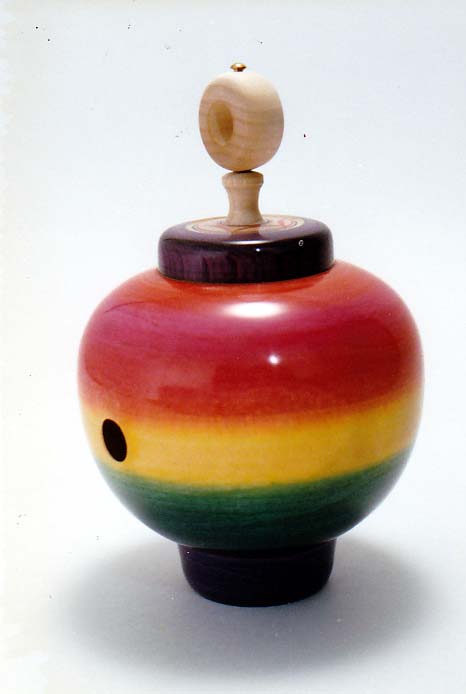
This top is in the shape of a paper lantern. It is a special type of top called nari goma 鳴り独楽, or a “howling top.”
The hole in the side allows air inside, so when it is spun it makes a whistling noise. Click here to see a video of a nari goma being spun.
Below, you’ll find a video of Hiroi-sensei explaining the top, along with transcripts of his explanation.
***
***
Hiroi Michiaki: This is narigoma (howling top), and it’s one where if you spin it, a sound like boouuu comes out. This is one type of howling top– there are many, but this is one, and this is a paper lantern narigoma. It’s a narigoma in the shape of a paper lantern.
The top depicted here is an oikake koma, or “chasing top.” It is designed to have a large, central spinning top around which two discs rotate. The discs are very lightweight and appear to chase one another, sometimes one leaping over the other as they spin. Hiroi-sensei explained that although the traditional “the tortoise and hare” stories are often seen on this type of top, before that, the imagery of a robber being chased by a dog was used, which he has painted here. In the video clip, he tells us about the Japanese image of a robber with a tennugui (a type of cloth) tied around his head.
Below, you’ll find a video of Hiroi-sensei explaining the top in Japanese, along with transcripts of the clip:
***
Hiroi Michiaki: Number two, this is…
Mrs. Hiroi: Chasing…
HM: The thief and the robber, yes.
MH: Yeah, that’s right.
HM: That chasing top you saw before that, um, spun around, that was the hare and the tortoise.
MH: That was the hare and the tortoise this time. But before, it was the thief and the robber.
HM: This, the dog pursues the robber, and the dog overtakes him.
Janell Landis: Sensei, Japanese robbers take the tennugui, and do this…
HM: Ah. That’s right, that’s right.
JL: They do this, that’s drawn there and it’s cute.
HM: A thief’s head-covering, a tennugui doing this…
JL: They hide the face.
MH: Right.
HM: We don’t have a tennugui here do we.
MH: Don’t we? A red one.
JL: That’s alright. It’s… oh. We received tennugui from the hotel.
HM: Like this. The thief, for some reason, [ties it] like this, and does it in this way. (ties tenugui) And ties it here under the nose.
JL: (laughs)
HM: Like this and like this. He does this and enters. And, um he puts the thing he swiped [on his shoulder] like this, and when he runs away the dog barks “Woof woof woof woof!” and when the dog chases him, he panics and runs away, but the dog gets ahead of him.
JL: His tale in Japanese. Robbery.
HM: It’s that sort of, um, playful feeling. The dog overtakes him and everyone claps and is happy [about it]. That sort of thing.







 Carving Community: