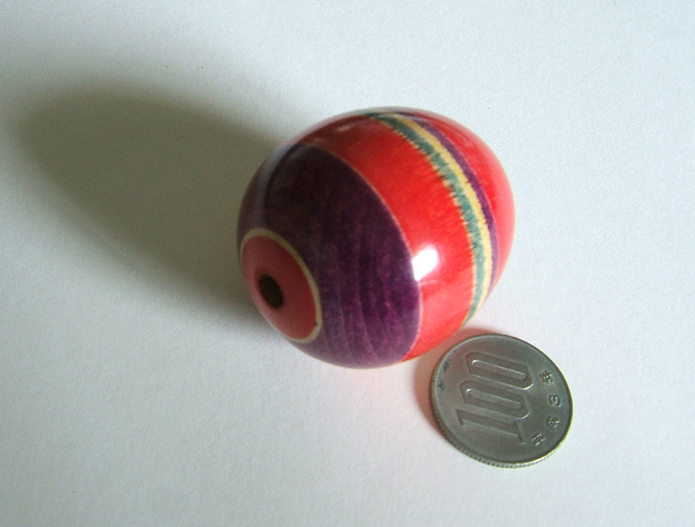
These tops depict a bird with its eggs in a nest. The eggs are red and white, which are traditionally lucky colors. The bird is a type of top called an “unkind” ijiwaru 意地悪 top, because it is especially difficult to spin.
Click to enlarge.
***
***
Hiroi Michiaki: And this is, “nesting,” I think? It’s nesting.
Paula Curtis: It’s the same as this one here.
Hiroi Michiaki: Ahh yeah yeah yeah yeah. This is an egg. Red and white eggs? Ahh, yes, yes, that’s it. And it’s an ijiwaru [unkind]* one.
*[Editor’s note: This is a type of top known as an “unkind” top, because it is especially difficult to spin.]
This is a top in the shape of an egg. When it is spun very hard, it stands up on its tip like a hard-boiled egg.
***
***
Hiroi Michiaki: This is… what is this? Ah, this is that thing that, if you spin it hard, it stands up. There’s not really a name for it, but you do this and spin it sharply, and it stands in the same way a boiled egg stands up.
While Janell was an apprentice to Hiroi-sensei, he encouraged her to produce tops that dealt with themes related to American folk culture and lore that reflected both her background and the art and culture of her new home through traditional Japanese crafts. The photos below show tops Janell made in the 1980s.
This top is a string-release top, which is spun by wrapping a string carefully around the uppermost knob shown in the photo to the right. It is then spun by releasing the top with a sharp toss towards the ground. This string-release top is in the shape of a cat.
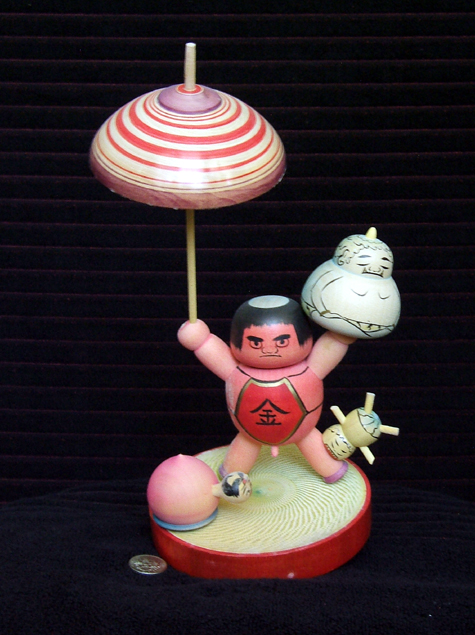
どうだ、金太郎が鬼退治 (dōda, kintarō ga oni taji) How about that! Kintarō Exterminated the Oni
=====================
This top depicts Momotarō, sometimes translated as “The Peach Boy,” or “Peach Tarō,” a legendary figure originating in the Edo period (1600-1868). In many versions of the Momotarō legend, Momotarō is a boy who came to Earth inside a giant peach who is discovered by an elderly couple who then raise him. He later leaves his home to fight a band of demons on a distant island, meeting a talking dog, a monkey, and a pheasant on the way who joint him in his quest. Most versions of the legend end with Momotarō defeating the demons, taking their treasure and their chief captive, and then returning home to live happily ever after with his parents.
It also depicts Kintarō, a semi-legendary figure in Japanese folktales said to be a child born with superhuman strength and great bravery. Here, Hiroi-sensei is playing with the story of the two legendary figures by combining them. Even though it is Momotarō who exterminates the oni (ogres) in folklore, here he shows Kintarō defeating them first, while Momotarō is still in his peach. Momotarō looks disappointed because by the time he emerges to exterminate the oni, Kintarō has already done it, and the oni are biting Kintarō’s leg.
***
***
Hiroi Michiaki: And this, actually it’s Momotaro who goes to exterminate the oni [ogre], but in this top, Kintaro gets there and does it first [while Momotaro is still in the peach]. And the oni are upset and biting onto [Kintaro’s]* legs, and Momotaro sticks his head out of his peach, and looks upset that Kintaro has beat [him to the punch]. And if you spin this, this part spins about. And [Kintaro]* is triumphant. And the oni were exterminated and [Momotaro] is disappointed, and [the oni] children are bitter and biting at [Kintaro]*. And now that it’s Momotaro’s turn [to exterminate the oni and the job is already done] he doesn’t know what to do.
*Hiroi-sensei mistakenly says Momotaro here, but means Kintaro.




 Carving Community: