
タイトル:
小春日 (koharubi)
early autumn day
=====================
穏やかな小春日がテーマの作品。おばあさんが縁側でまどろんでいる猫を撫でながら、うたた寝している。
***
***
廣井道顕:えぇとこれは、これは何だ?小春日かな。
廣井夫人:あぁなんか。
廣井:これはあの、おばあさんが、縁側で、日向ぼっこしるの、猫抱いて。で、うつらうつらとしてっとこ。
タイトル:
小春日 (koharubi)
early autumn day
=====================
穏やかな小春日がテーマの作品。おばあさんが縁側でまどろんでいる猫を撫でながら、うたた寝している。
***
***
廣井道顕:えぇとこれは、これは何だ?小春日かな。
廣井夫人:あぁなんか。
廣井:これはあの、おばあさんが、縁側で、日向ぼっこしるの、猫抱いて。で、うつらうつらとしてっとこ。

Title:
雷さまのたいこつり (kaminarisama no taikotsuri)
the thunder god’s taiko fishing
=====================
This top depicts the thunder god. In this scene, the thunder god has dropped the taiko drum he uses to create the sound of thunder. He leans over the side of a cloud and uses a hook to try to reclaim his fallen drum. When you spin the uppermost top, the thunder god clatters back and forth, having difficulty trying to hook his drum.
***
***
Hiroi Michiaki: And this is the thunder god, it’s called “Raikō’s taiko-drum fishing.” While the thunder god is thumping the taiko drum to sound the thunder, he drops the drum and can’t make thunder anymore. In his haste he tries to fish for his drum from atop a cloud, tries to snag it on the hook. If you spin this, he clatters about and can’t easily ensnare [the drum]. And in the middle of that he stops thundering. It’s that sort of top.

タイトル:
雷さまのたいこつり (kaminarisama no taikotsuri)
the thunder god’s taiko fishing
=====================
雷さまがモチーフの独楽である。雷さまが雷の音を鳴らすために使う太鼓を落としてしまったという場面である。雲の端に身を乗り出し、かぎ針を使って落ちてしまった太鼓を取り戻そうとしている。一番上にある独楽を回すと、雷さまはカタカタと音を立てて前後に揺れるので、太鼓を取り戻すのが難しくなってしまう。
***
***
廣井道顕:で、これがね。これは雷さん、雷公の太鼓釣りっつって、雷さんがあのゴロゴロって鳴らす太鼓叩いてるうちに落っことしちゃって、鳴らなくなっちゃったから、慌てて雲の上からこの太鼓を釣りあげようとして、針で引っ掛けて。でこれ回すとやっぱりこうガタガタして、なかなか引っ掛からない。で雷が、途中で鳴りやんでしまったという、そういう独楽ですね。

Title:
花独楽 (hana koma)
flower tops
=====================
These tops depict a bouquet of flowers. Each blossom is carefully balanced on a wooden stick representing the stem, and can be removed to become a separate top.
***
***
Hiroi Michiaki: And these are tops of flowers. They’re [in that room] over there.
Mrs. Hiroi: Yeah.
タイトル:
花独楽 (hana koma)
flower tops
=====================
花束がモチーフの独楽である。花一つ一つが、花の茎を模した木の棒にバランスよく付けられている。それぞれ外すと独楽になる。
***
***
廣井道顕:で、これは花独楽っつって、あの、そっちにあるよね。
廣井夫人:うん。
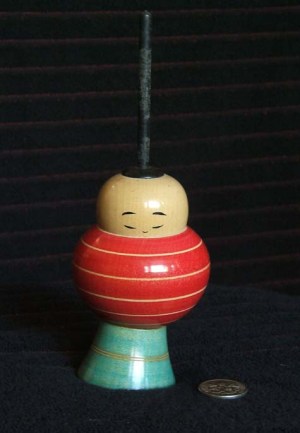
Title:
ナンキンさん (nankinsan)
Nanking-san
=====================
This top depicts a Chinese person with a queue hairstyle, which was traditionally worn by Manchu men and later became a hairstyle imposed on the Han Chinese in the seventeenth century, during the Qing dynasty. Despite its foreign origins, the image of men’s queue hairstyle came to be popularly seen by the West as a quintessentially Chinese. Playing with this stereotypical image, Hiroi-sensei whimsically stands the queue pigtail straight up in the air to become the handle of the top.
***
***
Hiroi Michiaki: Umm what is this. Oh, it’s Nanking-san. Nanking-san is… Long ago Japan greatly respected China, and so Chinese people were called Nanking-san, and so it was like [unintelligible]. That pigtail–in the past Chinese people grew out their hair. This top puts that hair high up into the air, and makes it the handle of the top that spins it.
タイトル:
ナンキンさん (nankinsan)
Nanking-san
=====================
辮髪をした中国人、ナンキンさんがテーマの独楽である。辮髪は元々満州の男性がしていた髪型だが、17世紀 清代の漢民族のイメージを示す髪型となった。外来の文化であるにも関わらず、辮髪のイメージは西洋において典型的な中国人のイメージとして見られるようになった。廣井先生は固定概念とも言えるこのイメージを使い、独楽の軸を辮髪の編んだ髪に見立てて回せるようにした。
***
***
廣井道顕:ううんと、これが何だ、やっぱりナンキンさんか。ナンキンさんってこれは・・・昔の日本はあのう、中国をすごく尊敬してて、だから中国人を、ナンキンさんとかって呼んで。___ある※、みたいな部分で。その、これあの辮髪ってあの中国、昔中国の人髪の毛長く伸ばしてた。それをこう持ちあげて頭のてっぺんにつけて、独楽の芯にして回してる独楽。
(※___の部分は不明瞭で聞き取れず、文字に起こすことができませんでした。)
Title:
後ろの正面 (ushiro no shōmen)
Behind You (Kagome Kagome)
=====================
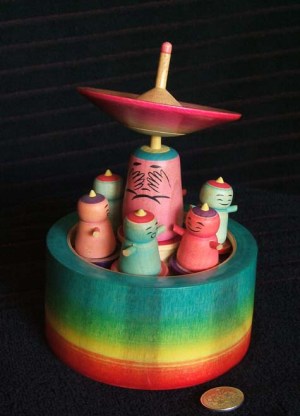
This piece depicts a game called “Behind You” (ushiro no shōmen), also known as Kagome Kagome (bird in the basket/cage). In this popular Japanese children’s game, one person is selected to be the oni (ogre), and must sit with their hands covering their eyes or blindfolded. The other players, who represent human children, hold hands and circle around the oni player, singing:
The bird in the basket/cage, (Kagome Kagome)
When, oh when will it come out
In the night of dawn
The crane and turtle slipped
Who is behind you now?
When the song ends, the oni player must guess who is standing directly behind them. Hiroi-sensei plays with the image of the oni in the middle; instead of showing an oni surrounded by human children, he represents all the players as oni, with the figure in the middle as a large parent oni being circled by its children. When you spin the top above the central oni, it makes the oni below move and spin.
***
***
Hiroi Michiaki: And this… ahh, this is called “Behind You,”* that “It’s Behind You!” children-
Mrs. Hiroi: Children play it.
Hiroi: —play it; it’s a type of game from long ago. You pick someone to be an oni (ogre) [in the middle], and the oni’s children are playing [around them]. And the oni parent covers their eyes, and if you spin this, the oni spins around and around, and this turns while it spins. And while singing you do it like this, and an older girl says, “Who’s behind you?!” and everyone suddenly stops. And the oni will name who’s in front of them, like “It’s so-and-so!” and the others go “You got it! [Or] you’re wrong!” It’s a children’s game. I’ve made them oni, so, it’s not the normal children [in the game, where only the one in the middle is an oni], but [now] an oni and oni children.
タイトル:
後ろの正面 (ushiro no shōmen)
Behind You (Kagome Kagome)
=====================
後ろの正面という遊びがテーマの独楽である。後ろの正面はかごめかごめ(籠の中の鳥)の歌でも知られている。日本で大衆的な子供の遊び歌で、一人が鬼になり、手か布で目隠しをしてしゃがむ。他の者は人間の子供という設定で、お互いの手を取って輪になり鬼の周りを回りながら歌を歌う。
かごめかごめ
かごの中の鳥は いついつ出会う
夜明けの晩に
鶴と亀がすべった
後ろの正面だあれ?
歌が終わった時、鬼は自分の真後ろに誰が立っているのか当てなければならない。鬼は本来、中心に一人だけなのだが、廣井先生は周りの子供たちを鬼に変え、中心の鬼を子鬼に囲まれている大きな親鬼にした。中心の親鬼の上にある独楽を回すと、下にある鬼が動き、回るようにできている。
***
***
廣井道顕:でこれが、あぁ、後ろの正面って言われた、あの『後ろの正面だあれ』ってあの、子供達が―
廣井夫人:子供遊ぶのね。
廣井:遊ぶ、昔の遊び方なんですけど。それを鬼に作って、鬼の子供が遊んでるんですね。で親の鬼が目隠しして、で、これ回すとこの鬼が回をりグルグルこう、回りながら回る。でなんか歌を歌いながらこうやって、こうお姉さんがこう、後ろの正面だあれってピタッと止まって「何とかちゃん」ってこう当てて「当たった!はずれた」って言って遊ぶ。子供の遊びですね。それを鬼、だからこれを普通の子供でなくて鬼にして、鬼の子供にして。

In this post, Janell describes how her gift for impersonation and desire to entertain led to her meeting Hiroi in Sendai.
===
Janell Landis: You see, it all comes down to my puppets. And you haven’t gotten–[47:27]
Malina Suity [47:30] I was going to ask you about your puppets. You mentioned working with puppets in America, as well. When did you start–
Janell [47:45] Well I started when my brother went–and my family–I was working in the summer camp, cooking, and helping to clean up and stuff. And my brother and sister and my mother and father went to New York City to visit my older sister who was working for Exxon, or Esso at that time, in the Rockefeller Center area. In the basement there, in one of those malls, he found little monkey puppets. And so he bought two and he gave me one. And that’s what started me with the puppetry. That was back in, hmm, ‘40– see, I graduated from college in ‘48, and this was before college. So around ‘45, ‘46 I started. I used to do imitations and impersonations.
One time I heard on the radio, Fred Waring had one [a comedy bit] where you push buttons and change the stations and then you get a funny connection. And I had a routine using spoons pushing the button and going from one to the other and I had ZaSu Pitts and Bette Davis and roosters and all kinds of stuff.
So that was what started me, and then, when I got the puppet I started with puppets then. And I have them [still], they’re getting ready, I’m going to have a little show coming up next month. But, I have them separated as to the ones that I started with, and then, when I was in Japan I met a wonderful woman who was really creative and she made me twenty-four puppets. Rabbits, and a bear, and an octopus. All kinds.


Malina [49:50] What was her name?
Janell [49:51] Her name was Michii Sato. And she’s gone now, but she was a wonderful friend. One of the teachers at Miyagi, Mr. Ishii, he was a teacher of Japanese and at one time the head of his department there too. He introduced me to her when I first went to Sendai after language study. And she made me a grandma and a grandpa, wonderful puppets uh, and started with that.
And when I was on a TV show for a year, teaching homemakers English with Mrs. Amano’s help, uh, I had three other puppets she made me. A boy and a girl and a mother. And after every show, thirty minute show, at the close we would review what we went through with these puppets so the children would talk to their mother and answer. So, then I was asked by a man in our church in America if I could use puppets and do a Sunday school program, you know for a yearly program, but anyway at that time Michii Sato made me twenty four puppets. And I never got to use them to make that.
***
Malina [55:45]: And you mentioned doing a TV show? How did you get into that?
Janell: That was through the man that later, after that, he’s the one that got into contact with my top teacher. But when I was teaching at Miyagi in the college, I would have juniors and seniors taking a course, not compulsory. What’s the word I’m searching for? A course that elect–you elect. This one–that year I had a woman named uh, what was her name before marriage? After she graduated from Miyagi she married Mr. Amano who was working for the TBS radio and television station. And um, they asked me, they asked me to have this program for housewives. It was half an hour everyday, Monday through Friday, and Amano-san’s wife, my former student, was my associate. She would use the Japanese to translate and I would always be speaking in English. And she could use English too. So, it was funny, they asked me…they set, up until they set a date and then I thought I was finished, but um, they wanted to keep it on. And I had only gotten permission for one year from my school representative. I said, I couldn’t continue that program more than one year. But the way they had said it sounded, to them it sounded, like forever, but to me it sounded like the end.
It was at that time then, that Amano-san, Mr. Amano, and his associate at TBS asked me to do this program for New Year’s with Mr. Hiroi the top maker. And that was 1981, we taped it and then it was broadcast on the 3rd of January 1982. And then I was accepted by Mr. Hiroi as an apprentice. And from that time I worked first in his home on the lathe, and then he got me in contact with a man who made a lathe for me.
Jan’s Cultural References:
See ZaSu Pitts in action: view a video of her singing “Your Mother!” in 1934’s RKO Sing and Like It.
See Bette Davis in one of her iconic roles, as Julie in William Wyler’s 1938 Jezebel, a Warner Brothers film.
Listen to Fred Waring introduce the song “Buckle Down, Winsocki” from the musical Best Foot Forward on Command Performance in 1942, right around the time Jan would have been listening.
 Carving Community: