金の字やじろべー (kin no ji yajirobee)
“kin” character balancing toy
=====================
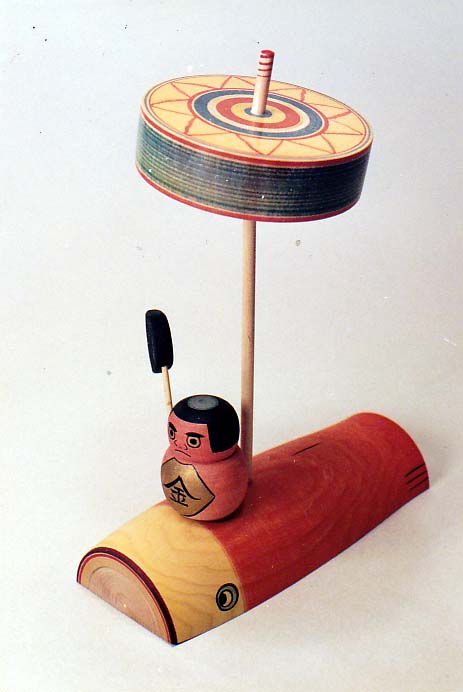
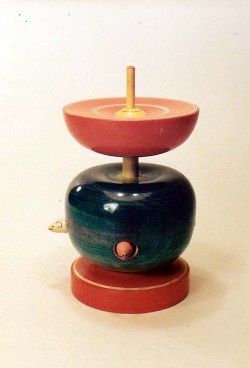
This top is a a yajirobee, a kind of balancing toy. Hiroi-sensei uses the natural shape of yajirobee toys to cleverly form the shape of the character 金 (kin), meaning “gold” or “money.”
***
***
Mrs. Hiroi: Mm. This is a kin character balancing toy.
Hiroi Michiaki: This is called a kin character balancing toy. If you look at this, it [appears in the shape of] kin, the kin character in kanji. [Meaning] gold.
Janell Landis: Gold.
Hiroi: Yeah. It looks like the kin kanji. There’s a reason for it. Because [the balancing toy already] looks like the character kin.
Mrs. Hiroi: That…
Hiroi: [You write it like] this, this, this, this, this, this, this [demonstrating strokes of the character]. The kin character balancing toy.
蛸の当独楽 (tako no ategoma)
octopus roulette-style top
=====================
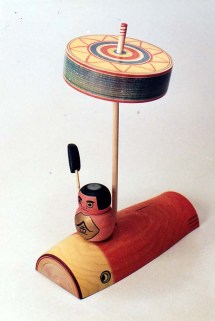
This is a roulette-style top, which is a kind of game. Someone spins the top in the middle, in this case an octopus, and the handle of the top lands on a particular picture. Although the connection between the various images you can land on is not clear, Hiroi-sensei explains that because the octopus hates mice, that is the losing image on the wheel. The best image one can get to win is the Palace of the Dragon King, the mythic palace of the Japanese dragon god who keeps magic jewels that can control the tides.
***
***
Hiroi Michiaki: This is an octopus roulette-style top, and it falls over like this. And underneath, [it lands on a picture of] a crab, a mouse; this the Palace of the Dragon King. If you land on the Palace of the Dragon King it’s a big win. The mouse is… I think it must be that the octopus hates mice, so that’s a losing spot. The top is this sort of game.
かぼちゃ喰いねずみ (kabocha kui nezumi)
kabocha-eating mouse
=====================
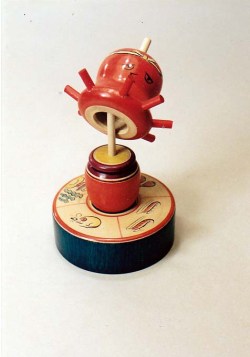
This top depicts four mice that have nested inside of a kabocha (an Asian variety of winter squash). Each mouse faces a cardinal direction and is painted the color associated with that direction based on Chinese traditions sometimes seen in Japan. South is red, west is white, north is black, and east is green.
***
***
Hiroi Michiaki: And this is…
Mrs. Hiroi: The kabocha-eating mouse.
Hiroi: It’s called the kabocha-eating mouse. This also happens to be something that’s good luck.
Mrs. Hiroi: When you spin it, the [mouse] pops its head out from the kabocha.
Hiroi: Inside the kabocha, the mouse is inside building a nest. When you spin it, all these different mice poke their faces in and out of it from the four directions. And this red mouse, red is for the south, so [he’s facing] south. And yellow, yellow is… is this yellow or white?
Mrs. Hiroi: It’s white.
Hiroi: But it looks like it’s yellow.
Mrs. Hiroi: It’s not yellow, it’s white.
Hiroi: It must be white. White is west, isn’t it…
Mrs. Hiroi: Yeah, that’s right.
Hiroi: These, these are colors indicating the four directions.
金魚とふぐつり独楽 (kingyo to fugu tsurigoma) goldfish and puffer fish string-release top
=====================
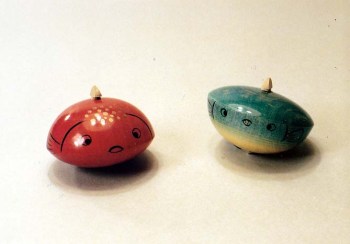
These tops depict a puffer fish and a goldfish. They are both tsurigoma, or string-release tops, which are spun by wrapping a string carefully around the top as shown in the photo to the right. They are then spun by releasing the top with a sharp toss towards the ground.
***
***
Hiroi Michiaki: And this is a string-release top… It’s a puffer fish and a goldfish.
This week we have a small update to our content. Five new top images have been added to the “Collection” section of the site! Thank you for all your support!

 Carving Community: