We’ve started a Twitter feed to help spread the word about the Carving Community project! You can follow us there at https://twitter.com/CarvingComm to receive automatic updates to your feed about our newest posts! 🙂 See you there!
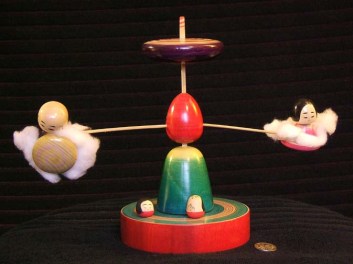
Kume no sennin (literally, The Immortal Kume) is a legendary figure popularly depicted in Edo period (1603-1868) paintings. According to a tale from Konjaku monogatari (a collection of tales written in the late Heian period [794-1185]), Kume no sennin, having learned the skills of the immortals in the mountains, was flying over the Yoshino River one day when he spotted a young woman washing laundry. So struck with passion at the sight of her beautiful, pale legs, his powers failed him and he fell to the ground before her. She later became his wife. Most images of Kume no sennin show him tumbling to the ground from a cloud before the woman, and so for this top Hiroi-sensei also depicts him on his cloud in the sky.
***
***
Hiroi Michiaki: Umm. This is Kume no Sennin.
Mrs. Hiroi: Yeah.
Hiroi: Kume no Sennin, long ago… This is Kume no Sennin. Ah, this one. Wait…. yes. This one. He was an immortal (sennin) and rode on a cloud. Mmm, he was a person who lived up in the mountains, like a monk. He also loved young women, and when he was going about up on his cloud, two young women were doing their laundry in a stream. And he peeked at them from up on his cloud and he fell, you see, to the ground. He was an immortal and he died because he fell to the earth. It’s that sort of, what should you call it– a cautionary tale. It’s a top that tells the story of how that sort of thing is bad.
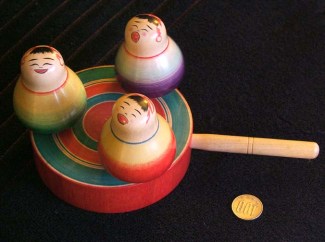
This top depicts three young priests gazing up at the rain. When you hold the handle of the base, you are supposed to pick which of the three priest tops you want to move, focus on it, and then carefully jiggle the base back and forth until you get only that one top to spin.
***
***
Hiroi Michiaki: And these are young priests in the rain.
Mrs. Hiroi: Yeah.
Hiroi: The young priests in the rain, for some reason, if you spin it one by one they rotate about.
This top depicts Kuzunoha, a popular figure in Japanese folklore who is a female magic kitsune (fox). In traditional legends, kitsune are said to be able to shapeshift into human figures. In various tales, Kuzunoha is said to be the mother of the famous historical figure Abe no Seimei (921-1005), a well-known expert in Japanese esoteric cosmology (onmyōdō).
『新形三十六怪撰』
There are many variations on the Kuzunoha story, but in its simplest form, the courtier Abe no Yasuna battles and is injured by a hunter who is capturing foxes to sell their livers to make medicine. Freeing a fox (Kuzunoha) trapped by the hunter, Yasuna later encounters a beautiful woman (Kuzunoha in human form) who tends to his wounds and helps him home. They fall in love, are married, and eventually have Abe no Seimei. But several years later, Seimei glimpses his mother’s tail (or in some stories, sees her shadow against a screen in the form of a fox). With her true nature revealed, she must leave her family behind and return to the wild.
***
***
Hiroi Michiaki: And this is… Kuzunoha, I think?
Mrs. Hiroi: Yeah. It’s Kuzunoha.
Hiroi: And, if you spin this, this fox leaps out. All of the sudden. Stories about Kuzunoha, there are a lot of sad ones, but here it would be a little hard to explain them, so [I won’t]. Heh heh heh…
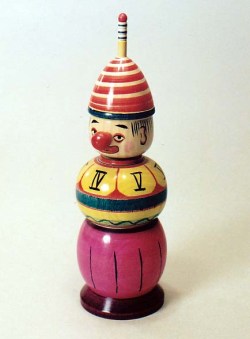
This top is a roulette-style top of a clown. Ategoma-style tops are used for games. When the handle is spun, the clown’s head spins with it, and its nose points to one of the six numbers. Hiroi-sensei notes that Janell taught him how to write the Roman numerals for this top.
***
***
Mrs. Hiroi: This is like what you saw before…
Hiroi Michiaki: This is, well, it’s a clown.
Mrs. Hiroi: Yes, it’s a clown.
Hiroi: The way you write these numbers, Landis-sensei taught it to me.




 Carving Community: