This top depicts a bush warbler and plum blossom. The theme of “bush warbler in the plum blossoms” is found extensively in Japanese artistic traditions, including both poetry and art. Both bush warblers and plum blossoms are considered symbols of the arrival of spring, poems about which appear as early as Japan’s oldest extant collection of poetry, the Man’yōshū (Collection of Ten Thousand Leaves), dating from the mid-eighth century. Although traditionally the bush warbler and plum blossom are paired together, in reality, people often spot the Japanese white-eye bird (mejiro, Zosterops japonicus), among plum blossoms in early spring, which looks markedly similar. As a matter of fact, Hiroi-sensei originally wrote “梅と目白 (plum and Japanese white-eye) on the top labels, but during his interview declared the top of a bush warbler. We amended the top title to reflect his interview content.
***
***
Hiroi Michiaki: Umm. This is–
Mrs. Hiroi: This is, oh, a whistle.
Hiroi: No this is different, it’s a howling top of a bush warbler on a plum blossom.
Mrs. Hiroi: So the bush warbler spins.
Hiroi: It’s a howling top.
Mrs. Hiroi: Eh? It’s not a whistle top?
Hiroi: No, no. This is, umm… ah, I know. Yeah. You wrap the string here, and if you hold this bush warbler and pull it, this is a top that makes a pooouu noise. It’s in the shape of a plum blossom, a bush warbler on a plum blossom.
Mrs. Hiroi: Yeah, the bottom is a plum blossom. Plum.
This top depicts sparrows in winter. As Hiroi-sensei describes, when the weather gets cold, the sparrows fluff up their feathers to stay warm, giving them a plump appearance. The word plump (fukura) is written with two characters, 福 (fuku – luck) and 良 (ra – good), and so the plump sparrow is said to be good luck. When this top is spun, it makes a cheeping sound like a little sparrow.
***
***
Hiroi Michiaki: This is–
Mrs. Hiroi: A sparrow.
Hiroi: It’s called a plump (fukura) sparrow.
Mrs. Hiroi: It’s said to have luck (fuku).
Hiroi: In the winter, often sparrows will fluff out because it’s cold. And that’s called a “plump sparrow,” and in kanji it’s written with 福 (fuku – luck) and 良 (ra – good), so it’s fukura. Umm and of course it’s said to be good luck. And this, when you spin it like this, somehow a sound like it’s singing comes out. A little noise. It goes chi-chi-chi-chi, chi-chi-chi-chi. How the noise comes out even I, who made it, don’t know. In any case, it makes a noise. It’s a faint little voice. And sparrows, they’re always in bamboo for some reason. Because it’s the sparrows’ home. The sparrows at my home nest in the roof tiles though.
Mrs. Hiroi: In the roof tiles.
Hiroi: Well, they don’t offer us any baskets. If they did, I’d only get a small one, though. Because the big ones are scary. Hahaha.*
This top is an abstract depiction of a tanuki, a kind of Japanese raccoon dog. Tanuki are significant figures in Japanese folklore, often appearing in stories as shapeshifting mischief-makers. In nature, male tanuki have unusually large testicles, which are often humorously depicted oversized in Japanese art, sometimes slung over the tanuki’s shoulder like a backpack or being used as drums. For this top, Hiroi-sensei has created a yajirobee, a kind of balancing toy, using the tanuki’s testicles as the balances.
***
***
Hiroi Michiaki: This is a tanuki.
Mrs. Hiroi: Yeah.
Hiroi: How much should I… he’s hard to explain, huh. Hahahaha. In old [stories, the tanuki’s testicles] were really big. Hahaha. [The top] becomes a balancing toy (yajirobee). This is pretty funny.
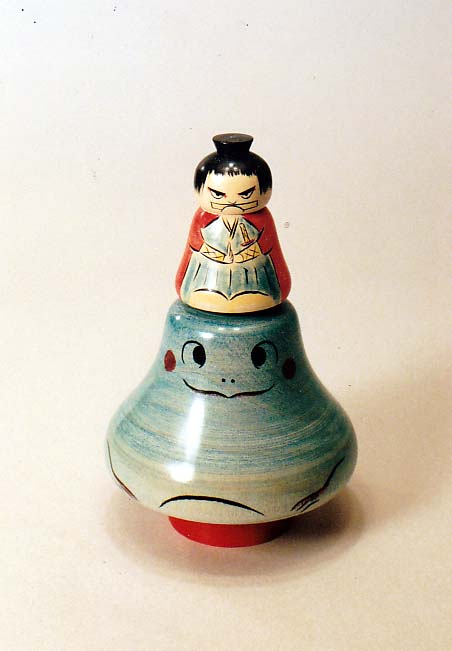
Jiraiya is a legendary character from the nineteenth-century tale Jiraiya Gōketsu Monogatari (児雷也豪傑物語, “The Tale of the Gallant Jiraiya”). He is often depicted riding or shapeshifting into a giant toad, and is popularly considered to be a folkloric ninja. Jiraiya has been adapted in various pop-culture forms from the nineteenth century to the present day, including novels, kabuki, film, and video games.
***
***
Hiroi Michiaki: This one is called Jiraiya, and he’s a legendary ninja. He’s Jiraiya and a ninja and he rides on top of this toad. He does this and that as a ninja does. Truthfully, smoke comes out from here and he dashes off somewhere, that kind of thing. And if you spin this part, the toad, I think it must spin straight and then spin around and around like this.


 Carving Community: