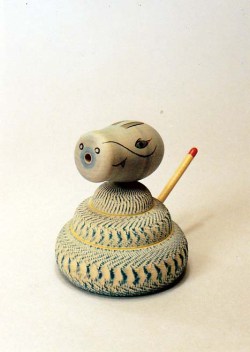
タイトル:
辰 (tatsu)
dragon
=====================
辰がテーマの独楽。日本の干支、辰年の記念に制作した独楽である。インタビューの中で、このテーマがコレクションの一つである『片目の鯉』という作品に関連するものであることに言及している。『片目の鯉』は天に昇り竜になることを夢見た鯉の話がテーマの作品である。
***
***
廣井道顕:これは辰年の竜。これになりたかった、鯉ね。これがね。へへへ。分かる?説明。へへへ。半分以上分かんないね。へへへ。
タイトル:
辰 (tatsu)
dragon
=====================
辰がテーマの独楽。日本の干支、辰年の記念に制作した独楽である。インタビューの中で、このテーマがコレクションの一つである『片目の鯉』という作品に関連するものであることに言及している。『片目の鯉』は天に昇り竜になることを夢見た鯉の話がテーマの作品である。
***
***
廣井道顕:これは辰年の竜。これになりたかった、鯉ね。これがね。へへへ。分かる?説明。へへへ。半分以上分かんないね。へへへ。

Title:
片目の鯉 (katame no koi)
one-eyed koi
=====================
This top depicts a one-eyed koi. According to Hiroi-sensei, this image comes from a tale about a giant koi (nearly 2 meters, or 6.5 feet) that lived in the moat of the imperial palace. The story goes that the fish wanted desperately to become a dragon, and one day, because the rainfall was so heavy, he thought he could make it up to the heavens by riding the rain. But in the end, he couldn’t reach heaven, and as he fell back down, he crashed into the guardrail of a bridge and lost his eye. Hiroi-sensei thinks it might be a story originating from the Edo period (1600-1868).
***
***
Hiroi Michiaki: And this is another [top] with an interesting story, called the “one-eyed koi.” If you spin this, it gets wrapped around here and the fish rises up to the top.
Mrs. Hiroi: Yeah, it goes around and around and around.
Hiroi: And this, long ago, um… the Imperial Palace, the place where the Emperor lives, in the moat there, there was a koi that lived in it that was about six shaku long, so about 2 meters. And… there was a story that the koi, he wanted to ascend to the heavens and become a dragon, right? And one day, there was really heavy rainfall, so at the time he thought “Ahh, I can make it up to heaven if it’s like this!” and he tried to ascend. But he couldn’t make it and he fell, and he smashed up one of his eyes on the guardrail. So he was the one-eyed koi. I heard from my father that the fish lived up until recently. Hahahahaha. And so I made that. I don’t know when the story is from, though. Probably from the Edo period. I think it’s probably a story from around where Tokugawa Ieyasu built Edo castle.
タイトル:
片目の鯉 (katame no koi)
one-eyed koi
=====================
片目の鯉の独楽である。廣井先生の話によれば、皇居のお堀に住んでいた(2メートル/6フィート半もの)巨大な鯉の逸話が独楽のテーマの基である。あるとき、竜になりたいと強く願っていた鯉が、激しい夕立のあった日に、この雨なら天に昇ることができると考えた。しかし、最終的に鯉は天に昇ることができず、途中で空から落ち、橋の欄干に当たって片目を失ってしまう。廣井先生は江戸時代(1600~1868年)からの話ではないかと考えている。
***
***
廣井道顕:で、これはまた面白い謂れがあって、片目の鯉っていうんですけど。これ回すとね、ここに絡んで、この鯉が上に上がってくるのね。
廣井夫人:うん、ぐるぐるぐるぐるとね。
廣井:でこれはね、昔、あのう・・・皇居、あの天皇陛下がいる所の、あそこの堀に、昔六尺のっていうから大体2メートルくらいの大っきな鯉がいたんだって。であのう・・・それが、あの、鯉ほら、天に昇ると竜になるって謂れがあるよね?であるとき、ものすごい夕立があったから、あったときに、こんなら天に昇れるなと思って、でこう、昇ろうとしたんだって。ところが昇りきれなくて、落っこって、橋の欄干で片目潰れてしまったって。で、片目の鯉で。で、それがつい最近まで居たんだって、親父に聞いたんだけどね。はははははは・・・。で、それを作ったんですね。いつからの話だかはよく分らないんですけど。多分江戸時代、徳川家康が江戸城を造った辺りの話だと思うんですけどね。

Title:
釣鐘とび出し (tsurigane tobidashi)
leaping out of the bell
=====================
This top is a type known as a “leaping top” and it depicts a bell. When it is spun, small tops appear to leap out of it from the inside.
***
***
Hiroi Michiaki: This is called a leaping top.
Mrs. Hiroi: That’s a leaping top.
Hiroi: If you spin it, a teeny top suddenly jumps out of the middle. It jumps right out. Did Maeda-kun make one of those yesterday?
Mrs. Hiroi: Yeah he did.
Hiroi: Why don’t we show you afterwards?
タイトル:
釣鐘とび出し (tsurigane tobidashi)
leaping out of the bell
=====================
釣鐘がテーマのとび独楽という種類の独楽である。独楽を回すと、中から小さな独楽がとびだす仕掛けになっている。
***
***
廣井道顕:これはとび独楽っていって
廣井夫人:それとび独楽。
廣井:回すと中からこのちっちゃい独楽がポンと出てくる。ポンポンと。あれ前田くんきのう作ってたっけ?
夫人:作ってた。
廣井:後で見せてもらったら?

Title:
梅と鶯 (ume to uguisu)
plum and bush warbler
=====================
This top depicts a bush warbler and plum blossom. The theme of “bush warbler in the plum blossoms” is found extensively in Japanese artistic traditions, including both poetry and art. Both bush warblers and plum blossoms are considered symbols of the arrival of spring, poems about which appear as early as Japan’s oldest extant collection of poetry, the Man’yōshū (Collection of Ten Thousand Leaves), dating from the mid-eighth century. Although traditionally the bush warbler and plum blossom are paired together, in reality, people often spot the Japanese white-eye bird (mejiro, Zosterops japonicus), among plum blossoms in early spring, which looks markedly similar. As a matter of fact, Hiroi-sensei originally wrote “梅と目白 (plum and Japanese white-eye) on the top labels, but during his interview declared the top of a bush warbler. We amended the top title to reflect his interview content.
***
***
Hiroi Michiaki: Umm. This is–
Mrs. Hiroi: This is, oh, a whistle.
Hiroi: No this is different, it’s a howling top of a bush warbler on a plum blossom.
Mrs. Hiroi: So the bush warbler spins.
Hiroi: It’s a howling top.
Mrs. Hiroi: Eh? It’s not a whistle top?
Hiroi: No, no. This is, umm… ah, I know. Yeah. You wrap the string here, and if you hold this bush warbler and pull it, this is a top that makes a pooouu noise. It’s in the shape of a plum blossom, a bush warbler on a plum blossom.
Mrs. Hiroi: Yeah, the bottom is a plum blossom. Plum.
タイトル:
梅と鶯 (ume to uguisu)
plum blossom and bush warbler
=====================
梅と鶯がテーマの独楽である。「梅の花に鶯」というのは日本芸術の中でも伝統的なテーマであり、詩歌から美術品を含め広範囲にわたって登場する。鶯と梅の花、両方とも春の訪れを告げるシンボルである。現存する日本最古の和歌とされる万葉集の中で、八世紀半ばごろの作品から登場する。鶯と梅の花が一緒に登場するのが伝統的ではあるものの、現実的には目白が梅の花と共に初春のシンボルとして注目される。実際に、廣井先生も元々「梅と目白」と題名を書いていたが、インタビューの中で鶯の独楽であると話している。インタビューの内容をもとに独楽のタイトルをこちらで訂正した。
***
***
廣井道顕:ええと。これは―
廣井夫人:これ、ほら、笛、ふふ
廣井:これ違うさ、梅に鶯の、鳴り独楽だ。
夫人:だから鶯の回るの。
廣井:鳴り独楽だ。
夫人:んー?笛独楽でねぇの?
廣井:違う違う。これが…ああと…あぁ、そうだ、うん。ここに糸巻いて、この鶯持ってこう引っ張ると、これがポオオっと鳴る独楽なんだね。で梅の形で、梅に鶯。
夫人:うん。下は梅、梅だな。

Title:
福良すずめ (fukura suzume)
“plump sparrows”
=====================
This top depicts sparrows in winter. As Hiroi-sensei describes, when the weather gets cold, the sparrows fluff up their feathers to stay warm, giving them a plump appearance. The word plump (fukura) is written with two characters, 福 (fuku – luck) and 良 (ra – good), and so the plump sparrow is said to be good luck. When this top is spun, it makes a cheeping sound like a little sparrow.
***
***
Hiroi Michiaki: This is–
Mrs. Hiroi: A sparrow.
Hiroi: It’s called a plump (fukura) sparrow.
Mrs. Hiroi: It’s said to have luck (fuku).
Hiroi: In the winter, often sparrows will fluff out because it’s cold. And that’s called a “plump sparrow,” and in kanji it’s written with 福 (fuku – luck) and 良 (ra – good), so it’s fukura. Umm and of course it’s said to be good luck. And this, when you spin it like this, somehow a sound like it’s singing comes out. A little noise. It goes chi-chi-chi-chi, chi-chi-chi-chi. How the noise comes out even I, who made it, don’t know. In any case, it makes a noise. It’s a faint little voice. And sparrows, they’re always in bamboo for some reason. Because it’s the sparrows’ home. The sparrows at my home nest in the roof tiles though.
Mrs. Hiroi: In the roof tiles.
Hiroi: Well, they don’t offer us any baskets. If they did, I’d only get a small one, though. Because the big ones are scary. Hahaha.*
*Here, Hiroi-sensei is making a reference to the story of the “The Old Woman Who Cut the Sparrow’s Tongue.”
タイトル:
福良すずめ (fukura suzume)
“plump sparrows”
=====================
冬の福良すずめをデザインした独楽。廣井先生のお話によると、寒い時期になるとすずめは防寒対策のため羽の間に空気を入れて膨らませ、まん丸とした姿になるという。『膨ら(ふくら)』が良い意味合いの『福』と『良』という漢字に置き換えられ、縁起がいいものの一つとされている。独楽を回すと、小さなすずめが鳴いているような、チチチチチと音を出す。
***
***
廣井道顕:で、これがね。
廣井夫人:雀。
廣井:福良雀って言って。
夫人:あの、福があるっていう。
廣井:冬、よく雀あのう寒いからこう膨らんでいるんですよね、雀ね。で、それをあのう福良雀って言って、漢字で書くと「福」が「良い」って書いて福良雀って言うの。であのう、やっぱり縁起がいいっていうことで。でこれは、こう回すとね、なんか、鳴いているような音が出るのね。小さくね。チチチチ、チチチチって。どういうわけで音が出るんだかは作った本人にも分らないんだけど。とにかく音が出るの。かすかにね、小さなって声で。で、雀は、なんか竹なんだね。雀のお宿だから。うちの雀は竹でなく、瓦に巣くってたけどね。
夫人:瓦に。
廣井:つづらくんねぇな、やっぱ。今度、くれたら小さいのもらうけど。大きいのおっかないから。へへへ。*
*ここでは『舌切り雀のおばあさん』の物語に出てくる内容を交えて話している

Title:
たんたん狸 (tan tan tanuki)
“a balanced tanuki”
=====================
This top is an abstract depiction of a tanuki, a kind of Japanese raccoon dog. Tanuki are significant figures in Japanese folklore, often appearing in stories as shapeshifting mischief-makers. In nature, male tanuki have unusually large testicles, which are often humorously depicted oversized in Japanese art, sometimes slung over the tanuki’s shoulder like a backpack or being used as drums. For this top, Hiroi-sensei has created a yajirobee, a kind of balancing toy, using the tanuki’s testicles as the balances.
***
***
Hiroi Michiaki: This is a tanuki.
Mrs. Hiroi: Yeah.
Hiroi: How much should I… he’s hard to explain, huh. Hahahaha. In old [stories, the tanuki’s testicles] were really big. Hahaha. [The top] becomes a balancing toy (yajirobee). This is pretty funny.
 Carving Community: