Tag Archives: top

河童の水汲み (kappa no mizukumi)

Click to enlarge.
Click to enlarge.

Title:

河童の水汲み (kappa no mizukumi)
kappa drawing water

=====================

This top depicts a kappa. Kappa are yōkai (supernatural creatures) from traditional Japanese folklore. Kappa are typically depicted as somewhat humanoid and the size of a child, although sometimes they can appear more like birds or turtles. They are said to live in rivers and ponds, where they cause mischief, occasionally kidnapping or drowning people or animals. Sometimes they are depicted as balancing a bowl or plate of water on their heads, which is a technique they use to travel outside of their watery homes. Even today, some areas of Japan will have signs near rivers warning people about kappa. Kappa may also be considered friendly or helpful, helping humans with water-related tasks like irrigation or fishing. Each part of this figure can be removed and turns into a separate top. This top features kappa drawing water out into gourds.

***

***

Hiroi Michiaki:  This is… What is this? Kappa drawing water? The kappa are drawing water out into gourds. When you spin this, it totters around like this. They look like they’re playing.
河童の水汲み

Click to enlarge.
Click to enlarge.

タイトル:

河童の水汲み (kappa no mizukumi)
kappa drawing water

=====================

河童とがテーマの独楽。河童は日本の伝統的な民間伝承に出てくる妖怪(日本の化け物、非科学的な存在)である。河童は人間のような姿をしており、大きさは子どもと同じ程度、しかし時に鳥や亀のような姿をしていることもある。川や池に住んでいると言われ、そこでいたずらをしたり、時には人や動物をさらったり溺れさせたりもする。頭に水の入った器や皿をのせている姿で描かれるが、河童が水中から外の世界に出ることができるのはこの皿や器があるからである。今日でさえ、河童についての注意書きが川の近くに立てられていることがある。河童は友好的、頼る存在として考えられることもある。かんがいや魚釣りなど水に関係することに関して人間の手助けをする。パーツを取り外すと、それぞれが独楽になり回すことができる。ひょうたんで水を汲む河童の姿が表現されている。

***

***

廣井道顕:これがこれが何だ。河童の水汲みか。河童がこの瓢箪に水を汲んでるところ。これ回すとやっぱりこう、ふらふら動いてね。なんか遊んでるように見える。

奴道中 (attendant on the road)

Click to enlarge.
Click to enlarge.

Title:

奴道中 (yakko dōchū)
attendant on the road

=====================

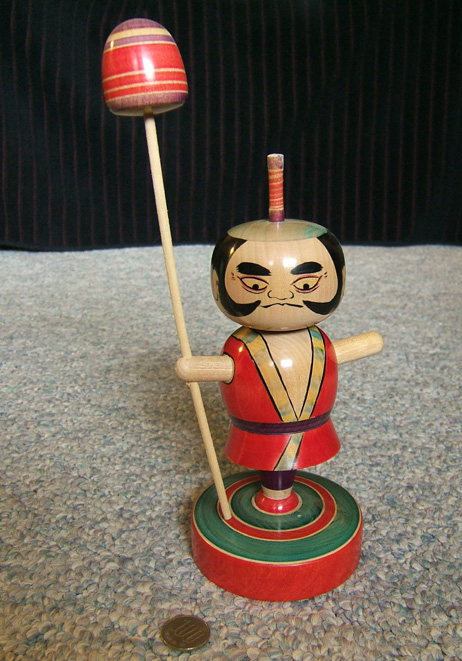
This top depicts a samurai attendant. During the Edo Period (1600-1868), daimyō (military lords) were required to travel to the capital of Edo (modern day Tokyo) on alternating years to reside there. Travel across the country took place in long processions of the daimyō and their retainers and servants. These processions were a point of pride for each individual province and local ruler, and could include as many as several thousand men. At the forefront of these processions were bannermen, who carried spears or flags, and called out for commoners to clear a path for the daimyō’s party to move through the road. Here, Hiroi-sensei has made a top of one of these bannermen.  

***

***

Hiroi Michiaki: And this is a samurai attendant. In the past, there were daimyō (military lord) processions; there was a practice called sankin kōtai [in which daimyō travelled on alternating years to do a year-long residence in Edo [Tokyo]]. For example the processions even went all the way from Sendai to Edo. And after some years they’d turn around and come back. At that time, the person in the very front of the line, the attendant, carried a spear, and while calling out something out loud he’d walk like this. [This top] shows this. The attendant on the road. At the very front of the daimyō procession.

奴道中

Click to enlarge.
Click to enlarge.

タイトル:

奴道中 (yakko dōchū)
attendant on the road

=====================

奴さんの独楽。江戸時代(1600-1868年)、大名は参勤交代のために江戸(現在の東京)に住むことが義務付けられていたので、江戸まで旅をしなければならなかった。家臣や家来を引き連れて大名行列をなし国々をまたいで旅をした。それぞれの国や地主の誇りに関わる大事だったので、数千人を動員することもあった。大名行列の先頭には旗や槍を持つ旗持ちがおり、大名のために道を開けるように庶民に掛け声をかける。廣井先生はこの旗持ちを独楽で作った。

***

***

廣井道顕:で、これはやっこさん。で昔あの、大名行列ってあの、参勤交代でみな江戸に、ま例えば仙台入るのもね、江戸まで。何年かにいっぺん行ってて。その時にはあの、行列の一番先頭でやっこさんがこう槍持って来て、なんか声かけながら、こうやって歩く。それを表してるんですけど。やっこ道中。大名行列の一番前ですね

だるま (daruma)

Click to enlarge.
Click to enlarge.

Title:

だるま (daruma)
daruma

=====================

This work depicts a daruma. A daruma is a traditional Japanese doll whose figure is based on the Bodhidharma, the founder of the Zen sect of Buddhism. Daruma are often depicted in this roundish shape because of a legend that the Bodhidharma stared at a wall in intense meditation for nine years, until both his arms and legs fell off. Daruma are traditionally depicted in red, but can appear in various colors with different meanings. They are considered good luck figures.

***

[no video/commentary]

***

だるま

Click to enlarge.
Click to enlarge.

タイトル:

だるま (daruma)
daruma

=====================

だるまがテーマの独楽。だるまは伝統的な日本の人形で、そのモデルになっているのは仏教禅宗の開祖とされている菩提達磨である。だるまがよく丸い形で表現されるのは、菩提達磨が壁を見つめて座禅を九年もの間 続けたので腕と脚が取れてしまったという伝説から来ている。だるまの伝統的な色は赤であるが、他の色もあり、色によってそれぞれ意味もある。どの色も幸運のシンボルとして考えられている。

***

[ビデオなし]

***

桃太郎 (Momotarō)

Click to enlarge.
Click to enlarge.

Title:

桃太郎 (momotarō)
Momotarō

=====================

This top depicts Momotarō, sometimes translated as “The Peach Boy,” or “Peach Tarō,” a legendary figure originating in the Edo period (1600-1868). In many versions of the Momotarō legend, Momotarō is a boy who came to Earth inside a giant peach who is discovered by an elderly couple who then raise him. He later leaves his home to fight a band of demons on a distant island, meeting a talking dog, a monkey, and a pheasant on the way who joint him in his quest. Most versions of the legend end with Momotarō defeating the demons, taking their treasure and their chief captive, and then returning home to live happily ever after with his parents.

***

***

Hiroi Michiaki: And this is, did this one have two faces? He’s facing backwards, and there’s another [face] in the front. This is Momotarō on the back, too. And he’s carrying dango (dumplings). Ahh, there it is, there it is. He’s carrying dango, Momotarō, too. And this is the back of the oni. I think the front is in here somewhere, too. This the reverse side of Momotarō.


桃太郎

Click to enlarge.
Click to enlarge.

タイトル:

桃太郎 (momotarō)
Momotarō

=====================

江戸時代(1600-1868年)が起源の伝説上のキャラクター、桃太郎を表現した独楽である。桃太郎の伝説には様々な種類の話があるが、どの話でも桃太郎は巨大な桃から生まれ、桃を見つけた老夫婦に育てられている。後に遠くの島にいる鬼を退治するために家を離れ、その道中で出会った話しのできる犬、猿、キジを鬼退治の仲間に引き入れる。どの話でも桃太郎が鬼を倒し、鬼の親玉を捕らえ、宝を持ち帰って育ての親である老夫婦と幸せに暮らすという終わり方をしている。

***

***

廣井道顕:そんでこれが、これ確か裏表あるんだっけ。こいつ後ろ向いてっけど。前もあるんだね。これ桃太郎も後ろ。確か団子しょってる、ああ、あるある。団子しょってるんだね。あぁこっちが後ろだね、桃太郎もね。で、あ、これ鬼の後ろで。ううん、正面もどっかにあるはずだね。これ桃太郎の裏表

桃太郎 (Momotarō)

Click to enlarge.
Click to enlarge.

Title:

桃太郎 (momotarō)
Momotarō

=====================

This top depicts Momotarō, sometimes translated as “The Peach Boy,” or “Peach Tarō,” a legendary figure originating in the Edo period (1600-1868). In many versions of the Momotarō legend, Momotarō is a boy who came to Earth inside a giant peach who is discovered by an elderly couple who then raise him. He later leaves his home to fight a band of demons on a distant island, meeting a talking dog, a monkey, and a pheasant on the way who joint him in his quest. Most versions of the legend end with Momotarō defeating the demons, taking their treasure and their chief captive, and then returning home to live happily ever after with his parents.

***

***

Hiroi Michiaki: And this is, did this one have two faces? He’s facing backwards, and there’s another [face] in the front. This is Momotarō on the back, too. And he’s carrying dango (dumplings). Ahh, there it is, there it is. He’s carrying dango, Momotarō, too. And this is the back of the oni. I think the front is in here somewhere, too. This the reverse side of Momotarō.


桃太郎

Click to enlarge.
Click to enlarge.

タイトル:

桃太郎 (momotarō)
Momotarō

=====================

江戸時代(1600-1868年)が起源の伝説上のキャラクター、桃太郎を表現した独楽である。桃太郎の伝説には様々な種類の話があるが、どの話でも桃太郎は巨大な桃から生まれ、桃を見つけた老夫婦に育てられている。後に遠くの島にいる鬼を退治するために家を離れ、その道中で出会った話しのできる犬、猿、キジを鬼退治の仲間に引き入れる。どの話でも桃太郎が鬼を倒し、鬼の親玉を捕らえ、宝を持ち帰って育ての親である老夫婦と幸せに暮らすという終わり方をしている。

***

***

廣井道顕:そんでこれが、これ確か裏表あるんだっけ。こいつ後ろ向いてっけど。前もあるんだね。これ桃太郎も後ろ。確か団子しょってる、ああ、あるある。団子しょってるんだね。あぁこっちが後ろだね、桃太郎もね。で、あ、これ鬼の後ろで。ううん、正面もどっかにあるはずだね。これ桃太郎の裏表。