These tops depict a bouquet of flowers. Each blossom is carefully balanced on a wooden stick representing the stem, and can be removed to become a separate top.
***
***
Hiroi Michiaki: And these are tops of flowers. They’re [in that room] over there.
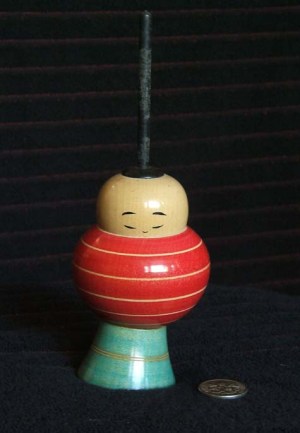
This top depicts a Chinese person with a queue hairstyle, which was traditionally worn by Manchu men and later became a hairstyle imposed on the Han Chinese in the seventeenth century, during the Qing dynasty. Despite its foreign origins, the image of men’s queue hairstyle came to be popularly seen by the West as a quintessentially Chinese. Playing with this stereotypical image, Hiroi-sensei whimsically stands the queue pigtail straight up in the air to become the handle of the top.
***
***
Hiroi Michiaki: Umm what is this. Oh, it’s Nanking-san. Nanking-san is… Long ago Japan greatly respected China, and so Chinese people were called Nanking-san, and so it was like [unintelligible]. That pigtail–in the past Chinese people grew out their hair. This top puts that hair high up into the air, and makes it the handle of the top that spins it.
後ろの正面 (ushiro no shōmen) Behind You (Kagome Kagome)
=====================
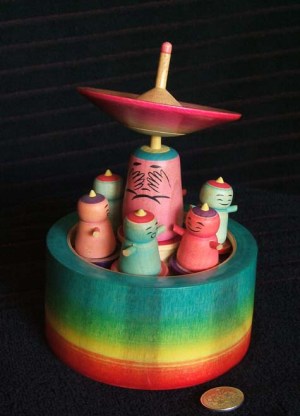
This piece depicts a game called “Behind You” (ushiro no shōmen), also known as Kagome Kagome(bird in the basket/cage). In this popular Japanese children’s game, one person is selected to be the oni (ogre), and must sit with their hands covering their eyes or blindfolded. The other players, who represent human children, hold hands and circle around the oni player, singing:
The bird in the basket/cage, (Kagome Kagome)
When, oh when will it come out In the night of dawn The crane and turtle slipped Who is behind you now?
When the song ends, the oni player must guess who is standing directly behind them. Hiroi-sensei plays with the image of the oni in the middle; instead of showing an oni surrounded by human children, he represents all the players as oni, with the figure in the middle as a large parent oni being circled by its children. When you spin the top above the central oni, it makes the oni below move and spin.
***
***
Hiroi Michiaki: And this… ahh, this is called “Behind You,”* that “It’s Behind You!” children-
Mrs. Hiroi: Children play it.
Hiroi: —play it; it’s a type of game from long ago. You pick someone to be an oni (ogre) [in the middle], and the oni’s children are playing [around them]. And the oni parent covers their eyes, and if you spin this, the oni spins around and around, and this turns while it spins. And while singing you do it like this, and an older girl says, “Who’s behind you?!” and everyone suddenly stops. And the oni will name who’s in front of them, like “It’s so-and-so!” and the others go “You got it! [Or] you’re wrong!” It’s a children’s game. I’ve made them oni, so, it’s not the normal children [in the game, where only the one in the middle is an oni], but [now] an oni and oni children.
This work depicts a daruma. A daruma is a traditional Japanese doll whose figure is based on the Bodhidharma, the founder of the Zen sect of Buddhism. Daruma are often depicted in this roundish shape because of a legend that the Bodhidharma stared at a wall in intense meditation for nine years, until both his arms and legs fell off. Daruma are traditionally depicted in red, but can appear in various colors with different meanings. They are considered good luck figures.


 Carving Community: