These tops depict a kappa and a cucumber. Kappa are yōkai (supernatural creatures) from traditional Japanese folklore. Kappa are typically depicted as somewhat humanoid and the size of a child, although sometimes they can appear more like birds or turtles. They are said to live in rivers and ponds, where they cause mischief, occasionally kidnapping or drowning people or animals. Sometimes they are depicted as balancing a bowl or plate of water on their heads, which is a technique they supposedly use to travel outside of their watery homes. Even today, some areas of Japan will have signs near rivers warning people about kappa. Kappa may also be considered friendly or helpful, helping humans with water-related tasks like irrigation or fishing. Each part of this figure can be removed and turns into a separate top.
***
***
Hiroi Michiaki: And this is a kappa.
Janell Landis: Kappa.
Paula Curtis: Ahh.
Hiroi: Yeah. Kappa, kappa in legend are living things [as opposed to ghosts or spirits], you know. They live in water, so they’re good luck against fire. And if you unfasten all of these [parts] they become tops.
This top depicts a cautionary folktale of a cruel, rich man who picked on others. On a summer day, he decides to spy on a hard-working maidservant, Otake, who is bathing in the garden. But when he peeps at her, she transforms, revealing she is actually the bodhisattva Kannon (sometimes called the bodhisattva of compassion or goddess of mercy). She had transformed into the maidservant to teach him a lesson about being cruel to others, admonishing him that to do ill would bring about punishment from the deities. After that encounter, the rich man reforms and does only good.
***
***
Hiroi Michiaki: Is this Otake’s Bath? This one also has many different tales. Umm in the old days there was an ill-mannered man… uhh, of course, a rich man. He was really rich, but he was nasty, and he picked on poor people. And in his manor, this jochūbōkō (女中奉公)… what would she be called today… in other words a servant… umm… a maid. Named Otake. Umm… nowadays she’d be called a maid. Should I call her that? What should I call her so it’s easiest to understand. A maid, in other words.
Janell Landis: A maid. Yeah, yeah.
Hiroi: And she was the most–her rank was the lowest, and she worked hard. And when it was hot in the summer Otake-san was bathing in the garden when the cruel rich man came to peep at her. And when that happened, Otake-san, she was actually Kannon-sama, a bodhisattva? The bodhisattva Kannon. She had taken the form of the maidservant to admonish him. And to teach him that being cruel to others was bad, she came down specifically for that and bathed where she could be seen. And when he arrived at the place [where she was bathing] she turned [back into] the bodhisattva Kannon. And admonished him that if you do something bad, you’ll incur divine punishment from the gods. The story of Otake-san’s bath tells of that rich man reforming and doing good [after that].
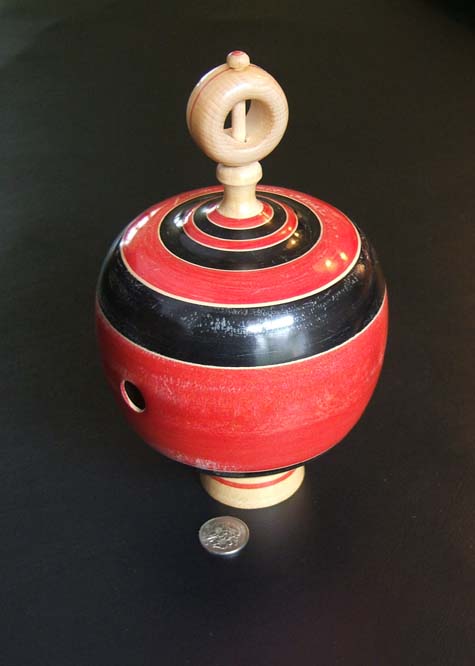
This top is a special type of top called narigoma (鳴り独楽), or a “howling top.” The hole in the side allows air inside, so when it is spun it makes a whistling noise. Click here to see a video of a narigoma being spun.
***
***
[commentary is embedded along with the previous top’s commentary]
Hiroi Michiaki: Umm this is…
Paula Curtis: It’s a dance, right?
Hiroi: It’s a night festival. If you spin it, inside it [looks like] they’re dancing. This is a paper lantern. Actually this is a howling top. A noise comes out of it.
Janell Landis: He made it for me.
Hiroi: Mm… Newton-san really liked night festivals. And later, he came even after Landis-sensei was gone, and, and what was it? He bought a number [of tops]. And one of them couldn’t move properly and he came all the way here, and I remember fixing it for him.
This top depicts a night festival. When it is spun, the little figures at the center of the base look as if they are dancing. Hiroi-sensei also comments on the next top in the collection, which is a howling top (narigoma) that whistles when spun.
***
***
Hiroi Michiaki: Umm this is…
Paula Curtis: It’s a dance, right?
Hiroi: It’s a night festival. If you spin it, inside it [looks like] they’re dancing. This is a paper lantern. Actually this is a howling top. A noise comes out of it.
Janell Landis: He made it for me.
Hiroi: Mm… Newton-san really liked night festivals. And later, he came even after Landis-sensei was gone, and, and what was it? He bought a number [of tops]. And one of them couldn’t move properly and he came all the way here, and I remember fixing it for him.
花咲ぢいさん (hanazaka jiisan) The Old Man Who Made the Dead Trees Blossom
=====================
This piece depicts the folktale “The Old Man Who Made the Dead Trees Blossom.” There are many versions of the story. One is that an old couple loved their dog dearly, and one day the dog dug up gold in their garden. An envious neighbor, thinking the dog must be able to sniff out treasure, stole the dog and had it dig in his own garden. But when the dog only dug up bones, he killed it and told the couple it had died naturally.
The old couple buried the dog under the fig tree where it had dug up the treasure, and that night the old man had a dream the dog told him to chop down the tree and use it to make a mortar for pounding mochi. He did so, and the rice they put into the mortar turned into gold. The neighbor also saw this and took the mortar, but the rice he put inside turned to dirt instead, so his wife burned the mortar and destroyed it. That evening, the dog returned to his master in a dream and told him to sprinkle the ashes of the mortar on nearby cherry trees. The old man did so, and the trees bloomed, and a passing daimyo (military lord) who saw them praised the old man and showered him with gifts. When the neighbor jealously tried to sprinkle the ashes as well, they blew into the daimyo’s eyes, and the daimyo threw the neighbor into prison. When he was released, he was banished from his village and had nowhere to live.
***
***
Hiroi Michiaki: And what is this? Ahh! The Old Man Who Made the Dead Trees Blossom. Hm? The Old Man Who Made the Dead Trees Blossom?
Mrs. Hiroi: Yeah, it’s that.
Hiroi: Mm. Yeah. It’s The Old Man Who Made the Dead Trees Blossom.
Mrs. Hiroi: It spins around and around. If you spin it from the top.
Hiroi: Ummm, this is The Old Man Who Made the Dead Trees Blossom. When [the old man] saved an adorable dog, as thanks, um… it barked for him to dig [in this spot], and when he dug there large and small gold coins came out. And later, when he was pounding mochi, I think the mochi turned to gold. It turned to gold. And the wicked old man next door felt bitter towards him. So he burned the mortar and mallet [for pounding mochi]. And the [first] old man took the ashes and scattered them and flowers bloomed from the withered trees there. And he was praised by his local lord. It’s an old legend… that goes like that.




 Carving Community: