This top depicts Momotarō, sometimes translated as “The Peach Boy,” or “Peach Tarō,” a legendary figure originating in the Edo period (1600-1868). In many versions of the Momotarō legend, Momotarō is a boy who came to Earth inside a giant peach who is discovered by an elderly couple who then raise him. He later leaves his home to fight a band of demons on a distant island, meeting a talking dog, a monkey, and a pheasant on the way who joint him in his quest. Most versions of the legend end with Momotarō defeating the demons, taking their treasure and their chief captive, and then returning home to live happily ever after with his parents.
***
***
Hiroi Michiaki: And this is, did this one have two faces? He’s facing backwards, and there’s another [face] in the front. This is Momotarō on the back, too. And he’s carrying dango (dumplings). Ahh, there it is, there it is. He’s carrying dango, Momotarō, too. And this is the back of the oni. I think the front is in here somewhere, too. This the reverse side of Momotarō.
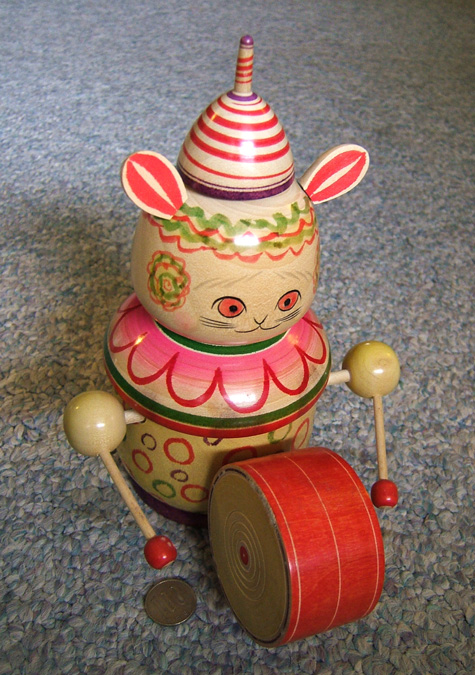
This top depicts a rabbit dressed as a clown beating a drum. It is called “rabbit antics” because of the whimsical image of a rabbit pretending to be a clown. Hiroi-sensei made it in honor of the year of the rabbit.
***
***
Hiroi Michiaki: This is called “rabbit antics.” I made it in the year of the rabbit, so I made it a rabbit. The hands move in this kind of way. The hands are moving back and forth. When you spin this. Though really what the “rabbit antics” are is the rabbit is dressed as a clown.
This top depicts an oni from the Momotarō legend, which originates from the Edo period (1600-1868). Oni are a kind of supernatural monster from Japanese folklore, often translated as “demon” or “ogre.” In many versions of the Momotarō legend, Momotarō, who is a boy who came to Earth inside a giant peach, later leaves the home of the elderly couple who raised him to fight a band of demons on a distant island. Most versions of the legend end with Momotarō defeating the demons and living happily ever after with his parents.
***
***
Hiroi Michiaki: This is an oni and Momotarō. I think there was another one that goes with this.
鬼の念仏 (oni no nenbutsu) oni nenbutsu (ogre’s prayer)
=====================
This top depicts an oni saying the nenbutsu prayer. Oni are a kind of supernatural monster from Japanese folklore, often translated as “demon” or “ogre.” The nenbutsu (念仏) is a type of prayer, common to Pure Land Buddhism, that generally refers to a repetition of the Amida Buddha’s name as a private devotional practice. For this top, Hiroi-sensei has depicted a reformed oni in a priest’s outfit saying the nenbutsu and striking a drum as he reads a sutra (a Buddhist scripture).
***
***
Hiroi Michiaki: Umm. Ah, this is the “oni’s [ogre’s] prayer” (oninenbutsu). The oni has reformed and he’s saying the nenbutsu. While he’s reading a sutra. This part moves like this, as if the hands are striking a drum.
This top depicts a maneki neko (beckoning cat). A maneki neko is a cat figurine often placed at the entrance of shops, restaurants, and other businesses to bring good fortune. The cat holds up one paw, either the right or the left, depending on what kind of luck it beckons in. Typically, the right paw indicates good luck and wealth, while the left invites in customers, although interpretations differ by area. Some maneki neko have both paws raised or feature different colors. Maneki neko also often feature gold coins called koban (小判) around their necks or in their hand, which were currency used during the Edo period (1600-1868) in Japan.
***
***
Hiroi Michiaki: This is a maneki neko (beckoning cat). And it’s raising its right paw. If their right paws are raised, it’s [beckoning] money [to come to you]. If it’s the left paw, it’s inviting people. And this one has the right, so it’s inviting money. Ahh, there’s money placed with it [in the photograph]. Heh heh heh. Long ago, if it was in Edo [contemporary Tokyo], the left paw up [meant money], and if you went to Kansai, it was the right. But nowadays the left is for money and the right is for people. Sometimes both are raised, though. But you shouldn’t do that. Heh heh heh. Because it’s a catch 22, wanting both money and people and raising both hands.




 Carving Community: