タイトル:
卵 (tamago)
egg
=====================
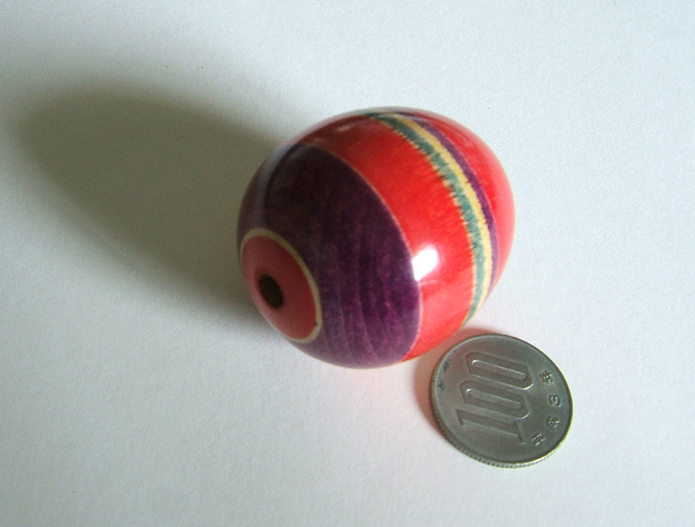
卵の形をした独楽。強く回すと、ゆで卵のように、卵の先端で立って回り出す。
***
***
廣井道顕:うんとあとこっちは…これは何だ。あぁ、これはあれだ、ピっと回すとこう、立つんだ。名前は特にないけど、こうやってやってピって回ってあの、卵、ゆで卵がこう立つのと同じ。
タイトル:
卵 (tamago)
egg
=====================
卵の形をした独楽。強く回すと、ゆで卵のように、卵の先端で立って回り出す。
***
***
廣井道顕:うんとあとこっちは…これは何だ。あぁ、これはあれだ、ピっと回すとこう、立つんだ。名前は特にないけど、こうやってやってピって回ってあの、卵、ゆで卵がこう立つのと同じ。

Title:
猫つり (neko tsuri)
cat string-release top
=====================
This top is a string-release top, which is spun by wrapping a string carefully around the uppermost knob shown in the photo to the right. It is then spun by releasing the top with a sharp toss towards the ground. This string-release top is in the shape of a cat.
***
***
[no commentary]
タイトル:
猫つり (neko tsuri)
cat string-release top
=====================
つり独楽という種類の独楽である。右の写真にある、独楽の一番上にあるつまみの部分に丁寧に紐を巻いて独楽を回す。独楽を素早く床に放すことで回すことができる。このつり独楽は猫の形をしている。
***
[ヴィデオなし]
***
[解説なし]
Title:
どうだ、金太郎が鬼退治 (dōda, kintarō ga oni taji)
How about that! Kintarō Exterminated the Oni
=====================
This top depicts Momotarō, sometimes translated as “The Peach Boy,” or “Peach Tarō,” a legendary figure originating in the Edo period (1600-1868). In many versions of the Momotarō legend, Momotarō is a boy who came to Earth inside a giant peach who is discovered by an elderly couple who then raise him. He later leaves his home to fight a band of demons on a distant island, meeting a talking dog, a monkey, and a pheasant on the way who joint him in his quest. Most versions of the legend end with Momotarō defeating the demons, taking their treasure and their chief captive, and then returning home to live happily ever after with his parents.
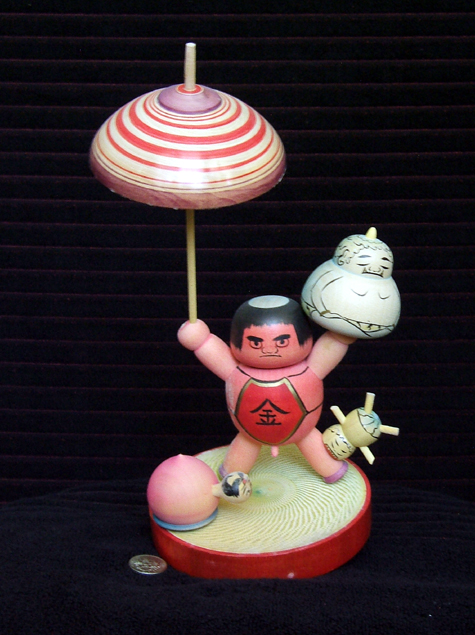
It also depicts Kintarō, a semi-legendary figure in Japanese folktales said to be a child born with superhuman strength and great bravery. Here, Hiroi-sensei is playing with the story of the two legendary figures by combining them. Even though it is Momotarō who exterminates the oni (ogres) in folklore, here he shows Kintarō defeating them first, while Momotarō is still in his peach. Momotarō looks disappointed because by the time he emerges to exterminate the oni, Kintarō has already done it, and the oni are biting Kintarō’s leg.
***
***
Hiroi Michiaki: And this, actually it’s Momotaro who goes to exterminate the oni [ogre], but in this top, Kintaro gets there and does it first [while Momotaro is still in the peach]. And the oni are upset and biting onto [Kintaro’s]* legs, and Momotaro sticks his head out of his peach, and looks upset that Kintaro has beat [him to the punch]. And if you spin this, this part spins about. And [Kintaro]* is triumphant. And the oni were exterminated and [Momotaro] is disappointed, and [the oni] children are bitter and biting at [Kintaro]*. And now that it’s Momotaro’s turn [to exterminate the oni and the job is already done] he doesn’t know what to do.
*Hiroi-sensei mistakenly says Momotaro here, but means Kintaro.
タイトル:
どうだ、金太郎が鬼退治 (dōda, kintarō ga oni taji)
How about that! Kintarō Exterminated the Oni
=====================
江戸時代(1600-1868年)が起源の伝説上のキャラクター、桃太郎を表現した独楽である。桃太郎の伝説には様々な種類の話があるが、どの話でも桃太郎は巨大な桃から生まれ、桃を見つけた老夫婦に育てられている。後に遠くの島にいる鬼を退治するために家を離れ、その道中で出会った話しのできる犬、猿、キジを鬼退治の仲間に引き入れる。どの話でも桃太郎が鬼を倒し、鬼の親玉を捕らえ、宝を持ち帰って育ての親である老夫婦と幸せに暮らすという終わり方をしている。
この作品では金太郎も登場する。金太郎は超人的な力と勇気を兼ね備えて生まれたとされる伝説的な人物として日本の民話で語り継がれている。廣井先生は伝説的なキャラクターとその物語を掛け合わせて作品を作った。鬼退治をするのは本来なら桃太郎であるが、この作品では桃太郎が桃の中にいる間に、金太郎が鬼を退治してしまっている。桃太郎は自分が鬼を倒そうと思い桃から出てきたが、金太郎が先に鬼を退治してしまっており、残念そうにしている。鬼も金太郎の脚に噛みついている。
***
***
廣井道顕:でこれはね、ほんとは桃太郎が鬼退治に行くんだけどその前に桃太郎の前に金太郎が鬼を退治してしまった。と鬼の側は悔しくなって桃太郎*の足にかぶりついてるし、桃太郎は桃の中から首出して、こりゃ参ったっていうような顔をして。でこれ回すとやっぱりこうグルグルグルって回って。桃太郎*が得意なってると。で鬼退治されてがっかりして、子供が悔しがって噛みついてるし。桃太郎出番がなくて困ってるの。

Title:
うん (un)
un
=====================
This top depicts Momotarō, sometimes translated as “The Peach Boy,” or “Peach Tarō,” a legendary figure originating in the Edo period (1600-1868). In many versions of the Momotarō legend, Momotarō is a boy who came to Earth inside a giant peach who is discovered by an elderly couple who then raise him. He later leaves his home to fight a band of demons on a distant island, meeting a talking dog, a monkey, and a pheasant on the way who joint him in his quest. Most versions of the legend end with Momotarō defeating the demons, taking their treasure and their chief captive, and then returning home to live happily ever after with his parents.
In this top, Momotarō is very nervous to go fight the demons and has to go to the bathroom. He’s trying very hard to go and looks like he is going to wet himself. If you spin it properly the bottom drops out. There is a play on words with the title “un,” which sounds like a person struggling to go to the bathroom, and the character un 運, which means “luck,” so this is also called an unkoma or “luck top.”
***
***
Hiroi Michiaki: This is an interesting one. It’s Momotaro and I think there’s another one around here somewhere that has an oni (ogre). Umm, there was one with an oni earlier and it has an interesting story. There’s no oni on this one, I think. Huh? I think there was an oni. Somewhere. Ahh, it’s different than the oni.
This is from before Momotaro goes to the island of demons to exterminate them. Before that he’s extremely nervous and has to go to the bathroom. Heh heh heh. He’s trying really hard. If you spin it, it plops from the bottom. It will come out of ones that are made well. You spin it. In Japan, if you do that, it’s good luck. It’s called an unkoma 運独楽 (luck top). It’s said you’re spinning luck. And another [meaning here] is that the next time there’s an oni battle, Momotaro is coming to fight them, and he’s nervous and feels like he’s going to wet himself, and [the top] rattles about like this like he’s going to [pee himself]. I think the oni [top] is somewhere in here.
タイトル:
うん (un)
un
=====================
江戸時代(1600-1868年)が起源の伝説上のキャラクター、桃太郎を表現した独楽である。桃太郎の伝説には様々な種類の話があるが、どの話でも桃太郎は巨大な桃から生まれ、桃を見つけた老夫婦に育てられている。後に遠くの島にいる鬼を退治するために家を離れ、その道中で出会った話しのできる犬、猿、キジを鬼退治の仲間に引き入れる。どの話でも桃太郎が鬼を倒し、鬼の親玉を捕らえ、宝を持ち帰って育ての親である老夫婦と幸せに暮らすという終わり方をしている。
この独楽は、鬼退治に行く桃太郎がとても緊張してしまい、お手洗いに行かなければならなくなった姿を表現している。一生懸命に頑張っているが、今にもおもらししてしまいそうな姿である。この独楽をちゃんと回すことができると、独楽の下の部分が外れる。独楽の題名である『うん』は洒落になっている。お手洗いで力んで頑張っている時に出す『うーん』という声と、幸運の運をかけた言葉遊びで、うん(運)独楽としている。
***
***
廣井道顕:これが面白いんだ。これが、桃太郎でもう一つね、どこかにあると思うんだけど。鬼があるんですけど。うんと…先に鬼があると話が面白いんだよな。こっちに鬼なかったかな。あれ鬼あったよな。どっかにな。あぁ、この鬼とは違うな。
これはね。桃太郎が鬼が島へ鬼退治にに行く、前の。前であの、緊張のあまり、トイレに行きたくなってる。へへへ。このとき、頑張ってるのね。回すと、この下からポトンと。形の良いのが出てくる。で回るのね。で日本の場合、そうすると、縁起がいいんです。運独楽つってね。うんが回るっていうことで。でもう一つね、鬼の方が、今度せめ、桃太郎が攻めてくるっていうんで、ビビって、おしっこもらしそうなって、こうやってバタバタしてるのと組みなんです。その、そっちの方の鬼がまだこっちにあるのかな。

Title:
いざり入道 (izari nyūdō)
Izari nyūdō
=====================
This top depicts an obake (monster) named Izari nyūdō. When this top is spun, the monster appears to walk menacingly toward you. The word izaru いざる, from which the name of the top comes, means “to shuffle/crawl.” Nyūdō 入道 is a term often used for monks. In folklore, a large number of supernatural creatures appear to be monks before they transform into their monster selves, leading to this term often being used for various types of obake.
***
***
Hiroi Michiaki: Umm, this is actually an obake (monster). It’s called Izari nyūdō. This one has an interesting way of moving. If you spin it, it goes like this and this and this, like it’s walking, and the monster seems to come at you.
タイトル:
いざり入道 (izari nyūdō)
Izari nyūdō
=====================
お化けのいざり入道がテーマの独楽である。独楽を回すと、お化けの入道が自分に向かってくるように回る。「いざる」という言葉は引きずって歩く、腹ばいで歩く・進む、という意味の言葉から来ている。入道は僧侶に使われる言葉である。民話の中で、僧侶が妖怪となる話が多くあり、そのため僧侶に関連するような言葉がさまざまなお化けの名前に使われるようになったと考えられる。
***
***
廣井道顕:ううん、これはね、やっぱりお化けだね。いざり入道っつって。これが面白い動きするのね。こう回すとこう、こういうふうに、こういうふうに、こういうふうに、こう、歩くような形で、お化けだどーって出てくる感じ。

Title:
だるま (daruma)
daruma
=====================
This work depicts a daruma. A daruma is a traditional Japanese doll whose figure is based on the Bodhidharma, the founder of the Zen sect of Buddhism. Daruma are often depicted in this roundish shape because of a legend that the Bodhidharma stared at a wall in intense meditation for nine years, until both his arms and legs fell off. Daruma are traditionally depicted in red, but can appear in various colors with different meanings. They are considered good luck figures.
This particular top is a type of top known as a “headstand” (sakadachi 逆立ち) top. When spun fast enough it flips upside down and spins on the tip of its handle.
***
***
Hiroi Michiaki: This is a daruma, but I think there’s probably something inside of it.
Janell Landis: It’s a headstand [top].*
*[Editor: A type of top that when spun fast enough flips upside down and spins on the tip of its handle]
Hiroi: There’s something inside, right? Something–
Janell: A string. It has a big head, and–
Hiroi: It spins.
Janell: It’s a headstand top.
Hiroi: Oh really? Ahh, it does stand on its head.
Janell: It’s one of the last ones I got from him.
Hiroi: Ohh that might be so. This form [of top].
Janell: Yeah. You use it by putting the head down and putting this on, and you pull the string.
Hiroi: The image on [his stomach] reads kaiun (welcoming good fortune).
Janell: It’s a nice one.
 Carving Community: