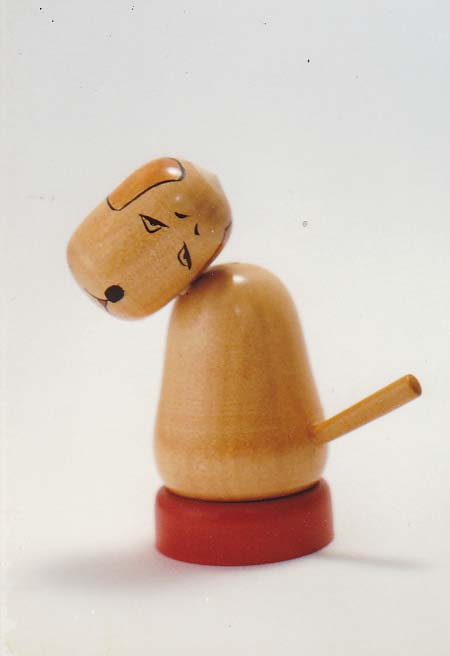
This top depicts a wild boar. Wild boar are often found in the mountains of Japan. When the top is spun, the boar below taps its feet as if digging its hooves into the ground. Hiroi-sensei made this design to celebrate the year of the boar.
***
***
Hiroi Michiaki: This is a wild boar.
Mrs Hiroi: Mm.
Hiroi: This… I wonder if this is one I made in the year of the boar.
Mrs. Hiroi: Yeah.
Hiroi: When you spin it, the boar goes tap tap tap tap tap…
Janell Landis: (laughs)
Hiroi: It’s like it’s going around digging and doing this, you know?
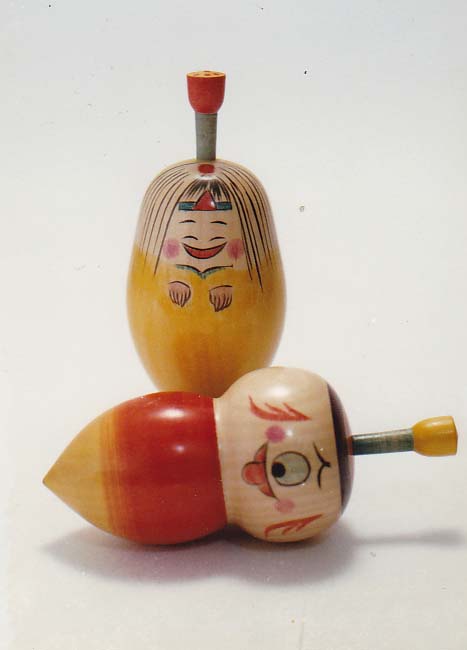
This top depicts an obake (monster/spirit). In Japanese folklore, obake (or sometimes bakemono 化け物) are types of preternatural creatures similar to monsters or spirits that can take many forms. Their main characteristic is an ability to transform. They sometimes disguise themselves as humans (though their true form may be an animal such as a fox or cat) or can be normal household objects that transform themselves into demonic creatures (see tsukumogami). They are distinct from the spirits of the dead, although sometimes ghost-like apparitions can be called obake or bakemono.
This top is designed so that when you use a string to wind up the top and spin it, it looks like the spooky obake is staggering about.
***
***
Hiroi Michiaki: This is an obake (monster/spirit), right.
Paula Curtis: Yes. [Top] number twelve.
Hiroi: This one, as you can see, when you spin it, the obake staggers about.
Janell Landis: Hehehe.
Hiroi: When you wrap the string around this one, too, and zip it off, it goes around like this, lolling around as it spins.
Title: 天女の舞 (tennyo no mai)
“the heavenly maiden’s dance”
=====================
This top depicts the dance of the heavenly maiden, a story connected to Japan’s version of the swan maiden folklore. Variations on this story typically include a beautiful young woman spotted bathing in the woods by a male hero. While she bathes, he steals her feathered robe (or an article of clothing) from where it hangs on a tree branch, which prevents her from changing back into her magical bird form to escape. He then forces her to become his wife.
Hiroi-sensei has created a top that mimics the heavenly maiden dancing at the top of a mountain as she descends from the sky. Made up of two different tops, this set is particularly difficult to spin. First you must spin the bottom half (the mountain), then carefully balance the second top on the very tip of the first, so that it begins to rotate from the force of the lower half. Balanced properly, the maiden appears to be dancing as she rotates in opposition to the mountain’s spin.
***
***
Hiroi Michiaki:And this is, ah—this is the heavenly maiden’s dance.
Mrs. Hiroi: The heavenly maiden’s dance.
HM: This is Mt. Fuji, below Mt. Fuji… Umm, at the base of the mountain, there’s a pine forest. It’s also included now in the World Heritage sites. Now, Mt. Fuji and that pine grove… what pine grove was it…
MH: Some kind of pine forest.
HM: There, long ago the heavenly maiden came down [from the sky] dancing, and she hung her feather robe in the pines… and a young hunter or someone takes it, and even though the heavenly maiden asked him to return it, he didn’t, I suppose. Somehow or another there are other things [that happen] and many interesting stories there. It’s a top modeled on that [story]. As it turns it looks like the heavenly maiden teetering around [dancing] on top of the mountain.
Janell Landis: Th-That [one], spinning it is hard.
HM: (laughs) It’s kind of hard, yeah.
MH: Mmm… it doesn’t spin easily.
JL: And, um, when you put it on the handle and it, and it stays on, it’s incredible. But I’ve gotten gradually worse at it. And, that, this um, when… ah, that thing like bamboo, you wrap the string around it and put it in the bamboo, and it suddenly it spins. Then you have to, to use your hands to do the top. (claps)
HM: (laughs)
JL: Over and over she falls, but when you finally get it spinning [on top], boy it’s wonderful. Sensei, um, I won’t talk anymore after this, but I, that story, um…
Paula Curtis: You thought it was Kaguya-hime.
JL: Kaguya-hime. Yeah.
HM: Ahhh…
JL: I-I used Kaguya-hime.
HM: Kaguya-hime.
JL: When I was gone away. I-I used it in connection with her. Yeah.
HM: Yeah, it’s a similar story. Was it called the “Heavenly Feather Robe”? Mm.
ジャネル: そして、あのう、when you put it on the handle and it, and it stays on, 素晴らしいもん。けど私だんだん下手になった。そして、その、これした、あのう、いつま、あの、ah… bambooみたいな、それ紐をつけてそれをbamboo入れて、そしてザアアアとすると it spins. Then you have to, to use your hands to do the top. (claps)
This top depicts a loach and pond snail. These are freshwater aquatic animals, often found in ponds. Hiroi-sensei stated that these tops are meant to be good luck charms for protection against fires, since both are water creatures.
***
***
Hiroi Michiaki:This is… a pond snail and a loach.
Mrs. Hiroi: Mm. Pond snails are in paddy fields.
HM: It was a pond snail and a loach, or I have a feeling it might have been a horned turban snail and a loach…
MH: It’s a pond snail and a loach.
HM: And, um, this is the shell of the pond snail in the paddy and then the loach. You put those together and it [becomes] a top, and this… it’s a charm for protection against fire– these creatures live in the water, so [it makes it so] fires won’t happen. [This] top is that kind of charm.
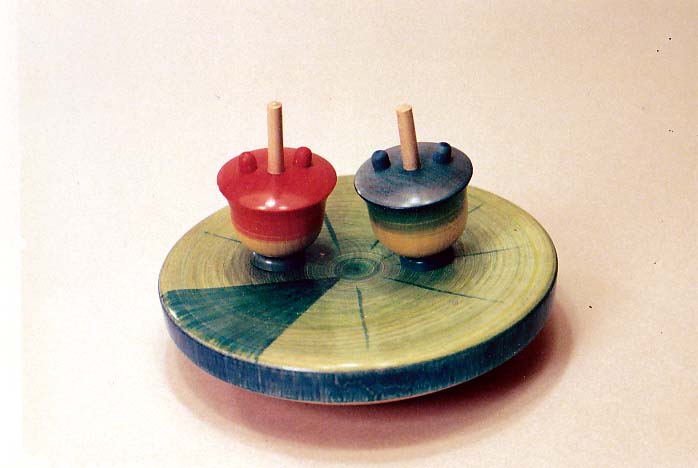
This set of tops forms two frogs on a lotus leaf engaging in a sumo match. Each of the frogs can be removed from the lotus leaf base to become individual tops. This playful theme is a popular one, which is even believed to have been represented in the famous 12-13th century Chōjū jinbutsu giga handscroll (seen below), which is thought to have one section that depicts anthropomorphic frogs and rabbits challenging each other to sumo.
***
***
Hiroi Michiaki:And… This is.. Ah. A frog. Frog sumo.
Mrs. Hiroi: A frog sumo match.
HM: The frog’s on a lotus leaf…
MH:They’re lined up [on the shelves] in the shop.
HM: On top of a leaf the frogs have a sumo match. Mm. They’re tops. …There’s not really much to say. (laughs)



 Carving Community: