This is an ategoma, or roulette-style top, with a sponge gourd (also known as an Egyptian cucumber). An image of a morning glory is painted on the surface of the principal top. Ategoma-style tops are used for games. When the handle is spun the gourd below spins with it, pointing to one of the six images. Unfortunately Hiroi-sensei has forgotten what pictures adorn the base.
***
***
Hiroi Michiaki: This is a sponge gourd roulette-style top, and here there’s a picture painted. Mm, these pictures have different stories, but here you can’t see them so I don’t really know.
Mrs. Hiroi: Yeah.
Hiroi: How many [pictures] is it separated into? Six?
Mrs. Hiroi: It’s six. Six.
Hiroi: Yeah, six. I thought this top must be a morning glory.
だるまともみ独楽 (daruma to momi goma) “daruma and hand-rubbing top”
This is a pair of two tops, one representing a daruma and the other a hand-rubbing top. A daruma is a traditional Japanese doll whose figure is based on the Bodhidharma, the founder of the Zen sect of Buddhism. Daruma are often depicted in this roundish shape because of a legend that the Bodhidharma stared at a wall in intense meditation for nine years, until both his arms and legs fell off. Daruma are traditionally depicted in red, but can appear in various colors with different meanings. They are considered good luck figures. Accompanying the daruma figure in this photo is a momigoma, or a “hand-rubbing top,” which is spun by rubbing the handle of the top quickly between your palms.
***
***
Mrs. Hiroi: It’s a daruma and–
Hiroi Michiaki: Yeah, this is a daruma and–
Mrs. Hiroi: A hand-rubbing top. [A top you spin by rubbing it between your palms instead of using a string.]
Hiroi: Yeah, it’s a top, and it’s not that it has any special story to it, but it’s a daruma, and a top.
This top depicts a rokurokubi, literally “lathe neck” or “pulley neck,” which is a type of yōkai (supernatural monster) in Japanese lore. These popular figures are characterized by looking like humans but having long necks that extend to the ceiling or heads that can come off of their bodies and fly around freely. Hiroi-sensei’s rokurokubi is the kind with the elongated neck. This kind was first described in an early nineteenth century tale as stretching its neck up to the ceiling to lick the oil from evening lanterns. Hiroi-sensei notes that his rokurokubi plays the shamisen, and as it plays, the rokurokubi’s neck slowly elongates towards the ceiling.
***
***
Hiroi Michiaki: Mmm this is Rokuro kubi.
Mrs. Hiroi: Yeah.
Hiroi: This is… umm… In the past, there was a person with a long neck, and this is actually a kind of yokai (demon). He plays this shamisen here and slowly slowly slowly slowly his neck stretches out. And he licks at the oil of evening lamps.
These tops depict candles with patterns of autumn plants (pampas grass and bush clover) on the sides. The flames on top are removed from the base and become tops.
***
***
Hiroi Michiaki: And these are candles.
Mrs. Hiroi: Candles, regular ones. For everyday use.
Hiroi: And it’s got spring and autumn, I think. This is… This has pampas grass on it, and this has bush clover, so they’re both autumn.
Mrs. Hiroi: Right.
Hiroi: This is the candle, this is the flame of the candle. If you use the string and wrap it around and give it a pop, it–
Mrs. Hiroi: It leaps out.
Hiroi: This comes out, and it spins like this. Mm. That’s all.
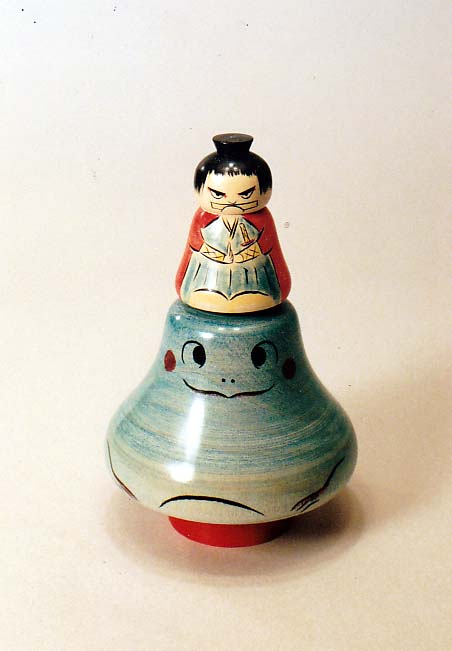
This top depicts a miso-grinding young priest (or perhaps an obake [monster/spirit]). Hiroi-sensei believes the tale originated from Gunma or Tochigi prefecture, where there was a one-eyed and one-legged priest who ground miso for use in miso soup. The story of this young man eventually became the basis for the tale of a one-eyed, one-legged obake. Here, the top is the one-eyed man, and the base is the grinding mortar. When the top is spun, it mimics the motion of a grinding pestle in a mortar.
***
***
Hiroi Michiaki: Ahh, ahh. This.
Mrs. Hiroi: Miso grinder.
Hiroi: The miso-grinding Buddhist priest…. young priest. From long ago, there was someone called the miso-grinding priest. Umm, the miso…
Mrs. Hiroi: He ground it.
Hiroi: Umm in a mortar he ground it like this… and that was used for ingredients for miso soup. At that time he was called the miso-grinding priest… or was it young priest…
Mrs. Hiroi: The top is shaped like a priest.
Hiroi: This is, um… a one-eyed monster. There are also other items like that. Mm. At first I thought it was just something fanciful, but in reality there was a person with this sort of appearance. That was the model, and it became a one-eyed monster, and a sign board was put up. In Gunma or Tochigi, he was said to be a person working at a temple. And of course he had one leg, it was damaged in an accident or something and he lost it. He was working at a temple, though. That seems to have become the model. And this is the miso-grinding priest, and then I made it into a top with the same meaning. [Even] though [people] say ‘Ah!’ they don’t really get it. (laughs) How should I put it…
Mrs. Hiroi: It spins just like it’s grinding miso. Here, inside.


 Carving Community: