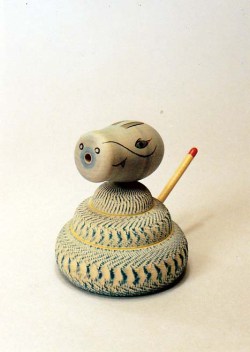
かぼちゃ喰いねずみ (kabocha kui nezumi)
kabocha-eating mouse
=====================
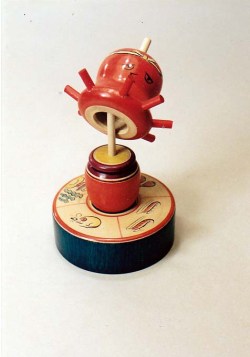
This top depicts four mice that have nested inside of a kabocha (an Asian variety of winter squash). Each mouse faces a cardinal direction and is painted the color associated with that direction based on Chinese traditions sometimes seen in Japan. South is red, west is white, north is black, and east is green.
***
***
Hiroi Michiaki: And this is…
Mrs. Hiroi: The kabocha-eating mouse.
Hiroi: It’s called the kabocha-eating mouse. This also happens to be something that’s good luck.
Mrs. Hiroi: When you spin it, the [mouse] pops its head out from the kabocha.
Hiroi: Inside the kabocha, the mouse is inside building a nest. When you spin it, all these different mice poke their faces in and out of it from the four directions. And this red mouse, red is for the south, so [he’s facing] south. And yellow, yellow is… is this yellow or white?
Mrs. Hiroi: It’s white.
Hiroi: But it looks like it’s yellow.
Mrs. Hiroi: It’s not yellow, it’s white.
Hiroi: It must be white. White is west, isn’t it…
Mrs. Hiroi: Yeah, that’s right.
Hiroi: These, these are colors indicating the four directions.
金魚とふぐつり独楽 (kingyo to fugu tsurigoma) goldfish and puffer fish string-release top
=====================
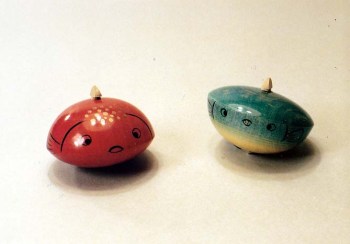
These tops depict a puffer fish and a goldfish. They are both tsurigoma, or string-release tops, which are spun by wrapping a string carefully around the top as shown in the photo to the right. They are then spun by releasing the top with a sharp toss towards the ground.
***
***
Hiroi Michiaki: And this is a string-release top… It’s a puffer fish and a goldfish.
ひも絵当独楽 (himoe ategoma) string picture roulette-style top
=====================
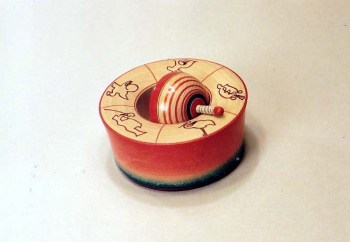
This is a roulette-style top, which is a kind of game. Someone spins the top in the middle, and the handle of the top lands on a particular picture. It is called a “string picture top” for two reasons. First, there is a string with which the top is spun which is also used to create an image (thereby “drawing a picture” with the string). The person who “draws” the picture then asks a playmate to guess what they have drawn. Second, the images on the front of the top’s base are created using a single line (contour line drawing), mimicking the idea of using the single string to create an image.
***
***
Hiroi Michiaki: This is called a string painting, and these pictures, there’s a string you spin the top with. You play by making pictures with that string. Not only do you spin the top, but you draw a picture with that string and you ask “What is this a picture of?” and the children guess. Yesterday I made a picture there with that string painting.
Mrs. Hiroi: Yeah, you did, you did.
Hiroi: She looked at it but she didn’t know what it was at all. Hahaha.
Mrs. Hiroi: Yeah, somehow I couldn’t figure it out at all. But, ah, what is it? A ship on the water. Ahh, what do you call it? Fishers ride it, he made a picture of one fishing. You continuously place the string [down]. Knowing that, you’re like, “Ahh, I see!”
Hiroi: And this, it’s really difficult because you draw it with [only] one continuous line. Because it’s only one string. You do it like this without drawing and all at once go like this. Without stopping at all. This is string painting. This is, and, you can actually do it, using the string. It’s a string– roulette-style top.
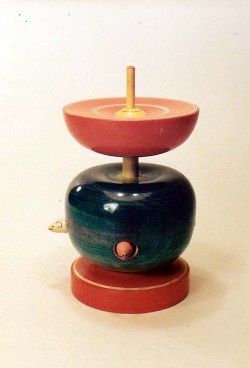
This top depicts a dragon. Hiroi-sensei made this top coinciding with the zodiac year of the dragon. In his interview, he mentions that it is also related to the story of the previous top in the collection, “the one-eyed koi”, which is about a koi who wishes to become a dragon and ascend to the heavens.
***
***
Hiroi Michiaki: This is the dragon from the [zodiac] year of the dragon. The koi, you know, wanted to be this. Heh heh heh. Do you get it? I’ll explain. Heh heh heh. I wonder if you got about half of it. Heh heh heh.
This top depicts a one-eyed koi. According to Hiroi-sensei, this image comes from a tale about a giant koi (nearly 2 meters, or 6.5 feet) that lived in the moat of the imperial palace. The story goes that the fish wanted desperately to become a dragon, and one day, because the rainfall was so heavy, he thought he could make it up to the heavens by riding the rain. But in the end, he couldn’t reach heaven, and as he fell back down, he crashed into the guardrail of a bridge and lost his eye. Hiroi-sensei thinks it might be a story originating from the Edo period (1600-1868).
***
***
Hiroi Michiaki: And this is another [top] with an interesting story, called the “one-eyed koi.” If you spin this, it gets wrapped around here and the fish rises up to the top.
Mrs. Hiroi: Yeah, it goes around and around and around.
Hiroi: And this, long ago, um… the Imperial Palace, the place where the Emperor lives, in the moat there, there was a koi that lived in it that was about six shaku long, so about 2 meters. And… there was a story that the koi, he wanted to ascend to the heavens and become a dragon, right? And one day, there was really heavy rainfall, so at the time he thought “Ahh, I can make it up to heaven if it’s like this!” and he tried to ascend. But he couldn’t make it and he fell, and he smashed up one of his eyes on the guardrail. So he was the one-eyed koi. I heard from my father that the fish lived up until recently. Hahahahaha. And so I made that. I don’t know when the story is from, though. Probably from the Edo period. I think it’s probably a story from around where Tokugawa Ieyasu built Edo castle.

 Carving Community: