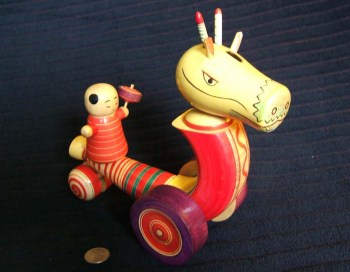
This is not a top but a pulling roller toy. The toy depicts Kintarō, a semi-legendary figure in Japanese folktales, who is said to be a child born of superhuman strength and great bravery. It is customary to put out dolls of Kintarō on Boy’s Day (nowChildren’s Day) in the hope that young boys will become equally strong and brave. Special carp streamers (koinobori) are also flown on this day, and in popular imagery, a number of famous prints show Kintarō wrestling a giant koi, so the two often appear together.
***
***
Hiroi Michiaki: This is also a toy. This is Kinta riding a koi, and this isn’t a top, but a toy you pull along with the string.
Mrs. Hiroi: Yeah.
Hiroi: This koi looks like it’s swimming like this.
Mrs. Hiroi: It spins like it’s swimming.
Hiroi: And Kintarō’s carrying a broadaxe, this… what is this…? What should I call this?
Mrs. Hiroi: Kintarō.
Hiroi: A mallet… What was this called? I forgot the name. Anyway, the hammer is really huge.
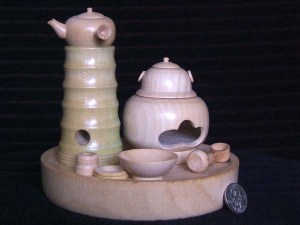
This piece depicts open-air tea utensils. In spring or autumn, sometimes tea ceremonies are held outdoors so that the participants can enjoy nature and beautiful weather while drinking their tea with seasonal treats. Open-air tea ceremony is sometimes held at temples or shrines.
Another view:
Click to enlarge.
***
***
Hiroi Michiaki: And, ah, these are tea utensils. For open-air tea ceremony.
Mrs. Hiroi: Open-air tea.
Hiroi Michiaki: It’s for setting up tea outdoors, green tea. So it’s the same as the tea we’re drinking now.





 Carving Community: