
タイトル:
花独楽 (hana koma)
flower tops
=====================
花束がモチーフの独楽である。花一つ一つが、花の茎を模した木の棒にバランスよく付けられている。それぞれ外すと独楽になる。
***
***
廣井道顕:で、これは花独楽っつって、あの、そっちにあるよね。
廣井夫人:うん。
タイトル:
花独楽 (hana koma)
flower tops
=====================
花束がモチーフの独楽である。花一つ一つが、花の茎を模した木の棒にバランスよく付けられている。それぞれ外すと独楽になる。
***
***
廣井道顕:で、これは花独楽っつって、あの、そっちにあるよね。
廣井夫人:うん。
Title:
ナンキンさん (nankinsan)
Nanking-san
=====================
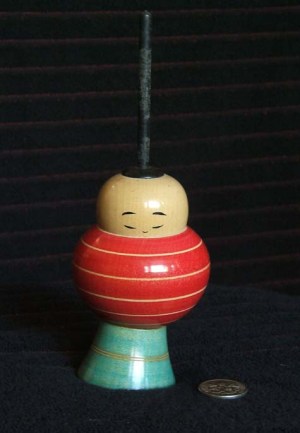
This top depicts a Chinese person with a queue hairstyle, which was traditionally worn by Manchu men and later became a hairstyle imposed on the Han Chinese in the seventeenth century, during the Qing dynasty. Despite its foreign origins, the image of men’s queue hairstyle came to be popularly seen by the West as a quintessentially Chinese. Playing with this stereotypical image, Hiroi-sensei whimsically stands the queue pigtail straight up in the air to become the handle of the top.
***
***
Hiroi Michiaki: Umm what is this. Oh, it’s Nanking-san. Nanking-san is… Long ago Japan greatly respected China, and so Chinese people were called Nanking-san, and so it was like [unintelligible]. That pigtail–in the past Chinese people grew out their hair. This top puts that hair high up into the air, and makes it the handle of the top that spins it.
タイトル:
ナンキンさん (nankinsan)
Nanking-san
=====================
辮髪をした中国人、ナンキンさんがテーマの独楽である。辮髪は元々満州の男性がしていた髪型だが、17世紀 清代の漢民族のイメージを示す髪型となった。外来の文化であるにも関わらず、辮髪のイメージは西洋において典型的な中国人のイメージとして見られるようになった。廣井先生は固定概念とも言えるこのイメージを使い、独楽の軸を辮髪の編んだ髪に見立てて回せるようにした。
***
***
廣井道顕:ううんと、これが何だ、やっぱりナンキンさんか。ナンキンさんってこれは・・・昔の日本はあのう、中国をすごく尊敬してて、だから中国人を、ナンキンさんとかって呼んで。___ある※、みたいな部分で。その、これあの辮髪ってあの中国、昔中国の人髪の毛長く伸ばしてた。それをこう持ちあげて頭のてっぺんにつけて、独楽の芯にして回してる独楽。
(※___の部分は不明瞭で聞き取れず、文字に起こすことができませんでした。)
Title:
後ろの正面 (ushiro no shōmen)
Behind You (Kagome Kagome)
=====================
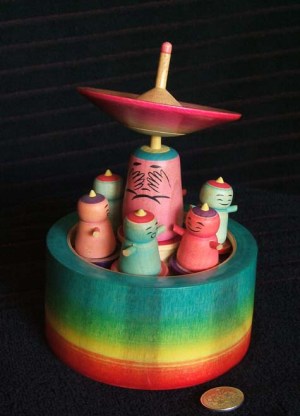
This piece depicts a game called “Behind You” (ushiro no shōmen), also known as Kagome Kagome (bird in the basket/cage). In this popular Japanese children’s game, one person is selected to be the oni (ogre), and must sit with their hands covering their eyes or blindfolded. The other players, who represent human children, hold hands and circle around the oni player, singing:
The bird in the basket/cage, (Kagome Kagome)
When, oh when will it come out
In the night of dawn
The crane and turtle slipped
Who is behind you now?
When the song ends, the oni player must guess who is standing directly behind them. Hiroi-sensei plays with the image of the oni in the middle; instead of showing an oni surrounded by human children, he represents all the players as oni, with the figure in the middle as a large parent oni being circled by its children. When you spin the top above the central oni, it makes the oni below move and spin.
***
***
Hiroi Michiaki: And this… ahh, this is called “Behind You,”* that “It’s Behind You!” children-
Mrs. Hiroi: Children play it.
Hiroi: —play it; it’s a type of game from long ago. You pick someone to be an oni (ogre) [in the middle], and the oni’s children are playing [around them]. And the oni parent covers their eyes, and if you spin this, the oni spins around and around, and this turns while it spins. And while singing you do it like this, and an older girl says, “Who’s behind you?!” and everyone suddenly stops. And the oni will name who’s in front of them, like “It’s so-and-so!” and the others go “You got it! [Or] you’re wrong!” It’s a children’s game. I’ve made them oni, so, it’s not the normal children [in the game, where only the one in the middle is an oni], but [now] an oni and oni children.
タイトル:
後ろの正面 (ushiro no shōmen)
Behind You (Kagome Kagome)
=====================
後ろの正面という遊びがテーマの独楽である。後ろの正面はかごめかごめ(籠の中の鳥)の歌でも知られている。日本で大衆的な子供の遊び歌で、一人が鬼になり、手か布で目隠しをしてしゃがむ。他の者は人間の子供という設定で、お互いの手を取って輪になり鬼の周りを回りながら歌を歌う。
かごめかごめ
かごの中の鳥は いついつ出会う
夜明けの晩に
鶴と亀がすべった
後ろの正面だあれ?
歌が終わった時、鬼は自分の真後ろに誰が立っているのか当てなければならない。鬼は本来、中心に一人だけなのだが、廣井先生は周りの子供たちを鬼に変え、中心の鬼を子鬼に囲まれている大きな親鬼にした。中心の親鬼の上にある独楽を回すと、下にある鬼が動き、回るようにできている。
***
***
廣井道顕:でこれが、あぁ、後ろの正面って言われた、あの『後ろの正面だあれ』ってあの、子供達が―
廣井夫人:子供遊ぶのね。
廣井:遊ぶ、昔の遊び方なんですけど。それを鬼に作って、鬼の子供が遊んでるんですね。で親の鬼が目隠しして、で、これ回すとこの鬼が回をりグルグルこう、回りながら回る。でなんか歌を歌いながらこうやって、こうお姉さんがこう、後ろの正面だあれってピタッと止まって「何とかちゃん」ってこう当てて「当たった!はずれた」って言って遊ぶ。子供の遊びですね。それを鬼、だからこれを普通の子供でなくて鬼にして、鬼の子供にして。
Title:
かえる (kaeru)
frog
=====================
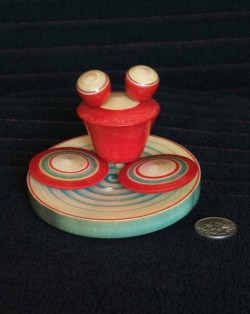
These tops depict a frog in a pond. The frog’s eyes, body, and feet detach from the base (pond) and all become individual tops.
***
***
Hiroi Michiaki: Ahh. This is a frog.
Mrs. Hiroi: Yeah.
Hiroi: There was a frog over there somewhere, too.
Paula Curtis: Yesterday.
Hiroi: You saw it yesterday.
タイトル:
かえる (kaeru)
frog
=====================
池のかえるがモチーフの独楽。かえるの目、体、脚は土台(池)から取り外し可能で、それぞれが独楽になる。
***
***
廣井道顕:あぁ、これはかえるだね。
廣井夫人:うん。
廣井:かえるもどっかその辺にあったよね。
ポーラ・カーティス:昨日。
廣井:昨日見たね。

Title:
だるま (daruma)
daruma
=====================
This work depicts a daruma. A daruma is a traditional Japanese doll whose figure is based on the Bodhidharma, the founder of the Zen sect of Buddhism. Daruma are often depicted in this roundish shape because of a legend that the Bodhidharma stared at a wall in intense meditation for nine years, until both his arms and legs fell off. Daruma are traditionally depicted in red, but can appear in various colors with different meanings. They are considered good luck figures.
***
***
Hiroi Michiaki: This is a daruma.
タイトル:
だるま (daruma)
daruma
=====================
だるまがテーマの独楽。だるまは伝統的な日本の人形で、そのモデルになっているのは仏教禅宗の開祖とされている菩提達磨である。だるまがよく丸い形で表現されるのは、菩提達磨が壁を見つめて座禅を九年もの間 続けたので腕と脚が取れてしまったという伝説から来ている。だるまの伝統的な色は赤であるが、他の色もあり、色によってそれぞれ意味もある。どの色も幸運のシンボルとして考えられている。
***
***
廣井道顕:これだるま。
Title:
投げ独楽 (nagegoma)
throwing top
=====================
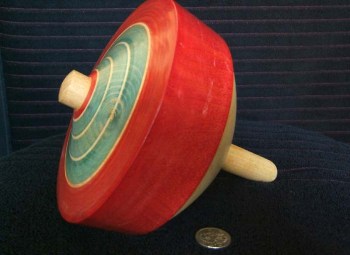
This top is a nagegoma, or throwing top. It is spun by carefully wrapping a string around the top from the outside and throwing it skillfully towards the ground.
***
***
Hiroi Michiaki: This is a normal– one of those, you know, throwing tops that you throw outside.
 Carving Community: