This top depicts a loach and pond snail. These are freshwater aquatic animals, often found in ponds. Hiroi-sensei stated that these tops are meant to be good luck charms for protection against fires, since both are water creatures.
***
***
Hiroi Michiaki:This is… a pond snail and a loach.
Mrs. Hiroi: Mm. Pond snails are in paddy fields.
HM: It was a pond snail and a loach, or I have a feeling it might have been a horned turban snail and a loach…
MH: It’s a pond snail and a loach.
HM: And, um, this is the shell of the pond snail in the paddy and then the loach. You put those together and it [becomes] a top, and this… it’s a charm for protection against fire– these creatures live in the water, so [it makes it so] fires won’t happen. [This] top is that kind of charm.
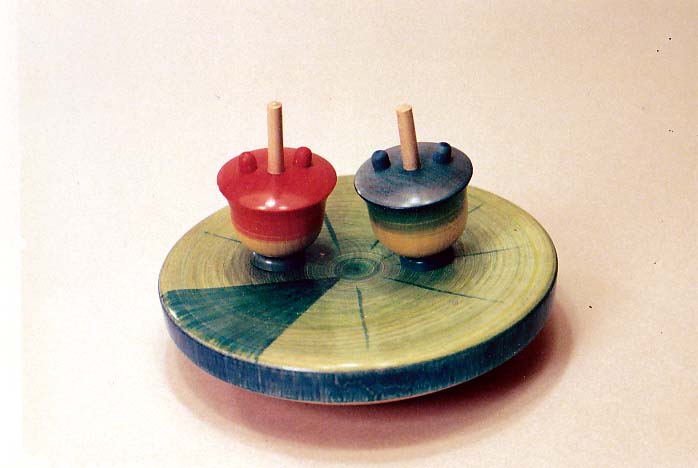
This set of tops forms two frogs on a lotus leaf engaging in a sumo match. Each of the frogs can be removed from the lotus leaf base to become individual tops. This playful theme is a popular one, which is even believed to have been represented in the famous 12-13th century Chōjū jinbutsu giga handscroll (seen below), which is thought to have one section that depicts anthropomorphic frogs and rabbits challenging each other to sumo.
***
***
Hiroi Michiaki:And… This is.. Ah. A frog. Frog sumo.
Mrs. Hiroi: A frog sumo match.
HM: The frog’s on a lotus leaf…
MH:They’re lined up [on the shelves] in the shop.
HM: On top of a leaf the frogs have a sumo match. Mm. They’re tops. …There’s not really much to say. (laughs)
This top depicts a tengu nest. Tengu are creatures from Japanese folklore that are considered a kind of kami (god/spirit) or yōkai (supernatural being). Although they are thought to take the form of birds, they are frequently depicted with both bird-like and human characteristics. Beginning around the fourteenth century, tengu began being depicted with a distinctive long nose. Tengu masks are often represented with bright red faces and extended, phallic noses. Tengu, sometimes appearing with yamabushi garb or Buddhist monks’ staffs, have had varying associations in legend with Shintō, mountain asceticism (shūgendō), and Buddhist customs. They are often depicted holding a magical fan made of feathers called a ha-uchiwa (羽団扇 “feather fan”).
***
***
Hiroi Michiaki: Next… Ah. This is the tengu’s nest. I don’t think the tengu actually builds a nest, though, you know.
Mrs. Hiroi: All of these are tengu hatching out of the nest.
Hiroi: The tengu’s egg, there’s also an egg you see. Tengu, in legend—
Mrs. Hiroi: The nose. The nose gets long like this.
Hiroi: What would you call a tengu? A yōkai? They live in the mountains, though it’s not that they do anything particularly bad. They hold a fan like this and… sort of frighten people and such. And they, um, they’re born from eggs. And this is a tengu’s egg and here they’ve built a nest. So those are the tengu’s eggs. If you spin this, if you spin this to the side, it stands straight up. It doesn’t flip upside down, but if you spin it to the side, it straightens out. Although it’s an egg, it’s like the egg has a nose. If you spin that this stands on its side.
お化けのトビ出し (obake no tobidashi) obake (monster/spirit) springing out
=====================
This top depicts an obake お化け springing out of its skin. In Japanese folklore, obake (or sometimes bakemono 化け物) are types of preternatural creatures similar to monsters or spirits that can take many forms. Their main characteristic is an ability to transform. They sometimes disguise themselves as humans (though their true form may be an animal such as a fox or cat) or can be normal household objects that transform themselves into demonic creatures (see tsukumogami). They are distinct from the spirits of the dead, although sometimes ghost-like apparitions can be called obake or bakemono.
Below, you’ll find a video of Hiroi-sensei explaining the top, along with transcripts of his explanation.
***
***
Hiroi Michiaki: What is this? Ah. An obake.
Mrs. Hiroi: Mm.
Janell Landis: (laughs)
Hiroi: This is an obake… leaping out and spinning.
MH: That thread, you wind it around and pull it and the obake pops out.
HM: When that happens, this spins and [the obake] leaps out. And this and that part inside also split into two.
MH: Yeah.
Paula Curtis: Ohhh.
HM: This is the obake and this is the obake’s husk. So… oh, but does it become three? One, two, three. It becomes three. And the lid, that makes it four. It turns round and round.
唐子の蝶々遊び (karako no chōchō asobi) karako (Chinese child) playing with butterflies
=====================
This top depicts a karako (Chinese child, or a child dressed in a Chinese fashion) dancing with butterflies. In Japan, these figures are said to be messengers for the God of Luck, sent to do his bidding. They are thought to be good omens.
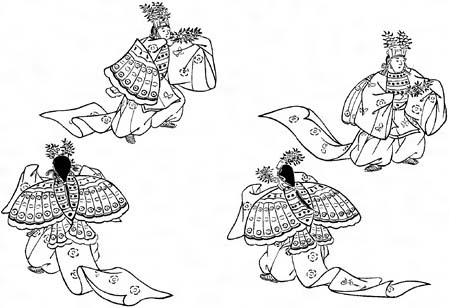
kochō no mai 胡蝶楽〈舞楽図譜 宮内庁書陵部蔵〉
The image of a Chinese child with butterflies also extends to ancient Japan, when there was a tradition of kochō no mai 胡蝶の舞 (butterfly dance) inherited from China. As a part of gagaku 雅楽 court music performance, four young boys would dress as butterflies, attaching yellow wings to their outfits, and perform dances for the imperial court.
Below, you’ll find a video of Hiroi-sensei explaining the top, along with transcripts of his explanation.
***
***
Hiroi Michiaki: This is, um, “A karako (Chinese child) playing with butterflies.” A karako is… [literally] a Chinese child [a child dressed in a Chinese fashion], but in Japan they’re said to be the messengers of the God of Luck. The God of Luck orders them to go do something, “Go here, go there.” And when he requests many things, it is said that this karako goes about taking care of it. They’re good omens. This, if you spin it, the butterflies look like they’re fluttering and fluttering, flying about.
Paula Curtis: Um, in ancient times there was also a “butterfly dance,” right?
HM: Mm. Ahhhh [yes].
PC: From China.
HM: Yes, there is. They move around with the same feeling as that.
Janell Landis: Looks like butterflies flying.
HM: Yeah.
JL: Uh huh.
HM: If you spin it here a little, [it looks that way] because [the butterflies] clatter about.
JL: Right.
HM: The butterflies look like they’re fluttering flying about. This is the “Chinese child (karako) playing with butterflies”…



 Carving Community: