Category Archives: video

福良すずめ

Click to enlarge.
Click to enlarge.

タイトル:

福良すずめ (fukura suzume)
“plump sparrows”

=====================

冬の福良すずめをデザインした独楽。廣井先生のお話によると、寒い時期になるとすずめは防寒対策のため羽の間に空気を入れて膨らませ、まん丸とした姿になるという。『膨ら(ふくら)』が良い意味合いの『福』と『良』という漢字に置き換えられ、縁起がいいものの一つとされている。独楽を回すと、小さなすずめが鳴いているような、チチチチチと音を出す。

***

***

廣井道顕:で、これがね。

廣井夫人:雀。

廣井:福良雀って言って。

夫人:あの、福があるっていう。

廣井:冬、よく雀あのう寒いからこう膨らんでいるんですよね、雀ね。で、それをあのう福良雀って言って、漢字で書くと「福」が「良い」って書いて福良雀って言うの。であのう、やっぱり縁起がいいっていうことで。でこれは、こう回すとね、なんか、鳴いているような音が出るのね。小さくね。チチチチ、チチチチって。どういうわけで音が出るんだかは作った本人にも分らないんだけど。とにかく音が出るの。かすかにね、小さなって声で。で、雀は、なんか竹なんだね。雀のお宿だから。うちの雀は竹でなく、瓦に巣くってたけどね。

夫人:瓦に。

廣井:つづらくんねぇな、やっぱ。今度、くれたら小さいのもらうけど。大きいのおっかないから。へへへ。

ここでは『舌切り雀のおばあさん』の物語に出てくる内容を交えて話している

たんたん狸 (a balanced tanuki)

Click to enlarge.
Click to enlarge.

Title:

たんたん狸 (tan tan tanuki)
“a balanced tanuki”

=====================

This top is an abstract depiction of a tanuki, a kind of Japanese raccoon dog. Tanuki are significant figures in Japanese folklore, often appearing in stories as shapeshifting mischief-makers. In nature, male tanuki have unusually large testicles, which are often humorously depicted oversized in Japanese art, sometimes slung over the tanuki’s shoulder like a backpack or being used as drums. For this top, Hiroi-sensei has created a yajirobee, a kind of balancing toy, using the tanuki’s testicles as the balances.

***

***

Hiroi Michiaki: This is a tanuki.

Mrs. Hiroi: Yeah.

Hiroi: How much should I… he’s hard to explain, huh. Hahahaha. In old [stories, the tanuki’s testicles] were really big. Hahaha. [The top] becomes a balancing toy (yajirobee). This is pretty funny.

たんたん狸

Click to enlarge.
Click to enlarge.

タイトル:

たんたん狸 (tan tan tanuki)
“a balanced tanuki”

=====================

日本の生き物、狸がテーマの独楽。狸は日本の民話において欠かせないキャラクターであり、変幻自在に姿かたちを変えるイタズラ好きとしてよく物語に登場する。本来、オスの狸は大きな睾丸を持つとされるが、日本芸術ではそれを大袈裟に大きくすることで面白おかしくその特徴を描いていることがよくある、時にはカバンのように肩にかけていたり、太鼓として使っている姿も見受けられる。廣井先生はやじろべえにもなる独楽を作り、重りのデザインに狸の睾丸を使った。

***

***

廣井道顕:でこれは狸。

廣井夫人:うん。

廣井:どの程度…こいつも説明しにくいな。へへへへへ。でかかったんだって昔から。へへへ。やじろべえになって、バランスとって。これは大変笑うんです。

児雷也 (Jiraiya)

Click to enlarge
Click to enlarge

Title:

児雷也 (jiraiya)
“Jiraiya”

=====================

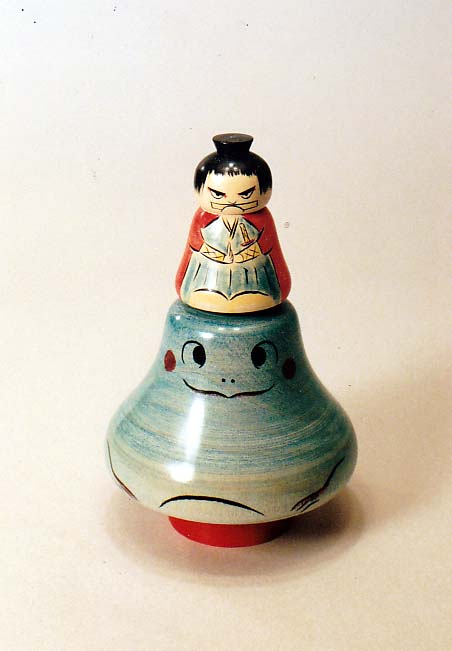
Jiraiya is a legendary character from the nineteenth-century tale Jiraiya Gōketsu Monogatari (児雷也豪傑物語, “The Tale of the Gallant Jiraiya”). He is often depicted riding or shapeshifting into a giant toad, and is popularly considered to be a folkloric ninja. Jiraiya has been adapted in various pop-culture forms from the nineteenth century to the present day, including novels, kabuki, film, and video games.

***

***

Hiroi Michiaki: This one is called Jiraiya, and he’s a legendary ninja. He’s Jiraiya and a ninja and he rides on top of this toad. He does this and that as a ninja does. Truthfully, smoke comes out from here and he dashes off somewhere, that kind of thing. And if you spin this part, the toad, I think it must spin straight and then spin around and around like this.

Mrs. Hiroi: Yeah, it spins around.  

児雷也

Click to enlarge
Click to enlarge

タイトル:

児雷也 (jiraiya)
“Jiraiya”

=====================

児雷也は『児雷也豪傑物語』という19世紀に作られた物語に登場するキャラクターである。巨大なカエルの上に乗っている姿や、自らが巨大なカエルに化けている姿でよく描かれており、民話に登場する忍者として広く知られている。児雷也は19世紀以来、今でも、小説、歌舞伎、映画やビデオゲーマなどを含め、様々なポップカルチャーの中で使われてきている。

***

***

廣井道顕これはあの、自雷也っつって、昔の忍者。自雷也で忍者でこの蝦蟇(かながえる)っていうカエルの上に乗ってこう、こうやって、忍術こう、やってるところなのね。ここから本当はボウッと煙が出て、どこかへ飛んでく。そういう役なの。で、これ回すとこのカエルが、確かまっすぐ回るんでな、こうぐるぐる回るんだと思うのね。

廣井夫人:うん。回るんだ。

へちま当独楽 (sponge gourd roulette-style top)

Click to enlarge
Click to enlarge

Title:

へちま当独楽 (hechima ategoma)
“sponge gourd roulette-style top”

=====================

This is an ategoma, or roulette-style top, with a sponge gourd (also known as an Egyptian cucumber). An image of a morning glory is painted on the surface of the principal top. Ategoma-style tops are used for games. When the handle is spun the gourd below spins with it, pointing to one of the six images. Unfortunately Hiroi-sensei has forgotten what pictures adorn the base.

***

***

Hiroi Michiaki: This is a sponge gourd roulette-style top, and here there’s a picture painted. Mm, these pictures have different stories, but here you can’t see them so I don’t really know.

Mrs. Hiroi: Yeah.

Hiroi: How many [pictures] is it separated into? Six?

Mrs. Hiroi: It’s six. Six.

Hiroi: Yeah, six. I thought this top must be a morning glory.

Mrs. Hiroi: Yeah.

へちま当独楽

Click to enlarge
Click to enlarge

タイトル:

へちま当独楽 (hechima ategoma)
“sponge gourd roulette-style top”

=====================

へちまの付いた当独楽である。独楽本体の表側には朝顔が描かれている。当て独楽は独楽遊びの一種である。独楽の軸を回すと、下のへちまが一緒に回り、土台に描かれた六つの絵のうち一つを指す。残念ながら、土台に何が描かれているのか、作った本人である廣井先生も忘れてしまい、不明である。

***

***

廣井道顕:これがね、へちまの当て独楽で、ここに絵が描いてるんですけど。うんと、この絵がいろいろ謂れはある絵で、これ見えねな分んないな。

廣井夫人:うん。

廣井:いくつに分かってんだ。六つかな。

夫人:六つだ、六つ。

廣井:六つかよ。この独楽が、確か朝顔だと思ったな。

夫人:うん。

だるまともみ独楽 (daruma and hand-rubbing top)

021
Click to enlarge.


Title:

だるまともみ独楽 (daruma to momi goma)
“daruma and hand-rubbing top”

This is a pair of two tops, one representing a daruma and the other a hand-rubbing top. A daruma is a traditional Japanese doll whose figure is based on the Bodhidharma, the founder of the Zen sect of Buddhism. Daruma are often depicted in this roundish shape because of a legend that the Bodhidharma stared at a wall in intense meditation for nine years, until both his arms and legs fell off. Daruma are traditionally depicted in red, but can appear in various colors with different meanings. They are considered good luck figures. Accompanying the daruma figure in this photo is a momigoma, or a “hand-rubbing top,” which is spun by rubbing the handle of the top quickly between your palms.

***

***

Mrs. Hiroi: It’s a daruma and–

Hiroi Michiaki: Yeah, this is a daruma and–

Mrs. Hiroi: A hand-rubbing top. [A top you spin by rubbing it between your palms instead of using a string.]

Hiroi: Yeah, it’s a top, and it’s not that it has any special story to it, but it’s a daruma, and a top.

だるまともみ独楽

Click to enlarge.
Click to enlarge.

タイトル:

だるまともみ独楽 (daruma to momi goma)
“daruma and hand-rubbing top”

=====================

二つの独楽がセットになっている。一つはだるま、もう一つがもみ独楽である。だるまは日本の伝統的な人形で、禅宗の始祖である菩提達磨(ぼだいだるま)がそのモデルとされている。だるまがよくこのような丸い形で表現されるのは、菩提達磨が九年間にわたり壁に向かって座禅を組み瞑想したことで手足が腐り取れてしまったという伝説があるからである。だるまは伝統的には赤色であるが、他の色でも作られ、色ごとに様々な意味もある。縁起のいいものとされている。だるまと一緒に写っているのがもみ独楽である。もみ独楽は手の平で素早く揉むことで回すことができる。

***

***

廣井夫人:だるまと―

廣井道顕:うん、これはだるまと―

夫人:もみ独楽。

廣井:うん、独楽で、特に謂れがあってって言うわけじゃないけど、だるまさんと、独楽ですね。

ろくろ首 (rokurokubi [a type of supernatural monster])

Click to enlarge.
Click to enlarge.

Title:

ろくろ首 (rokurokubi)
rokurokubi (a type of demon)

=====================

This top depicts a rokurokubi, literally “lathe neck” or “pulley neck,” which is a type of yōkai (supernatural monster) in Japanese lore. These popular figures are characterized by looking like humans but having long necks that extend to the ceiling or heads that can come off of their bodies and fly around freely. Hiroi-sensei’s rokurokubi is the kind with the elongated neck. This kind was first described in an early nineteenth century tale as stretching its neck up to the ceiling to lick the oil from evening lanterns. Hiroi-sensei notes that his rokurokubi plays the shamisen, and as it plays, the rokurokubi’s neck slowly elongates towards the ceiling.  

***

***

Hiroi Michiaki: Mmm this is Rokuro kubi.

Mrs. Hiroi: Yeah.

Hiroi: This is… umm… In the past, there was a person with a long neck, and this is actually a kind of yokai (demon). He plays this shamisen here and slowly slowly slowly slowly his neck stretches out. And he licks at the oil of evening lamps.