This top depicts Kuzunoha, a popular figure in Japanese folklore who is a female magic kitsune (fox). In traditional legends, kitsune are said to be able to shapeshift into human figures. In various tales, Kuzunoha is said to be the mother of the famous historical figure Abe no Seimei (921-1005), a well-known expert in Japanese esoteric cosmology (onmyōdō).
『新形三十六怪撰』
There are many variations on the Kuzunoha story, but in its simplest form, the courtier Abe no Yasuna battles and is injured by a hunter who is capturing foxes to sell their livers to make medicine. Freeing a fox (Kuzunoha) trapped by the hunter, Yasuna later encounters a beautiful woman (Kuzunoha in human form) who tends to his wounds and helps him home. They fall in love, are married, and eventually have Abe no Seimei. But several years later, Seimei glimpses his mother’s tail (or in some stories, sees her shadow against a screen in the form of a fox). With her true nature revealed, she must leave her family behind and return to the wild.
***
***
Hiroi Michiaki: And this is… Kuzunoha, I think?
Mrs. Hiroi: Yeah. It’s Kuzunoha.
Hiroi: And, if you spin this, this fox leaps out. All of the sudden. Stories about Kuzunoha, there are a lot of sad ones, but here it would be a little hard to explain them, so [I won’t]. Heh heh heh…
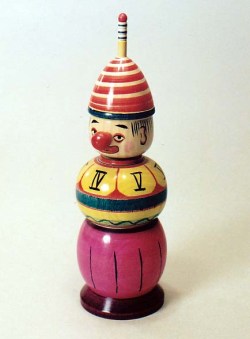
This top is a roulette-style top of a clown. Ategoma-style tops are used for games. When the handle is spun, the clown’s head spins with it, and its nose points to one of the six numbers. Hiroi-sensei notes that Janell taught him how to write the Roman numerals for this top.
***
***
Mrs. Hiroi: This is like what you saw before…
Hiroi Michiaki: This is, well, it’s a clown.
Mrs. Hiroi: Yes, it’s a clown.
Hiroi: The way you write these numbers, Landis-sensei taught it to me.
This top depicts crow tengu, a type of mythical creature of the tengu variety. They are more distinguishably bird-like, often featured with beaks and feathers. Hiroi-sensei states that they are the children of regular tengu and travel about as messengers who hang lanterns. He therefore depicts them here as bird-headed creatures holding balanced lanterns. Hiroi-sensei also notes that a photograph of this top was featured for some years in a junior high school textbook in Japan.
***
***
Hiroi Michiaki: This is… What was this? Ah. The crow tengu.
Mrs Hiroi: Yeah.
Hiroi: The children of the tengu hang paper lanterns and go out as messengers. And here, the lanterns are balanced. And it’s diagonal like this. And here, some years ago, in a junior high art–
Mrs Hiroi: Yeah.
Hiroi: It was printed in a school textbook, you know, this was. Umm about three years [ago], and I received royalties.
Mrs Hiroi: Yeah.
Hiroi: Once a year, well, every year around December I received some [royalties]. 50,000 yen or 60,000 yen. Heh heh heh.
Mrs Hiroi: Yeah. I don’t remember how many hundred yen.
Hiroi: Spending money. Heh heh heh. I received it for about three years. And it was published in a textbook and junior high schools all over the country; it was published in some grade level’s art textbooks.
梅にうぐいす (ume ni uguisu) bush warbler in the plum blossoms
=====================
This top depicts a bush warbler and plum blossoms, a popular seasonal theme in Japan. Bush warblers and plum blossoms are often featured together in classical poems and paintings, as they are thought to be signs of the close of winter and beginning of spring. The first cry of the bush warbler at the beginning of the year is a highly anticipated event. It even has a special word, hatsune 初音, meaning “the first warbling of the New Year.” This top is a special whistle top that comically mimics the first warbling of the year, making a loud, disagreeable sound, which is said to be a promise that the bush warbler’s songs for the rest of the year will be pleasant.
***
***
Hiroi Michiaki: And this is–
Mrs. Hiroi: Ah, this is a whistle.
Hiroi: This is–
Mrs. Hiroi: A bush warbler whistle.
Hiroi: The first–it’s called “the first warbling of the New Year,” and the first time the bush warbler sings, Japanese people are delighted. It’s usually close to the New Year that it sings, and it’s considered a very good omen. And if you blow this, it, it doesn’t go houhokekyu*, but it goes BEEEEEHHH. Heh heh heh.
* In Japanese, this is the traditional sound of the bush warbler tweeting.
Mrs. Hiroi: Yeah. It’s not a nice sound. If you hear [the bird’s voice coming out], you’re like “Whaaat?!” Its voice, it comes out.
Hiroi: If you blow it here this part spins about and the sound comes out.
Mrs. Hiroi: That’s right. Yeah.
Hiroi: And because it’s the first warbling of the year, it’s said that after that the bush warbler will sing in a pretty voice, so if you blow this, the BEEEEEHHH sound comes out. Heh heh heh.
Mrs. Hiroi: Yeah yeah yeah yeah. If you hear it it’s a weird sound, so you’re surprised.
Hiroi: Everyone laughs real hard and is delighted. Ha ha ha.
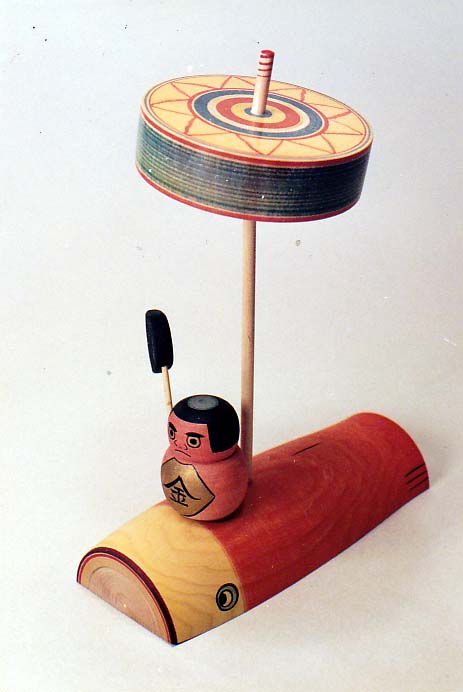
This top depicts Kintarō, a semi-legendary figure in Japanese folktales said to be a child born with superhuman strength and great bravery. It is customary to put out dolls of Kintarō on Boy’s Day (now Children’s Day) in the hope that young boys will become equally strong and brave. Special carp streamers (koinobori) are also flown on this day, and in popular imagery, a number of famous prints show Kintarō wrestling a giant koi, so the two often appear together.
***
***
Hiroi Michiaki: And, this is… Ah, Kintarō riding a koi.
Mrs. Hiroi: Yeah. Riding a koi. He’s riding a koi.
Hiroi: Kintarō riding a koi.
Mrs. Hiroi: Kintarō.
Paula Curtis: It is a koi, isn’t it.
Hiroi: The koi, too, it’s that koi from koinobori*. It’s not a koi in a pond. So, his mouth is like this and his tail, too, is cut off.
Mrs. Hiroi: It’s cut off.
* Here, Hiroi-sensei is referring to koinobori, or carp streamers, which are special wind socks flown in Japan to Tango no Sekku (Boy’s Day Celebration), a traditional event now designated the national holiday Children’s Day (Kodomo no Hi).




 Carving Community: