タイトル:
たたき相撲 (tataki sumō)
dirt floor sumo
=====================
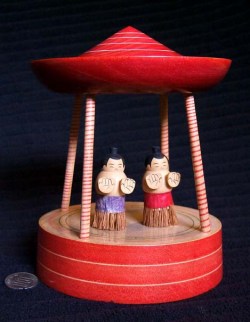
土俵の上にいる二人の相撲取りを表現した独楽。
***
[ビデオ・解説なし]
タイトル:
たたき相撲 (tataki sumō)
dirt floor sumo
=====================
土俵の上にいる二人の相撲取りを表現した独楽。
***
[ビデオ・解説なし]

Title:
犬と子供 (inu to kodomo)
dogs and child
=====================
This top depicts a child and two dogs. When the handle of the uppermost top is spun, it looks as if the child and the dogs are frolicking up and down.
***
[no video/transcript]
タイトル:
犬と子供 (inu to kodomo)
dog and child
=====================
二匹の犬と子供がモチーフの独楽。一番上の独楽の軸を回すと、子供が犬と一緒に飛び跳ねているように見える。
***
[ビデオ・解説なし]

Title:
たつ (tatsu)
dragon
=====================
This work depicts a dragon and is not a spinning top, but a hand-held toy.
***
[no video/transcript]
タイトル:
たつ (tatsu)
dragon
=====================
この作品のモチーフは竜で、独楽ではなく、手で持って遊ぶ子供用の玩具である。
***
[ビデオ・解説なし]

Title:
波乗り兎 (naminori usagi)
wave-riding rabbit
=====================
This top depicts a rabbit riding a wave, which is said to be an auspicious motif that acts as a charm for protection against fire. This is also an image connected to well-known folklore borrowed from Chinese mythology of a rabbit spirit who lives on the moon and mixes the elixir of immortality. The rabbit itself is seen as a sign of prosperity and longevity, frequently depicted in art with the moon, ocean waves, or both.
***
[no video/transcript]
タイトル:
波乗り兎 (naminori usagi)
wave-riding rabbit
=====================
波乗りをする兎を表現した独楽である。このモチーフは火除けのお守りとして縁起の良いものと言われている。またこのモチーフは、中国の神話の一つで月に住み不老不死の薬を作っている兎の霊が登場する話を基となっている有名な伝承にも関連している。兎自体は繁栄と長寿のシンボルであり、芸術の中では月や波、またはその両方と共に描かれることが頻繁にある。
***
[ビデオ・解説なし]
Title:
久米の仙人 (kume no sennin)
Kume no sennin
=====================
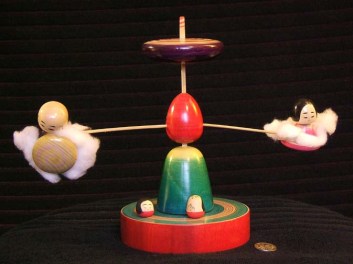
Kume no sennin (literally, The Immortal Kume) is a legendary figure popularly depicted in Edo period (1603-1868) paintings. According to a tale from Konjaku monogatari (a collection of tales written in the late Heian period [794-1185]), Kume no sennin, having learned the skills of the immortals in the mountains, was flying over the Yoshino River one day when he spotted a young woman washing laundry. So struck with passion at the sight of her beautiful, pale legs, his powers failed him and he fell to the ground before her. She later became his wife. Most images of Kume no sennin show him tumbling to the ground from a cloud before the woman, and so for this top Hiroi-sensei also depicts him on his cloud in the sky.
***
***
Hiroi Michiaki: Umm. This is Kume no Sennin.
Mrs. Hiroi: Yeah.
Hiroi: Kume no Sennin, long ago… This is Kume no Sennin. Ah, this one. Wait…. yes. This one. He was an immortal (sennin) and rode on a cloud. Mmm, he was a person who lived up in the mountains, like a monk. He also loved young women, and when he was going about up on his cloud, two young women were doing their laundry in a stream. And he peeked at them from up on his cloud and he fell, you see, to the ground. He was an immortal and he died because he fell to the earth. It’s that sort of, what should you call it– a cautionary tale. It’s a top that tells the story of how that sort of thing is bad.

タイトル:
久米の仙人 (kume no sennin)
Kume no Sennin
=====================
久米の仙人は、江戸時代(1603ー1868年)の日本画に広く描かれている伝説上の人物である。今昔物語(平安時代後期(794-1185年)に書かれた説話集)に書かれている話では、山で空中飛行の術を習得した久米の仙人が、ある日吉野川のあたりを飛んでいた時に、若い女が川で洗濯をしているのを見つけた。女の綺麗で白い脚に見惚れて心が乱れ、魔法の術が解けてしまい、その女の目の前に落ちてしまった。後に女は久米の仙人の妻となった。久米の仙人の絵の多くは、雲の上から地面へ、女の目の前に落ちていく姿が描かれており、廣井先生の独楽も久米の仙人が空の上の雲にいる姿を表現している。
***
***
廣井道顕:ええと。これは久米の仙人だな。
廣井夫人:うん。
廣井:久米の仙人が昔・・・こっちが久米の仙人。あぁ、こっちだな。待てよ・・・うん。これだな。あの、仙人ってあの、雲に乗っかって、いる。うーん、山に住んでる人なんですけど、坊さんなんですけど。これがまた女の子が大好きで、雲の上をずっと歩いてたら、小川で女の子が二人洗濯してたの。そいつをこう雲の上からこう覗いたら、落っこってしまったのね、地上に。で、仙人でなくなっちゃったんだよね。地上に落っこっちゃったから。そういう、何つうのかな、戒めっていう。そういうことはよくないですよという謂れの独楽なんです。
Title:
雨小僧 (amekozō)
young priests in the rain
=====================
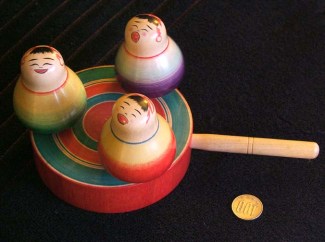
This top depicts three young priests gazing up at the rain. When you hold the handle of the base, you are supposed to pick which of the three priest tops you want to move, focus on it, and then carefully jiggle the base back and forth until you get only that one top to spin.
***
***
Hiroi Michiaki: And these are young priests in the rain.
Mrs. Hiroi: Yeah.
Hiroi: The young priests in the rain, for some reason, if you spin it one by one they rotate about.
Mrs. Hiroi: Yeah, that’s right, that’s right, that’s right.
Hiroi: This is in there, isn’t it? Ah, Misa-chan–
Misa: Yes.
Hiroi: This is in there, bring it here. Ahh, there it is, there it is. Yeah yeah yeah yeah yeah.
Janell Landis: That’s one I have too. Dusty, yeah.
Hiroi: It gathers dust quickly, right? Because I’m doing my work [here].
Mrs. Hiroi: Yeah. If you polish it, it has a lot of dust.
Hiroi: This, when you go like this, the places you want to spin will spin for you.
Mrs. Hiroi: The place that you think ‘I want it to spin!’ will spin.
Hiroi: Right now I’m thinking that I want this part to spin, though.
Mrs. Hiroi: It’s not spinning.
Hiroi: Huh, I wonder if it’s not going to spin.
Mrs. Hiroi: It spun, it spun, it spun, it spun. It spun, it spun, it spun.
Hiroi: Right.
Mrs. Hiroi: You can do it as you like.
Hiroi: And, this time, this time I think I want this part to spin. Ah–…
Mrs. Hiroi: It’s not spinning; it’s not spinning. This part is spinning.
Hiroi: If you stop it. Only this part. This.
Janell: It spun. It spun.
Mrs. Hiroi: All of it spun. Look look look.
Hiroi: Spin all of them.
Mrs. Hiroi: We got all of the pieces are spinning. This way of spinning, it’s hard.
Hiroi: No, it’s not that hard. You, you want to try?
Mrs. Hiroi: First, [you have to think of] which part you want to spin. This is all of them, though.
Hiroi: But if you spin the part you want to spin, you often set them all spinning, surprisingly. But the part you wanted to spin–
Janell:Look at all of them together.
Paula Curtis: Ahh this is harder than I thought.
Hiroi: Heh heh heh… It’s that kind of thing.
 Carving Community: