Category Archives: tops

梅にうぐいす (bush warbler in the plum blossoms)

Click to enlarge.
Click to enlarge.

Title:

梅にうぐいす (ume ni uguisu)
bush warbler in the plum blossoms

=====================

This top depicts a bush warbler and plum blossoms, a popular seasonal theme in Japan. Bush warblers and plum blossoms are often featured together in classical poems and paintings, as they are thought to be signs of the close of winter and beginning of spring. The first cry of the bush warbler at the beginning of the year is a highly anticipated event. It even has a special word, hatsune 初音, meaning “the first warbling of the New Year.” This top is a special whistle top that comically mimics the first warbling of the year, making a loud, disagreeable sound, which is said to be a promise that the bush warbler’s songs for the rest of the year will be pleasant.

***

***

Hiroi Michiaki: And this is–

Mrs. Hiroi: Ah, this is a whistle.

Hiroi: This is–

Mrs. Hiroi: A bush warbler whistle.

Hiroi: The first–it’s called “the first warbling of the New Year,” and the first time the bush warbler sings, Japanese people are delighted. It’s usually close to the New Year that it sings, and it’s considered a very good omen. And if you blow this, it, it doesn’t go houhokekyu*, but it goes BEEEEEHHH. Heh heh heh.

* In Japanese, this is the traditional sound of the bush warbler tweeting.

Mrs. Hiroi: Yeah. It’s not a nice sound. If you hear [the bird’s voice coming out], you’re like “Whaaat?!” Its voice, it comes out.

Hiroi: If you blow it here this part spins about and the sound comes out.

Mrs. Hiroi: That’s right. Yeah.

Hiroi: And because it’s the first warbling of the year, it’s said that after that the bush warbler will sing in a pretty voice, so if you blow this, the BEEEEEHHH sound comes out. Heh heh heh.

Mrs. Hiroi: Yeah yeah yeah yeah. If you hear it it’s a weird sound, so you’re surprised.

Hiroi: Everyone laughs real hard and is delighted. Ha ha ha.

Mrs. Hiroi: That’s the best part.

Hiroi: They burst out into laughter.

梅にうぐいす

Click to enlarge.
Click to enlarge.

タイトル:

梅にうぐいす (ume ni uguisu)
bush warbler in the plum blossoms

=====================

日本で春の風物詩として人気のある、うぐいすと梅の花を表現した独楽である。うぐいすと梅の花は和歌や日本画で共に登場し、晩冬や初春を告げる象徴と考えられている。うぐいすの初鳴きは人々が心待ちにするものである。うぐいすの初鳴きは『初音』とも呼ばれる。この独楽は特別な笛独楽で、うぐいすの初音をコミカルに真似するが、とても大きく、変な音を出す。この独楽がおかしな音を出すことで、それ以後のうぐいすの鳴き声が美しい音色になるのだと言われている。

***

***

廣井道顕:でこれが

廣井夫人:あぁ、それが笛だ。

廣井:これが

夫人:鶯笛。

廣井:初、初音っていって、鶯が初めて鳴いたとき、みな日本人は喜んだのね。大体お正月近くに鳴いてもらうと、すごく縁起がいいっていうことで。でこれ吹くとね、ベ、あの、ホーホケキョって言わないんだけど、ベエエエって鳴くんよね。へへへ。

夫人:うん。いい声でねえの。聞くと「えええ?!」っていうの。声、声が出るの。

廣井:これ、ここで吹くとこれがクルクル回って音が出るんですけど。

夫人:そう。うん。

廣井:で、初音だから鶯がこれから、いい声で鳴くからっつって、これ吹くと「ベエエエ」と音がするの。へへへ。

夫人:そうそうそうそう。聴くと変な声だからね、びっくりするの。

廣井:みんな大騒ぎして喜ぶの。ははは

夫人:そこがいいところなの。

廣井:大笑いするのね。


鯉のり金太 (Kinta riding a koi)

Click to enlarge.
Click to enlarge.

Title:

鯉のり金太 (koi nori kinta)
Kinta riding a koi

=====================

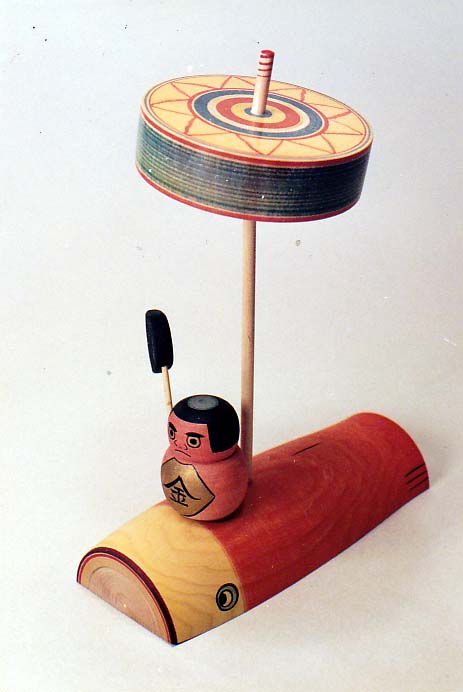
This top depicts Kintarō, a semi-legendary figure in Japanese folktales said to be a child born with superhuman strength and great bravery. It is customary to put out dolls of Kintarō on Boy’s Day (now Children’s Day) in the hope that young boys will become equally strong and brave. Special carp streamers (koinobori) are also flown on this day, and in popular imagery, a number of famous prints show Kintarō wrestling a giant koi, so the two often appear together.

***

***

Hiroi Michiaki: And, this is… Ah, Kintarō riding a koi.

Mrs. Hiroi: Yeah. Riding a koi. He’s riding a koi.

Hiroi: Kintarō riding a koi.

Mrs. Hiroi: Kintarō.

Paula Curtis: It is a koi, isn’t it.

Hiroi: The koi, too, it’s that koi from koinobori*. It’s not a koi in a pond. So, his mouth is like this and his tail, too, is cut off.

Mrs. Hiroi: It’s cut off.

* Here, Hiroi-sensei is referring to koinobori, or carp streamers, which are special wind socks flown in Japan to Tango no Sekku (Boy’s Day Celebration), a traditional event now designated the national holiday Children’s Day (Kodomo no Hi).

鯉のり金太

Click to enlarge.
Click to enlarge.

タイトル:

鯉のり金太 (koi nori kinta)
Kinta riding a koi

=====================

金太郎は超人的な強さと勇敢さを兼ね備えて生まれた子どもとして日本の童話に登場するキャラクターである。端午の節句(現在のこどもの日)には男の子が強く勇敢に育つように願いを込めて金太郎の人形を飾る。端午の節句には鯉のぼりも飾られる。有名な絵の多くは金太郎が巨大な鯉と格闘する姿を描いており、両方が一緒に登場することが多い。

***

***

廣井道顕:で、これは…あぁ、鯉乗り金太か。

廣井夫人:うん。鯉乗り。鯉に乗って。

廣井:鯉に乗ってる金太郎。

夫人:金太郎。

ポーラ・カーティス:鯉ですね。

廣井:鯉でも、あの鯉のぼりの鯉*ね。あの、池にいる鯉でなくて。だからこう、口こういう風になって、尻尾もこう切れてるんだけど。

夫人:切れちゃってんの。

*廣井先生は、端午の節句は日本の伝統行事であり、こどもの日として日本の祝日になっているが、その際に飾る鯉のぼりについて言及している


金の字やじろべー (“kin” character balancing toy)

Click to enlarge.
Click to enlarge.

Title:

金の字やじろべー (kin no ji yajirobee)
“kin” character balancing toy

=====================

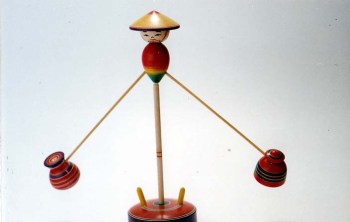
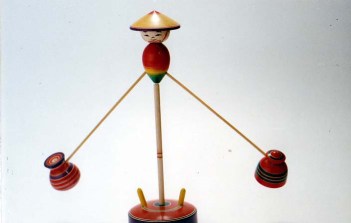
This top is a a yajirobee, a kind of balancing toy. Hiroi-sensei uses the natural shape of yajirobee toys to cleverly form the shape of the character 金 (kin), meaning “gold” or “money.”

***

***

Mrs. Hiroi: Mm. This is a kin character balancing toy.

Hiroi Michiaki: This is called a kin character balancing toy. If you look at this, it [appears in the shape of] kin, the kin character in kanji. [Meaning] gold.

Janell Landis: Gold.

Hiroi: Yeah. It looks like the kin kanji. There’s a reason for it. Because [the balancing toy already] looks like the character kin.

Mrs. Hiroi: That…

Hiroi: [You write it like] this, this, this, this, this, this, this [demonstrating strokes of the character]. The kin character balancing toy.

金の字やじろべー

Click to enlarge.
Click to enlarge.

タイトル:

金の字やじろべー (kin no ji yajirobee)
“kin” character balancing toy

=====================

やじろべーの独楽である。廣井先生がやじろべーの元々の形を用い、漢字の『金』の文字を模した作品でとなっている。

***

***

廣井夫人:うん、これは金の字やじろべー。

廣井道顕:これは金の字やじろべーって言って。これ見ると漢字のね、「金」、「金」っていう字に。ゴールド。

ジャネル・ランディス:Gold.

廣井:うん。「金」っていう字に見えるの。ここに筋があって。漢字の「金」っていう字に、見えるのね。

夫人:それの…

廣井:こう、こう、こう、こう、こう、こう、こう。金の字やじろべー。


蛸の当独楽 (octopus roulette-style top)

Click to enlarge.
Click to enlarge.

Title:

蛸の当独楽 (tako no ategoma)
octopus roulette-style top

=====================

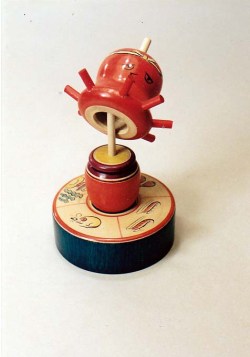
This is a roulette-style top, which is a kind of game. Someone spins the top in the middle, in this case an octopus, and the handle of the top lands on a particular picture. Although the connection between the various images you can land on is not clear, Hiroi-sensei explains that because the octopus hates mice, that is the losing image on the wheel. The best image one can get to win is the Palace of the Dragon King, the mythic palace of the Japanese dragon god who keeps magic jewels that can control the tides.

***

***

Hiroi Michiaki: This is an octopus roulette-style top, and it falls over like this. And underneath, [it lands on a picture of] a crab, a mouse; this the Palace of the Dragon King. If you land on the Palace of the Dragon King it’s a big win. The mouse is… I think it must be that the octopus hates mice, so that’s a losing spot. The top is this sort of game.


蛸の当独楽

Click to enlarge.
Click to enlarge.

タイトル:

蛸の当独楽 (tako no ategoma)
octopus roulette-style top

=====================

独楽遊びの一種である当独楽という種類の独楽である。真ん中の独楽(この独楽の場合は蛸)を回し、回転し終わると独楽の軸が下の絵を指し示すように作られている。下に描かれている絵の関連性は不明である。廣井先生の説明では、蛸はねずみが嫌いなのでねずみの絵を指したら負けということである。勝ちは竜宮城の絵である。日本の伝説で竜宮城は潮を操る力のある宝を持つ竜神が住んでいるとされる宮殿である。

***

***

廣井道顕:これはあのー蛸の、当て独楽で、これ倒れたところで。で下にー、あのこれエビにねずみに、ここは竜宮城だ。竜宮城行ったら大当たりっていうことで。ねずみは…確か蛸は、ねずみ嫌いだからここハズレなのかも。そういうゲームする独楽なのね。


かぼちゃ喰いねずみ (kabocha-eating mouse)

Click to enlarge.
Click to enlarge.

Title:

かぼちゃ喰いねずみ (kabocha kui nezumi)
kabocha-eating mouse

=====================

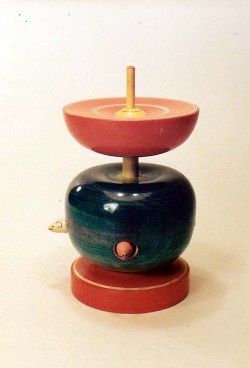
This top depicts four mice that have nested inside of a kabocha (an Asian variety of winter squash). Each mouse faces a cardinal direction and is painted the color associated with that direction based on Chinese traditions sometimes seen in Japan. South is red, west is white, north is black, and east is green.

***

***

Hiroi Michiaki: And this is…

Mrs. Hiroi: The kabocha-eating mouse.

Hiroi: It’s called the kabocha-eating mouse. This also happens to be something that’s good luck.

Mrs. Hiroi: When you spin it, the [mouse] pops its head out from the kabocha.

Hiroi: Inside the kabocha, the mouse is inside building a nest. When you spin it, all these different mice poke their faces in and out of it from the four directions. And this red mouse, red is for the south, so [he’s facing] south. And yellow, yellow is… is this yellow or white?

Mrs. Hiroi: It’s white.

Hiroi: But it looks like it’s yellow.

Mrs. Hiroi: It’s not yellow, it’s white.

Hiroi: It must be white. White is west, isn’t it…

Mrs. Hiroi: Yeah, that’s right.

Hiroi: These, these are colors indicating the four directions.


かぼちゃ喰いねずみ

Click to enlarge.
Click to enlarge.

タイトル:

かぼちゃ喰いねずみ (kabocha kui nezumi)
kabocha-eating mouse

=====================

かぼちゃの中に巣を作る四匹のねずみを表現した独楽である。ねずみはそれぞれ東西南北の方角を向いており、それぞれの方角を象徴する色をしている。中国の伝統では南が赤、西が白、北が黒、東が緑である。

***

***

廣井道顕:でこっちが…

廣井夫人:南瓜食いねずみ。

廣井:南瓜食いねずみっていう。でこれも何かやっぱ縁起のいいもので。

夫人:回すとね、あのー、そのー、南瓜からく、首出すの。

廣井:南瓜の中に、ねずみが、南瓜の中に入って、巣食ってるんだね。これ回すと四方から、チョロチョロっていろんな色のねずみが顔を出したり引っ込めたりするの。これも何か縁起がいいっていう…ことでこの色がね、東西南北を表してるのね。でこれ赤いねずみは赤は南だから、南。で黄色…黄色は…これ黄色か白か。

夫人:白でね。

廣井:黄色に見えるけど。

夫人:黄色でない、白だよ。

廣井:白だよな。白は西だよな―

夫人:うん。そうだ。

廣井:これあの、方角を表してる、色なのね。