Category Archives: tops

火鉢セット (hibachi set)

Click to enlarge.
Click to enlarge.

Title:

火鉢セット (hibachi setto)
hibachi set

=====================

For this piece, Hiroi-sensei has created wooden parts of a miniature hibachi set. Hibachi are heating devices used for cooking. They come in either cylindrical or square shapes and typically use charcoal as their source of heating. Hiroi-sensei has included a kettle, small dishes, and a container with real charcoal inside.

***

***

Hiroi Michiaki: And this, this is a hibachi set. In the set there’s a kettle. And I think there’s charcoal in here. Charcoal.

Mrs. Hiroi: Yeah. There’s charcoal in it.

Hiroi: And here there’s a tea cup. What is this? I think it’s a pitcher.

Mrs. Hiroi: Yeah.

Hiroi: If there’s no more water, you put it in from here. And in the old days, green tea was like a luxury, and you would usually only drink hot water. You would only drink green tea on special occasions.



火鉢セット

Click to enlarge.
Click to enlarge.

タイトル:

火鉢セット (hibachi setto)
hibachi set

=====================

この作品では、廣井先生が木製でミニチュアの火鉢セットを制作した。火鉢は調理のためにも使われた暖房器具である。円柱や四角い形をしており、通常は加熱するために炭を使用する。廣井先生は薬缶、小皿、本物の炭を中に入れた炭入れをこの火鉢セットで作った。

***

***

廣井道顕:で、これは、これは火鉢セットでね。あの火鉢で、こう薬缶が入っていて。で、ここに炭が入ってるのか。炭。

廣井夫人:うん。炭入るのね。

廣井:で、ここに湯呑があって。これ何だ、水差しかな。

廣井夫人:うん。

廣井:これ水がなくなったら、こっからスッと入れたりして。で昔はあの、お茶はうんと贅沢みたいで、お湯飲んでたんだそうですね。普通にはね。お茶は特別の時しか飲めなかった、みたい。


熊坂長範 (Kumasaka Chōhan)

Click to enlarge.
Click to enlarge.

Title:

熊坂長範 (kumasaka chōhan)
Kumasaka Chōhan

=====================

This top depicts Kumasaka Chōhan, a legendary Heian period (794-1185) figure known as the original Japanese burglar. Kamasaka Chōhan first appeared in literary and performance works of the late Muromachi period (1336-1573). Most notably, he appears as an antagonist in the fifteenth-century Japanese war tale Gikeiki (義経記), where his band of thieves encounter the hero Minamoto Yoshitsune and the two battle.

***

***

Hiroi Michiaki: This is Kumasaka Chōhan, the original Japanese burglar. Heh heh heh. He’s the first person to burgle.

熊坂長範

Click to enlarge.
Click to enlarge.

タイトル:

熊坂長範 (kumasaka chōhan)
Kumasaka Chōhan

=====================

平安時代(794-1185年)の伝説上の人物であり、日本で最初の泥棒として知られている熊坂長範がモチーフの独楽である。熊坂長範が最初に文学や舞台芸の中で登場したのは室町時代(1336-1573年)後期である。注目すべきなのは、熊坂長範が15世紀の日本の軍記物語、義経記に敵として登場することである。義経記の中で長範とその一味は英雄、源義経に出くわし、長範と義経が戦うことになる。

***

***

廣井道顕:これは熊坂長範っていって、日本の泥棒の元祖。へへへ。泥棒の始まりの人なんだって。

やじきた (Yajikita)

Click to enlarge.
Click to enlarge.

Title:

やじきた (yajikita)
Yajikita

=====================

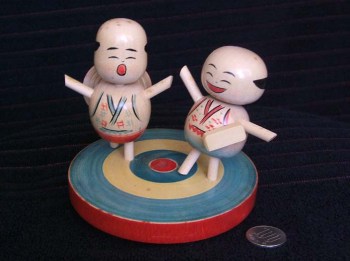
These top figures depict a scene from a popular nineteenth-century comical story called Tōkaidōchū Hizakurige (東海道中膝栗毛), known in translation as Shank’s Mare. It is also popularly known as “Yajikita on the Road,” as it depicts two main characters, Yajirobē (彌次郎兵衛) and Kitahachi (喜多八), on a pilgrimage from Edo (modern day Tokyo) to Ise Shrine. The story was written as a comical travel account of the anecdotes and foibles of the pair as they cross the country acting foolishly.

***

***

Hiroi Michiaki: This is called “Yajikita”… there’s an interesting story from long ago called “Yajikita on the Road.” It’s about these two people, like a short story now. Mm. And Yaji and Kita are walking along the Tokaido road. There’s all kinds of interesting stories about their journey, and here I’m showing one of them. If you do this, they stagger about and spin. Mm. It’s just like they’re traveling and having fun and like they’re walking about.

やじきた

Click to enlarge.
Click to enlarge.

タイトル:

やじきた (yajikita)
Yajikita

=====================

これは19世紀に人気を博した東海道中膝栗毛と呼ばれる滑稽本の中の一幕を表現した独楽である(英語ではShank’s Mareと訳され知られている)。また弥次喜多道中としても広く知られており、最初の四文字にある通り、弥次郎兵衛と喜多八が江戸から伊勢参りをする道中の話である。諸国を巡る二人がばかげたことをする逸話を語る滑稽な旅行記として話が書かれている。

***

***

廣井道顕:これは弥次喜多ってあの・・・うんと昔のなんか、弥次喜多道中って面白い話なんですけど。これはみんな二人で、今に小説みたいなのかな。うん。で弥次さんと喜多さんが東海道を旅して歩く。その中にいろいろと面白い話が、ある中その一つを表して、これもこうやるとね、ふらふらふらふら回るの。うん。ちょうど旅して喜んで、歩いてるような感じでね。

たつと竜の子太郎 (dragon and Tarō, the Dragon Boy)

048Title:

たつと竜の子太郎 (tatsu to tatsu no kotarō)
dragon and Tarō, the Dragon Boy

=====================

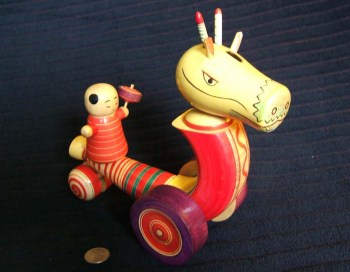
This toy depicts a dragon and Tarō, the Dragon Boy. Though there are many versions of the tale, the story behind the toy comes from a local legend called Koizumi Kotarō monogatari (小泉小太郎物語), about a dragon that gave birth to a little boy near Lake Sayama. The waters of the lake sweep the boy away, and he is found and raised by a kind old woman living in a village nearby. He later embarks on a journey to find his dragon mother. Depicting the story of Tarō, the Dragon Boy in rolling toys such as this one is very popular in Japan.

***

***

Hiroi Michiaki: This is a toy I made in the year of the dragon. Like the ones children ride on, [but] you hold it in one hand [like a top]. It’s a toy, not a top.


たつと竜の子太郎

048

タイトル:

たつと竜の子太郎 (tatsu to tatsu no kotarō)
dragon and Tarō, the Dragon Boy

=====================

たつと竜の子太郎を表現したおもちゃ。この話には様々な種類があるが、このおもちゃは小泉小太郎物語と呼ばれる地元の伝説を基に作ったものである。小泉小太郎物語は狭山湖の近くで男の子を産んだ竜の話である。湖の水で流されていってしまった男の子は、近くの村に住む優しいおばあさんに拾われ育てられることになる。男の子は後に海の母である竜を探す旅に出ることとなる。この作品のように、竜の子太郎のお話がモチーフの車輪付きおもちゃは日本でとても人気がある。

***

***

廣井道顕:これは辰年に作った、これも玩具だな。で子供が乗って、これ独楽片手に持って。玩具ですね、独楽でなくて。


鯉のり金太 (Kinta riding a koi)

Click to enlarge.
Click to enlarge.

Title:

鯉のり金太 (koinori kinta)
Kinta riding a koi

=====================

This is not a top but a pulling roller toy. The toy depicts Kintarō, a semi-legendary figure in Japanese folktales, who is said to be a child born of superhuman strength and great bravery. It is customary to put out dolls of Kintarō on Boy’s Day (now Children’s Day) in the hope that young boys will become equally strong and brave. Special carp streamers (koinobori) are also flown on this day, and in popular imagery, a number of famous prints show Kintarō wrestling a giant koi, so the two often appear together.

***

***

Hiroi Michiaki: This is also a toy. This is Kinta riding a koi, and this isn’t a top, but a toy you pull along with the string.

Mrs. Hiroi: Yeah.

Hiroi: This koi looks like it’s swimming like this.

Mrs. Hiroi: It spins like it’s swimming.

Hiroi: And Kintarō’s carrying a broadaxe, this… what is this…? What should I call this?

Mrs. Hiroi: Kintarō.

Hiroi: A mallet… What was this called? I forgot the name. Anyway, the hammer is really huge.


鯉のり金太

Click to enlarge.
Click to enlarge.

タイトル:

鯉のり金太 (koinori kinta)
Kinta riding a koi

=====================

この作品は独楽ではなく、ヒモを引っ張り遊ぶおもちゃである。金太郎は超人的な強さと勇敢さを兼ね備えて生まれた子どもとして日本の童話に登場するキャラクターである。端午の節句(現在のこどもの日)には男の子が強く勇敢に育つように願いを込めて金太郎の人形を飾る。端午の節句には鯉のぼりも飾られる。有名な絵の多くは金太郎が巨大な鯉と格闘する姿を描いており、両方が一緒に登場することが多い。

***

***

廣井道顕:これも玩具だな。これはやっぱり鯉乗り金太で、こっちはあの、独楽じゃなくて、これひもで引っぱると

廣井夫人:うん。

廣井:この鯉がこういうふうに、泳いでるように見える。

夫人:泳いでるように回るの。

廣井:であの、まさかり担いでこう、なんだこれ・・・なんつったっけこういう

夫人:金太郎。

廣井:槌・・・これのこと呼び名なんつったっけな。名前忘れたわ。とにかくあの、ハンマーのをデカいやつだね。