Category Archives: tops

桃太郎 (Momotarō)

Click to enlarge.
Click to enlarge.

Title:

桃太郎 (momotarō)
Momotarō

=====================

This top depicts Momotarō, sometimes translated as “The Peach Boy,” or “Peach Tarō,” a legendary figure originating in the Edo period (1600-1868). In many versions of the Momotarō legend, Momotarō is a boy who came to Earth inside a giant peach who is discovered by an elderly couple who then raise him. He later leaves his home to fight a band of demons on a distant island, meeting a talking dog, a monkey, and a pheasant on the way who joint him in his quest. Most versions of the legend end with Momotarō defeating the demons, taking their treasure and their chief captive, and then returning home to live happily ever after with his parents.

***

***

Hiroi Michiaki: And this is, did this one have two faces? He’s facing backwards, and there’s another [face] in the front. This is Momotarō on the back, too. And he’s carrying dango (dumplings). Ahh, there it is, there it is. He’s carrying dango, Momotarō, too. And this is the back of the oni. I think the front is in here somewhere, too. This the reverse side of Momotarō.

 

桃太郎

Click to enlarge.
Click to enlarge.

タイトル:

桃太郎 (momotarō)
Momotarō

=====================

江戸時代(1600-1868年)が起源の伝説上のキャラクター、桃太郎を表現した独楽である。桃太郎の伝説には様々な種類の話があるが、どの話でも桃太郎は巨大な桃から生まれ、桃を見つけた老夫婦に育てられている。後に遠くの島にいる鬼を退治するために家を離れ、その道中で出会った話しのできる犬、猿、キジを鬼退治の仲間に引き入れる。どの話でも桃太郎が鬼を倒し、鬼の親玉を捕らえ、宝を持ち帰って育ての親である老夫婦と幸せに暮らすという終わり方をしている。

***

***

廣井道顕:そんでこれが、これ確か裏表あるんだっけ。こいつ後ろ向いてっけど。前もあるんだね。これ桃太郎も後ろ。確か団子しょってる、ああ、あるある。団子しょってるんだね。あぁこっちが後ろだね、桃太郎もね。で、あ、これ鬼の後ろで。ううん、正面もどっかにあるはずだね。これ桃太郎の裏表

桃太郎 (Momotarō)

Click to enlarge.
Click to enlarge.

Title:

桃太郎 (momotarō)
Momotarō

=====================

This top depicts Momotarō, sometimes translated as “The Peach Boy,” or “Peach Tarō,” a legendary figure originating in the Edo period (1600-1868). In many versions of the Momotarō legend, Momotarō is a boy who came to Earth inside a giant peach who is discovered by an elderly couple who then raise him. He later leaves his home to fight a band of demons on a distant island, meeting a talking dog, a monkey, and a pheasant on the way who joint him in his quest. Most versions of the legend end with Momotarō defeating the demons, taking their treasure and their chief captive, and then returning home to live happily ever after with his parents.

***

***

Hiroi Michiaki: And this is, did this one have two faces? He’s facing backwards, and there’s another [face] in the front. This is Momotarō on the back, too. And he’s carrying dango (dumplings). Ahh, there it is, there it is. He’s carrying dango, Momotarō, too. And this is the back of the oni. I think the front is in here somewhere, too. This the reverse side of Momotarō.


桃太郎

Click to enlarge.
Click to enlarge.

タイトル:

桃太郎 (momotarō)
Momotarō

=====================

江戸時代(1600-1868年)が起源の伝説上のキャラクター、桃太郎を表現した独楽である。桃太郎の伝説には様々な種類の話があるが、どの話でも桃太郎は巨大な桃から生まれ、桃を見つけた老夫婦に育てられている。後に遠くの島にいる鬼を退治するために家を離れ、その道中で出会った話しのできる犬、猿、キジを鬼退治の仲間に引き入れる。どの話でも桃太郎が鬼を倒し、鬼の親玉を捕らえ、宝を持ち帰って育ての親である老夫婦と幸せに暮らすという終わり方をしている。

***

***

廣井道顕:そんでこれが、これ確か裏表あるんだっけ。こいつ後ろ向いてっけど。前もあるんだね。これ桃太郎も後ろ。確か団子しょってる、ああ、あるある。団子しょってるんだね。あぁこっちが後ろだね、桃太郎もね。で、あ、これ鬼の後ろで。ううん、正面もどっかにあるはずだね。これ桃太郎の裏表。


うさぎ道化 (rabbit antics)

Click to enlarge.
Click to enlarge.

Title:

うさぎ道化 (usage dōke)
rabbit antics

=====================

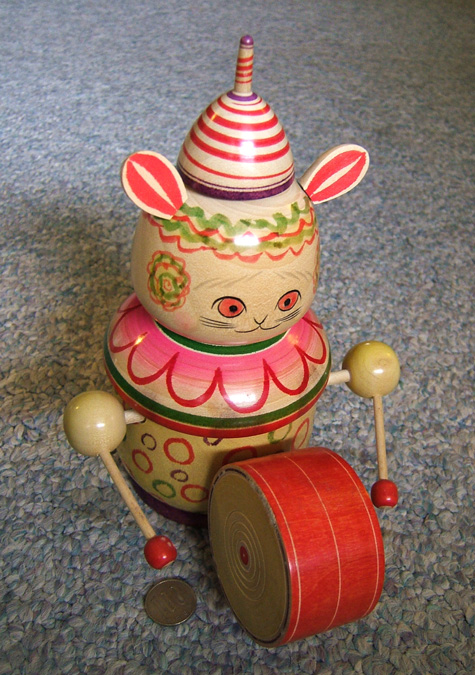
This top depicts a rabbit dressed as a clown beating a drum. It is called “rabbit antics” because of the whimsical image of a rabbit pretending to be a clown. Hiroi-sensei made it in honor of the year of the rabbit.

***

***

Hiroi Michiaki: This is called “rabbit antics.” I made it in the year of the rabbit, so I made it a rabbit. The hands move in this kind of way. The hands are moving back and forth. When you spin this. Though really what the “rabbit antics” are is the rabbit is dressed as a clown.

うさぎ道化

Click to enlarge.
Click to enlarge.

タイトル:

うさぎ道化 (usage dōke)
rabbit antics

=====================

道化の格好をしたうさぎが太鼓を叩いている、うさぎ道化の独楽である。うさぎが道化のように振る舞う風変わりな姿を表現している。廣井先生が兎年の記念に作った独楽である。

***

***

廣井道顕:これは兎の道化って。兎、兎年に作ったから、兎にしたんだと思うんですけど。これあの、こういう風に動くのかな、手が。この手が行ったり来たりね。ここを回すと。で要するにあの、ピエロね、道化ってね

鬼 (oni (ogre))

Click to enlarge.
Click to enlarge.

Title:

鬼 (oni)
oni (ogre)

=====================

This top depicts an oni from the Momotarō legend, which originates from the Edo period (1600-1868). Oni are a kind of supernatural monster from Japanese folklore, often translated as “demon” or “ogre.” In many versions of the Momotarō legend, Momotarō, who is a boy who came to Earth inside a giant peach, later leaves the home of the elderly couple who raised him to fight a band of demons on a distant island. Most versions of the legend end with Momotarō defeating the demons and living happily ever after with his parents.

***

***

Hiroi Michiaki: This is an oni and Momotarō. I think there was another one that goes with this.

Janell Landis: Ah, yeah yeah yeah.

Hiroi Michiaki: Right.

Click to enlarge.
Click to enlarge.

タイトル:

鬼 (oni)
oni (ogre)

=====================

桃太郎伝説の鬼を描いた独楽。桃太郎の伝説は江戸時代(1600-1868年)が起源である。鬼は日本の民間伝承に登場する超自然的な化け物。桃太郎の伝説には様々な種類があるが、桃太郎が巨大な桃から生まれた男の子で、育ての親であるおじいさんとおばあさんの家を出て遠くの島に住む鬼を退治しに行くという話が共通となっている。桃太郎が鬼を退治して、育ての親であるおじいさんとおばあさんといつまでも幸せに暮らすというのが、ほとんどの話で共通する終わり方である。

***

***

廣井道顕:で、これはね。鬼と桃太郎と、確か組だと思ったけどな。

ジャネル:あ、あぁ、あぁ、あぁ。

廣井道顕:ね。

鬼の念仏 (oni no nenbutsu (ogre’s prayer))

Click to enlarge.
Click to enlarge.

Title:

鬼の念仏 (oni no nenbutsu)
oni nenbutsu (ogre’s prayer)

=====================

This top depicts an oni saying the nenbutsu prayer. Oni are a kind of supernatural monster from Japanese folklore, often translated as “demon” or “ogre.” The nenbutsu (念仏) is a type of prayer, common to Pure Land Buddhism, that generally refers to a repetition of the Amida Buddha’s name as a private devotional practice. For this top, Hiroi-sensei has depicted a reformed oni in a priest’s outfit saying the nenbutsu and striking a drum as he reads a sutra (a Buddhist scripture).  

***

***

Hiroi Michiaki: Umm. Ah, this is the “oni’s [ogre’s] prayer” (oni nenbutsu). The oni has reformed and he’s saying the nenbutsu. While he’s reading a sutra. This part moves like this, as if the hands are striking a drum.


鬼の念仏

Click to enlarge.
Click to enlarge.

タイトル:

鬼の念仏 (oni no nenbutsu)
oni nenbutsu (ogre’s prayer)

=====================

念仏を唱える鬼を表現した独楽である。鬼は日本の民間伝承に登場する超自然的な化け物である。念仏は浄土宗の行の一つで、阿弥陀仏の名前を行として唱えることを言う。廣井先生は改心した鬼が法衣を着て、経典(仏典)を読みながら太鼓を叩いている姿をこの独楽で表現した。

***

***

廣井道顕:ええと、あぁ。これは鬼の念仏ってね。鬼が改心して念仏を上げてるの。お経を上げてるところね。こう、これ動くんですよこう、手がこう、太鼓叩いてるように