Category Archives: koma

天女の舞 (the heavenly maiden’s dance)

010
Click to enlarge.

Title: 天女の舞 (tennyo no mai)
“the heavenly maiden’s dance”

=====================

This top depicts the dance of the heavenly maiden, a story connected to Japan’s version of the swan maiden folklore. Variations on this story typically include a beautiful young woman spotted bathing in the woods by a male hero. While she bathes, he steals her feathered robe (or an article of clothing) from where it hangs on a tree branch, which prevents her from changing back into her magical bird form to escape. He then forces her to become his wife.

Hiroi-sensei has created a top that mimics the heavenly maiden dancing at the top of a mountain as she descends from the sky. Made up of two different tops, this set is particularly difficult to spin. First you must spin the bottom half (the mountain), then carefully balance the second top on the very tip of the first, so that it begins to rotate from the force of the lower half. Balanced properly, the maiden appears to be dancing as she rotates in opposition to the mountain’s spin.

***

***

Hiroi Michiaki: And this is, ah—this is the heavenly maiden’s dance.

Mrs. Hiroi:   The heavenly maiden’s dance.

HM:  This is Mt. Fuji, below Mt. Fuji… Umm, at the base of the mountain, there’s a pine forest. It’s also included now in the World Heritage sites. Now, Mt. Fuji and that pine grove… what pine grove was it…

MH:   Some kind of pine forest.

HM:   There, long ago the heavenly maiden came down [from the sky] dancing, and she hung her feather robe in the pines… and a young hunter or someone takes it, and even though the heavenly maiden asked him to return it, he didn’t, I suppose. Somehow or another there are other things [that happen] and many interesting stories there. It’s a top modeled on that [story]. As it turns it looks like the heavenly maiden teetering around [dancing] on top of the mountain.

Janell Landis: Th-That [one], spinning it is hard.

HM:     (laughs) It’s kind of hard, yeah.

MH:   Mmm… it doesn’t spin easily.

JL:        And, um, when you put it on the handle and it, and it stays on, it’s incredible. But I’ve gotten gradually worse at it. And, that, this um, when… ah, that thing like bamboo, you wrap the string around it and put it in the bamboo, and it suddenly it spins. Then you have to, to use your hands to do the top. (claps)

HM:     (laughs)

JL:        Over and over she falls, but when you finally get it spinning [on top], boy it’s wonderful. Sensei, um, I won’t talk anymore after this, but I, that story, um…

Paula Curtis:    You thought it was Kaguya-hime.

JL:        Kaguya-hime. Yeah.

HM:     Ahhh…

JL:        I-I used Kaguya-hime.

HM:     Kaguya-hime.

JL:        When I was gone away. I-I used it in connection with her. Yeah.

HM:     Yeah, it’s a similar story. Was it called the “Heavenly Feather Robe”? Mm.

天女の舞

010
Click to enlarge.

タイトル: 天女の舞 (tennyo no mai)
“the heavenly maiden’s dance”

=====================

天女の舞がテーマの独楽である。天女の話は海外の民話・伝承にある白鳥の乙女の日本版のようなものである。色々なバリエーションがある中で一般的に含まれるのが、男の主人公が森で水浴びをする美しい若い女性を見つけるという点である。女性の入浴中に、木の枝にかけてある女性の羽衣(または服)を盗んでしまい、鳥の姿に戻ることができず逃げることができなくなる。それから主人公は女性を強引に自分の妻にする。

廣井先生は空から舞いおりてくるかのように山の頂上で舞う天女を表現した独楽を作った。二つの異なる独楽でできており、セットで回すのが非常に難しい。まず最初に下半分(山の部分)の独楽を回し、次に注意深く二つ目の独楽を下半分の独楽の上にのせると、下の独楽の力で上の独楽が回り始める仕組みになっている。きちんとバランスを取ることができると、下半分の山の独楽とは逆の方向に回る天女が舞っているように見える。

***

***

廣井道顕:  で、これが…あ、これは天女の舞。

廣井夫人:  天女の舞。

廣井: これ富士山、富士山の下・・・ええとう、ふもとの方にあのう、松林があるんですよね。え、なんて今世界遺産の中にそれも、は、含まれたね、今度ね、富士山と… あの松原… 何の松原っつたっけ…

夫人:  なんとかの松林…

廣井: そこに昔あの天女が舞降りて、羽衣を松の間に引っかけたやつを… 何か、猟師の若者か何かが、それ取って、天女が返してくれっつうのに、返さなかったっつたかな、それで、何だか何だかっていう色々ある、あの面白い話があるんですけど。それを象った独楽なんですよね。富士山の上にこの天女が回ってるように回すと見えるフラフラってね。

ジャネル・ランディ: そ、それは回すのは大変。

廣井: (laughs) あはは、ちょっと難しいね。

夫人:  うぅん・・・なかなか回んない。

ジャネル:      そして、あのう、when you put it on the handle and it, and it stays on, 素晴らしいもん。けど私だんだん下手になった。そして、その、これした、あのう、いつま、あの、ah… bambooみたいな、それ紐をつけてそれをbamboo入れて、そしてザアアアとすると it spins. Then you have to, to use your hands to do the top. (claps)

廣井: (laughs) あははは・・・

ジャネル:      何回も何回も彼女が落ちて、やっとつければ boy, it’s wonderful. 先生、あのう、もう話しませんけれども、私はその話は、あのう、um…

ポーラ・カーティス:   あの、かぐや姫だったと思って…

ジャネル:      かぐや姫. Yeah.

廣井: あぁ、あぁ、あぁ・・・

ジャネル:      I-I used Kaguya-hime.

廣井: かぐや姫。

ジャネル:      When I was gone away. I-I used it in connection with her. Yeah.

廣井: 似たような話だね。これ天の羽衣っつったっけか。な。

泥鰌と田螺 (loach and pond snail)

Click to enlarge.
Click to enlarge.

Title:

泥鰌と田螺 (dojō to tanishi)

“loach and pond snail”

=====================

This top depicts a loach and pond snail. These are freshwater aquatic animals, often found in ponds. Hiroi-sensei stated that these tops are meant to be good luck charms for protection against fires, since both are water creatures.

***

***

Hiroi Michiaki: This is… a pond snail and a loach.

Mrs. Hiroi:   Mm. Pond snails are in paddy fields.

HM:   It was a pond snail and a loach, or I have a feeling it might have been a horned turban snail and a loach…

MH:  It’s a pond snail and a loach.

HM:   And, um, this is the shell of the pond snail in the paddy and then the loach. You put those together and it [becomes] a top, and this… it’s a charm for protection against fire– these creatures live in the water, so [it makes it so] fires won’t happen. [This] top is that kind of charm.


泥鰌と田螺

Click to enlarge.
Click to enlarge.

タイトル:

泥鰌と田螺 (dojō to tanishi)
“loach and pond snail”

=====================

泥鰌と田螺がモチーフの作品。泥鰌と田螺はよく池で見かける、淡水に生息する生き物である。廣井先生は、この独楽のモチーフは両方とも水の生き物なので火伏のお守りとして作った作品であると説明していた。

***

***

廣井道顕:  これが―・・・タニシとドジョウね。

廣井夫人:  うん。タニシ田んぼにある。

廣井:  タニシとドジョウだったか、サザエとドジョウだったような気がするんだけど・・・

夫人:    タニシとドジョウだよ。

廣井:  で、あのう、これはあの田んぼにいるタニシって貝と、あとドジョウね。それ組み合わせの独楽で、これはあのう・・・火伏のおまじないって、水の中にいるから、火事にならないようにっていう、そういうおまじないの独楽なんです。

かえるの相撲 (frog sumō)

008
Click to enlarge.

Title:

かえるの相撲 (kaeru no sumō)
“frog sumo“

=====================

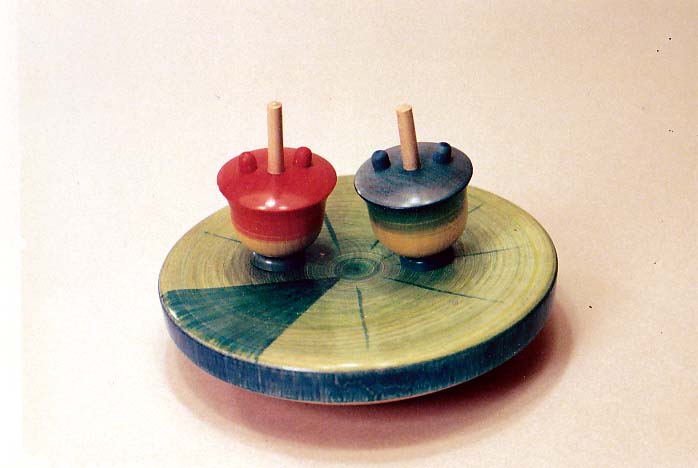
This set of tops forms two frogs on a lotus leaf engaging in a sumo match. Each of the frogs can be removed from the lotus leaf base to become individual tops. This playful theme is a popular one, which is even believed to have been represented in the famous 12-13th century Chōjū jinbutsu giga handscroll (seen below), which is thought to have one section that depicts anthropomorphic frogs and rabbits challenging each other to sumo.

***

***

Hiroi Michiaki: And… This is.. Ah. A frog. Frog sumo.

Mrs. Hiroi:   A frog sumo match.

HM:   The frog’s on a lotus leaf…              

MH: They’re lined up [on the shelves] in the shop.

HM:   On top of a leaf the frogs have a sumo match. Mm. They’re tops.  …There’s not really much to say. (laughs)

かえるの相撲

008
Click to enlarge.

タイトル:

かえるの相撲 (kaeru sumō)
“frog sumo“

=====================
ハスの葉の上で相撲を取っている二匹のカエルがセットになった独楽。カエルはそれぞれハスの葉の上から外して個々の独楽として回すことができる。遊び心にあふれた人気のあるモチーフであり、有名な12~13世紀の鳥獣人物戯画の巻物(下記参照)の中でも描かれたとされるモチーフである。鳥獣人物戯画の一部分では擬人化されたやカエルとウサギが描かれており、お互いに相撲で挑んでいる姿ではないかと考えられている。

***

***

廣井道顕: でぇ・・・これは。あっ、蛙が。蛙の相撲。

廣井夫人: うん。蛙の相撲取り。

廣井: 蛙があの、ハスの葉っぱ・・・

夫人:   店に並んでっけどね。

廣井:  葉っぱの上で相撲を取る。うーん、独楽ですね・・・特に謂れはないな。(へへへ。)

天狗の巣 (tengu nest)

Click to enlarge.
Click to enlarge.

Title:

天狗の巣 (tengu no su)
tengu nest”

=====================

This top depicts a tengu nest. Tengu are creatures from Japanese folklore that are considered a kind of kami (god/spirit) or yōkai (supernatural being). Although they are thought to take the form of birds, they are frequently depicted with both bird-like and human characteristics. Beginning around the fourteenth century, tengu began being depicted with a distinctive long nose. Tengu masks are often represented with bright red faces and extended, phallic noses. Tengu, sometimes appearing with yamabushi garb or Buddhist monks’ staffs, have had varying associations in legend with Shintō, mountain asceticism (shūgendō), and Buddhist customs. They are often depicted holding a magical fan made of feathers called a ha-uchiwa (羽団扇 “feather fan”).

***

***

Hiroi Michiaki:  Next… Ah. This is the tengu’s nest. I don’t think the tengu actually builds a nest, though, you know.

Mrs. Hiroi:  All of these are tengu hatching out of the nest.

Hiroi:  The tengu’s egg, there’s also an egg you see. Tengu, in legend—

Mrs. Hiroi:  The nose. The nose gets long like this.

Hiroi:  What would you call a tengu? A yōkai? They live in the mountains, though it’s not that they do anything particularly bad. They hold a fan like this and… sort of frighten people and such. And they, um, they’re born from eggs. And this is a tengu’s egg and here they’ve built a nest. So those are the tengu’s eggs. If you spin this, if you spin this to the side, it stands straight up. It doesn’t flip upside down, but if you spin it to the side, it straightens out. Although it’s an egg, it’s like the egg has a nose. If you spin that this stands on its side.

天狗の巣

Click to enlarge.
Click to enlarge.

タイトル:

天狗の巣 (tengu no su)
tengu nest”

=====================

天狗の巣をテーマにした作品。天狗は日本の伝承において神や妖怪の仲間として扱われる伝説上の生き物である。鳥の姿をしていると考えられているが、鳥のような姿や人間のような姿の両方で表現されることが頻繁にある。天狗は14世紀頃から、特徴的な長い鼻を伴って表現され始めた。天狗はよく朱色の顔に長く伸びた陽物的な鼻がついている仮面を付けた姿で描かれる。時に山伏の格好や仏僧の杖を持って登場する天狗は、神道の伝説、修験道や、仏教の風習などにおいて様々なつながりがあった。天狗は、羽で作られ不思議な力が備わっているという羽団扇(はうちわ)を持っている姿で、たびたび描かれる。

***

***

廣井道顕: あと・・・あぁ。これは天狗の巣だ。天狗がまさか巣をくってると思わないけどね。

廣井夫人:  全部これ、全部天狗にかえって。

廣井:  天狗の卵って、卵もあるんだもんね。天狗ってあのう、伝説の―、

夫人:  鼻。鼻こうやって高くなる。

廣井:  なんつったらいいんだ。妖怪なのかな。山に住んでいて、別に悪いことする訳ではないんですけど。こう団扇を持っていて、で何か・・・人を驚かしたり何かするんだよね。それがね、あのう、卵から生まれるんだって。で、これが天狗の卵でこれ巣をくってる。だからその天狗の卵で。これ回すとやっぱりあの、こう横に回すと、ピっとこう、真っ直ぐに立ち上がる。逆立ちまではしないんですけど横に回すとこう真っ直ぐになる。この天狗の、卵のくせに鼻があるんだよね。その鼻をこう回すと、こうピって横に立ち上がる。

お化けのトビ出し (obake springing out)

Click to enlarge.
Click to enlarge.

Title:

お化けのトビ出し (obake no tobidashi)
obake (monster/spirit) springing out

=====================

This top depicts an obake お化け springing out of its skin. In Japanese folklore, obake (or sometimes bakemono 化け物) are types of preternatural creatures similar to monsters or spirits that can take many forms. Their main characteristic is an ability to transform. They sometimes disguise themselves as humans (though their true form may be an animal such as a fox or cat) or can be normal household objects that transform themselves into demonic creatures (see tsukumogami). They are distinct from the spirits of the dead, although sometimes ghost-like apparitions can be called obake or bakemono.

Below, you’ll find a video of Hiroi-sensei explaining the top, along with transcripts of his explanation.

***

***

Hiroi Michiaki:  What is this? Ah. An obake.

Mrs. Hiroi:  Mm.

Janell Landis:   (laughs)

Hiroi:  This is an obake… leaping out and spinning.

MH:  That thread, you wind it around and pull it and the obake pops out.

HM:   When that happens, this spins and [the obake] leaps out. And this and that part inside also split into two.

MH:  Yeah.

Paula Curtis:  Ohhh.

HM:   This is the obake and this is the obake’s husk. So… oh, but does it become three? One, two, three. It becomes three. And the lid, that makes it four. It turns round and round.

お化けのトビ出し

Click to enlarge.
Click to enlarge.

タイトル:

お化けのトビ出し (obake no tobidashi)
obake (monster/spirit) springing out

=====================

飛び出して人をおどかす お化けをテーマにした独楽。日本の昔話で、お化け(化け物とも言われる)は怪物や霊魂などと類似した超自然的な存在として扱われており、様々な形で描かれている。主な特徴として挙げられるのが変身する能力があること。時にお化けは人間にも化けることがある(本当の姿はキツネやネコなどの動物)また家庭にある一般的な物でも化け物に姿かたちを変えることもある(付喪神についての説明)お化けは死者の霊とは区別されているものの、時には幽霊や亡霊のようなものがお化けや化け物と呼ばれることもある。

廣井先生が独楽について説明されている際の映像と、インタビュー記録はこのキャプションの下にあります。

***

***

廣井道顕:      これは何だ。あぁ。お化けだ。

廣井夫人:  うん。

ジャネル・ランディス:    (laughs)

廣井:  これはお化けの、と、飛び出し独楽。

夫人: そう糸、上に糸巻いて引っ張って出すの、お化けを。

廣井:  そうすると、これが回って、飛び出して、で、これと、この中のやつとまた二つに分かれる。

夫人: そう。

ポーラ・カーティス  へええ。

廣井:   こっちがお化けで、こっちがお化けの抜け殻。んーだから、でも三つになるのか。一、ニ、三と。三つになるんですね。で、蓋回すと四つになっちゃうんだ。で、ぐるぐる回る。