タイトル:
かえる (kaeru)
frog
=====================
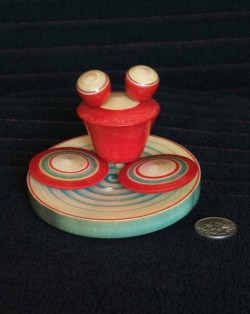
池のかえるがモチーフの独楽。かえるの目、体、脚は土台(池)から取り外し可能で、それぞれが独楽になる。
***
***
廣井道顕:あぁ、これはかえるだね。
廣井夫人:うん。
廣井:かえるもどっかその辺にあったよね。
ポーラ・カーティス:昨日。
廣井:昨日見たね。
タイトル:
かえる (kaeru)
frog
=====================
池のかえるがモチーフの独楽。かえるの目、体、脚は土台(池)から取り外し可能で、それぞれが独楽になる。
***
***
廣井道顕:あぁ、これはかえるだね。
廣井夫人:うん。
廣井:かえるもどっかその辺にあったよね。
ポーラ・カーティス:昨日。
廣井:昨日見たね。

Title:
だるま (daruma)
daruma
=====================
This work depicts a daruma. A daruma is a traditional Japanese doll whose figure is based on the Bodhidharma, the founder of the Zen sect of Buddhism. Daruma are often depicted in this roundish shape because of a legend that the Bodhidharma stared at a wall in intense meditation for nine years, until both his arms and legs fell off. Daruma are traditionally depicted in red, but can appear in various colors with different meanings. They are considered good luck figures.
***
***
Hiroi Michiaki: This is a daruma.
タイトル:
だるま (daruma)
daruma
=====================
だるまがテーマの独楽。だるまは伝統的な日本の人形で、そのモデルになっているのは仏教禅宗の開祖とされている菩提達磨である。だるまがよく丸い形で表現されるのは、菩提達磨が壁を見つめて座禅を九年もの間 続けたので腕と脚が取れてしまったという伝説から来ている。だるまの伝統的な色は赤であるが、他の色もあり、色によってそれぞれ意味もある。どの色も幸運のシンボルとして考えられている。
***
***
廣井道顕:これだるま。
Title:
投げ独楽 (nagegoma)
throwing top
=====================
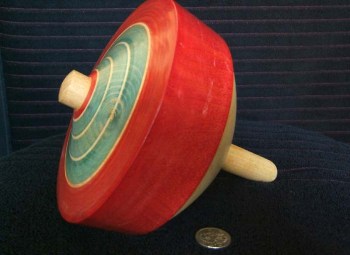
This top is a nagegoma, or throwing top. It is spun by carefully wrapping a string around the top from the outside and throwing it skillfully towards the ground.
***
***
Hiroi Michiaki: This is a normal– one of those, you know, throwing tops that you throw outside.
タイトル:
投げ独楽 (nagegoma)
throwing top
=====================
投げ独楽という種類の独楽である。独楽の外側に慎重に紐を巻いて、床にうまく投げることで回すことができる。
***
***
廣井道顕:で普通の、あのほら、外で投げる投げ独楽。

Title:
ミノ虫飛び出し (minomushi tobidashi)
bagworm larva leaping out
=====================
This top depicts a bagworm larva, the larval stage of the bagworm moth. They are sometimes called “case moths” because their caterpillars build little protective cases in which they gestate. As they emerge, bagworm larva pop their heads out of their case to eat the leaves of the tree they inhabit. In Japan, their popular image is related to the top of their case looking like a straw raincoat. Bagworms are often used as a subject for seasonal haiku in the fall. For this top, Hiroi-sensei depicts a bagworm popping out of its case, which is attached to a tree branch.
***
[no video/transcript]
タイトル:
ミノ虫飛び出し (minomushi tobidashi)
bagworm larva leaping out
=====================
蛾の幼虫、ミノ虫がテーマの独楽である。イモムシのときに自分を温めるためのミノを作るので英語では『ケース・モス(case moths/ ケースは入れ物、モスは蛾)』と呼ばれることもある。住んでいる木にある葉を食べるために、ミノ虫がミノから頭を出す。日本で人気があるのは蓑笠の蓑のように見えるミノがある姿である。ミノ虫は俳句の秋の季語として使われることがよくある。この独楽で、廣井先生はミノ虫が木の枝に付いているミノから顔を出す姿を表現している。
***
[ビデオ・解説なし]

Title:
柿つり独楽 (kaki tsurigoma)
persimmon string-release top
=====================
This top is a string-release top, which is spun by wrapping a string carefully around the uppermost knob shown in the photo to the right. They are then spun by releasing the top with a sharp toss towards the ground. This string-release top is in the shape of a persimmon fruit.
***
[no video/transcript]
タイトル:
柿つり独楽 (kaki tsurigoma)
persimmon string-release top
=====================
つり独楽という種類の独楽である。右の写真にある、独楽の一番上にあるつまみの部分に丁寧に紐を巻いて独楽を回す。独楽を素早く床に放すことで回すことができる。このつり独楽は果物の柿の形をしている。
***
[ビデオ・解説なし]

Title:
河童ときゅうり (kappa to kyūri)
kappa and cucumber
=====================
These tops depict a kappa and a cucumber. Kappa are yōkai (supernatural creatures) from traditional Japanese folklore. Kappa are typically depicted as somewhat humanoid and the size of a child, although sometimes they can appear more like birds or turtles. They are said to live in rivers and ponds, where they cause mischief, occasionally kidnapping or drowning people or animals. Sometimes they are depicted as balancing a bowl or plate of water on their heads, which is a technique they supposedly use to travel outside of their watery homes. Even today, some areas of Japan will have signs near rivers warning people about kappa. According to legend, kappa love to eat cucumbers in particular, which can sometimes be given to them to form a friendship. In some cases, people will write their names on cucumbers and toss them into kappa-infested waters as a form of protection, or will eat cucumbers before going swimming. Kappa may also be considered friendly or helpful, helping humans with water-related tasks like irrigation or fishing. For this top, Hiroi-sensei has played with the image of kappa bearing things on their heads (such as the bowl of water) by putting a cucumber on the kappa’s head.
***
[no video/transcript]
 Carving Community: